

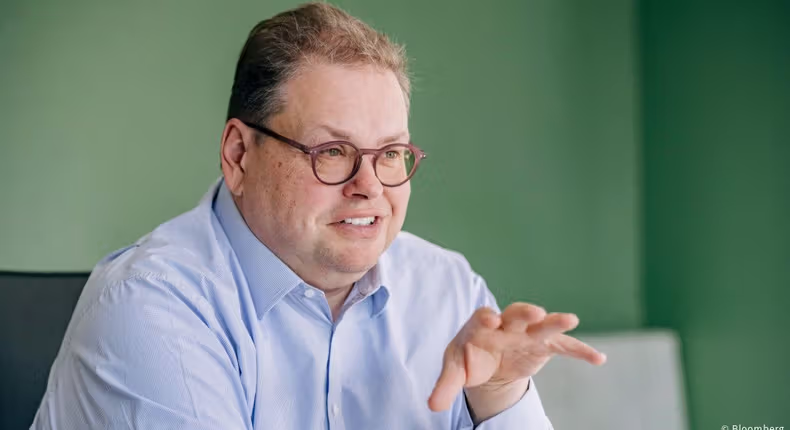
Some of the most prominent figures in the global mining business keep a low profile. One of them is Oskar Lewnowski, a metals investor who has spent decades financing mines but has rarely been in the public eye.
Lewnowski is leading a consortium looking to buy a 40% share in two large copper and cobalt mines in the Democratic Republic of Congo for around $9 billion. The assets are controlled by commodities giant Glencore and include the Mutanda and Kamoto mining operations, which are among the world’s most important cobalt producers.
The investment demonstrates Africa’s growing relevance in the global struggle to obtain crucial minerals for electric vehicles, renewable energy systems, and advanced electronics.
Lewnowski founded Orion Resource Partners, a mining and metals-focused investment firm based in New York.
For years, he maintained a low public presence, despite the fact that his firm grew to become one of the largest mining-focused investors. Unlike many investors, he gives few interviews and has mainly shunned media attention.
However, the Congo investment is tough to keep quiet.
The planned transaction is being pursued by the Orion Critical Minerals Consortium, which includes the US International Development Finance Corporation and Abu Dhabi sovereign investor ADQ.
If the deal is completed, the consortium will own a large portion of Glencore’s activities while the mining giant retains control of the assets.
The mines at the heart of the agreement produce copper and cobalt, two metals that are growing increasingly vital in the global economy.
Cobalt is a vital component in rechargeable batteries found in electric vehicles, smartphones, and energy storage systems. Meanwhile, copper is required for electricity networks, renewable energy systems, and electric vehicles.
The Democratic Republic of the Congo is the world’s largest cobalt producer, making it an important supplier to the technology and energy sectors.
However, China controls a large portion of the world’s cobalt refining capacity. For years, Chinese corporations have invested substantially in mining and processing activities throughout Africa, establishing a dominant position in the supply chain.
This has sparked concerns in the United States and Europe about the security of minerals required for future technology.
Lewnowski’s career started in international banking.
He worked at Deutsche Bank and later Credit Suisse First Boston, where he specialized in trading and corporate finance. Over time, he developed a keen interest in commodities, particularly industrial metals.
His experience finally led him to the mining industry itself. In the early 2000s, he co-founded Red Kite, a metals trading firm that evolved to become one of the industry’s largest specialty hedge funds during the commodity boom.
However, Lewnowski later shifted his attention away from trading and into direct mining funding.
In 2013, he founded Orion Resource Partners, which has grown into a major investment platform for mining firms around the world. The corporation has spent billions of dollars in projects on numerous continents and sponsored dozens of mining companies.
Its investors include pension funds and sovereign wealth funds looking for long-term exposure to the global resources sector.
The Congo agreement demonstrates a larger aim by Western governments to strengthen supply networks for vital minerals.
In 2025, Lewnowski helped establish the Orion Critical Minerals Consortium, which aims to finance mining projects that will supply essential resources to the United States and its allies.
Unlike exploratory projects, which can take years to develop, the consortium concentrates on mines that are already operating or nearing production. This technique enables fresh suppliers to enter the market more quickly.
The consortium’s anticipated investment in Congo is its largest move to date.
Glencore’s most valuable African holdings include the Mutanda and Kamoto mines. Together, they create enormous amounts of copper and cobalt, which are used in worldwide battery and technology supply networks.
According to the proposed agreement, the consortium would be permitted to pick directors and control the sale of its share of production to specific customers.
The transaction remains non-binding and will require due diligence, regulatory approvals, and final agreements before it can proceed.
If finished, it would be one of Africa’s largest mining projects in recent years, putting Lewnowski, a person best known in the metals business, at the center of the global fight for crucial minerals.