

In Lesotho’s mountains, water has become a significant source of national wealth. The small landlocked country makes more over $300 million per year by supplying water to neighboring South Africa, transforming its highland reserves into a valuable asset in a region under increasing water strain.
Water scarcity in Southern Africa is worsening, exposing fundamental structural flaws in infrastructure and administration, even as the region faces rising climate challenges.
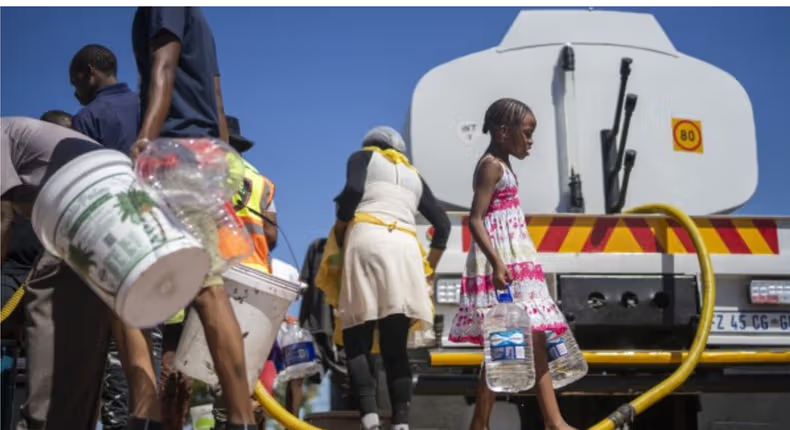
Supply issues have expanded throughout Johannesburg, the region’s economic core, with some towns lasting weeks without reliable water.
The issue has sparked protests, with some locals bathing in public, emphasizing the gravity of the crisis.
According to Associated Press reporting in 2024, locals were forced to line for water as the system’s pressure increased.
A five-litre bottle of water cost around 25 rand ($1.30), illustrating the financial hardship on households in a country where over 32% of the population is unemployed.
Despite periods of significant rains and dams apparently functioning at full capacity, shortages remain.
According to analysts, the situation is driven mostly by structural flaws rather than water scarcity. Municipalities have struggled to maintain reservoirs, pipelines, and pumping stations, while new infrastructure has fallen behind demand.
In response, President Cyril Ramaphosa has formed a national crisis committee and offered over 150 billion rand ($7.6 billion) in funding for water infrastructure and sanitation over the next three years.
As South Africa battles to stabilise supplies, nearby Lesotho is emerging as a critical supplier, transforming water into what many refer to as “liquid gold”.
With an economy worth just more than $2 billion and a reliance on textile and diamond exports, water has emerged as one of the government’s most important revenue sources.
The country of around 3 million people, which is completely encircled by South Africa, gets its water from a multibillion-dollar project started in 1986.
The Lesotho Highlands Water Project, which transports water from Lesotho’s highlands to South Africa’s economic areas, is essential to this relationship.
The system, which is based on the Katse and Mohale dams, transfers almost 800 million cubic metres of water per year, or approximately 800 billion liters, and meets roughly 60% of Johannesburg’s water requirements.
According to Bloomberg, the project earns almost $300 million in royalties for Lesotho each year, accounting for approximately 15% of total government revenue.
Nonetheless, officials are looking into ways to enhance profits, such as raising hydropower capacity and investing in floating solar projects, which might help the country become a net energy exporter.
With the strategic relevance of water increasing, Lesotho is looking to renegotiate the terms of a decades-old deal with South Africa.
According to News24, Natural Resources Minister Mohlomi Moleko stated that talks will begin in April, with a focus on royalties and compensation for a contract that amounts for more than 10% of the country’s economy.
“We have to go back and look at the impact of compensation,” Moleko told reporters. “If you give someone compensation, you do not want to make their life worse. “It has to be higher.”
Officials believe the current parameters no longer reflect economic reality or development priorities.