

From the continuing, multidimensional battles to tackle the perennial plague of terrorism in the Sahel and Horn of Africa to the localized wars resulting from internal disagreements and cross-border skirmishes, the continent is seeing more than its fair share of violence.
South Africa has received criticism from the US for conducting a naval training with Iran in the first 20 days of 2026.
Burkina Faso has arrested its former president for allegedly attempting to overthrow the country’s current regime, led by junta leader Ibrahim Traore.
M23 rebels have reoccupied the little town of Uvira, which they had taken and evacuated in December at the request of the US.
Ethiopia has stated that it intends to pursue a more prominent role in military cooperation in addition to becoming an economic and political partner in the BRICS.
Nigeria received a new package of military equipment from the United States, strengthening bilateral security cooperation following Trump’s attack on ISIS in the Northwestern state of Sokoto.
These complexities, among others, compel an evaluation of which African country has the most formidable military, one that is most ready to fight terrorist threats, repel foreign incursions, and engage in conventional battle if necessary.
Global Firepower (GFP) has announced its 2026 Global Firepower ranking, which considers more than 60 indicators to determine which countries have the most military power.
Below are the 10 African countries with the strongest military power according to GFP’s index.
Egypt
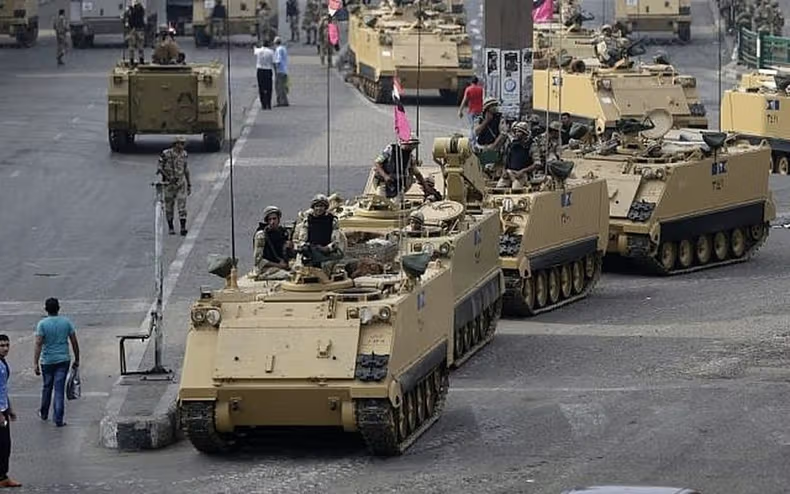
Egypt leads Africa’s military ranks, with one of the continent’s most formidable and well-organized armies.
The North African nation ranks 19th globally with a Power Index score of 0.3651, indicating a strong mix of personnel, equipment, and strategic capabilities.
Egypt’s military might is enhanced by its large population of 45.611,372 million people, making it one of the continent’s most robust recruitment pools.
Egypt’s personnel advantage, along with its regionally influential air and naval assets, allows it to sustain large-scale operations, maintain readiness, and project influence beyond Africa and the Middle East.
Algeria
Algeria has a strong military that prioritizes territorial security and defense.
The North African country has a Power Index score of 0.4849, placing 27th globally, demonstrating its ability to sustain a strong and structured armed force.
Algeria’s military strength relies on a huge workforce of 22.570,787 million people, providing a stable recruitment basis for both active service and long-term force sustainability.
Nigeria
Nigeria is one of Africa’s most formidable armed forces, owing to its size and strategic importance.
The West African giant ranks 33rd internationally with a Power Index score of 0.6097, indicating its rising defense capabilities and operational reach in West Africa.
Nigeria has the continent’s largest available manpower (125,475,979), which contributes to its military advantage.
With such a large recruitment pool, Nigeria can sustain long-term operations while also playing an important role in regional security and peacekeeping.
South Africa
South Africa is a significant military power in Africa, boasting a professional force structure and advanced defense capabilities.
The country’s 2026 Power Index score of 0.6843 places it at 40th globally, indicating a focus on quality, training, and technological sophistication over quantity.
South Africa’s military has a personnel pool of 27,803,618 people, allowing for continuous operations while maintaining a highly trained core.
Ethiopia
Ethiopia has one of Africa’s most strong military, owing to its large population and strategic location in the Horn of Africa.
Ethiopia has a Power Index score of 0.8525, placing 47th globally, suggesting its ability to maintain significant armed forces.
Ethiopia’s military strength is enhanced by its massive population of 56,904,143 people, one of the continent’s largest.
Morocco
Morocco boasts one of Africa’s largest armed forces, which is bolstered by regular investment and a well-organized defense architecture.
The North African country ranks 56th globally with a Power Index score of 1.0368, indicating its balanced military capabilities and strategic position in North Africa.
Morocco’s armed forces have a manpower pool of 17,946,041 soldiers, ensuring operational preparedness throughout the MENA area.
Angola
Despite having a modest armed force, Angola remains one of Africa’s strongest.
The Southern African country has a Power Index score of 1.1045, placing it 59th globally, indicating its ability to maintain credible military might in relation to its size.
However, Angola’s available manpower of 7,440,412 individuals is among the lowest among Africa’s leading military forces.
This emphasizes the importance of force efficiency and equipment strength, as the country’s defensive posture is based on organization and capacity rather than mere army numbers.
Democratic Republic of Congo
The Democratic Republic of Congo is a key military power in Central Africa due to its vast territory and valuable resources.
The country ranks 64th globally with a Power Index score of 1.3051, reflecting its military strength despite security risks.
The Democratic Republic of the Congo’s armed forces have a personnel pool of 39,237,029 people, making them stand out among their contemporaries.
Sudan
Sudan maintains a significant military presence in Northeast Africa, with forces molded by both historical experience and regional security requirements.
The country has a Power Index score of 1.3563, placing 66th globally, indicating its ability to project power despite internal challenges.
Sudan’s military has a manpower pool of 26,747,657 people, enough to support active and reserve forces.
Tunisia
Tunisia rounds out Africa’s most formidable military, with a professional army despite its tiny size.
The country has a Power Index score of 1.7823 and ranks 79th globally.
Tunisia has the continent’s smallest military force, with only 6,024,424 soldiers. To preserve its defense posture, the country must prioritize efficiency, training, and technological competence.