

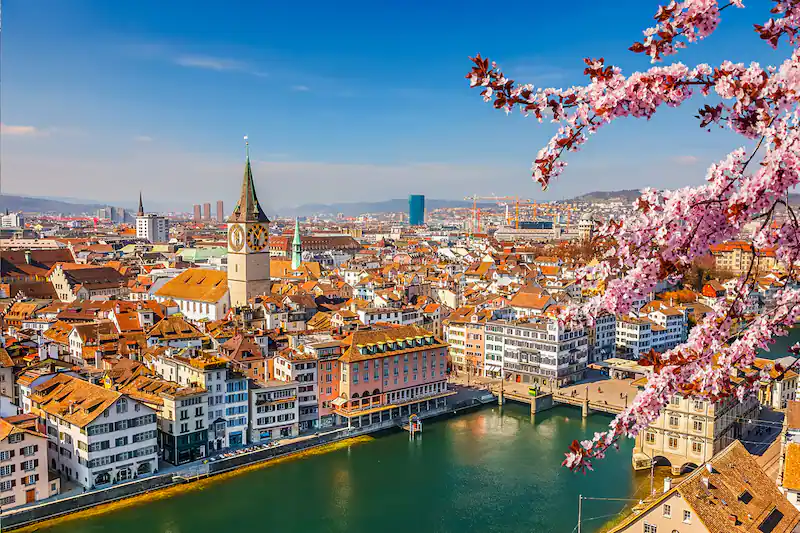
When countries are ranked according to the size of their economies or overall gross wealth, the United States is frequently at the top, followed by China, Japan, and Germany. However, when nations are sorted by per-capita average wealth—or even median per-capita wealth—other countries prevail. Using the first metric, Switzerland is the world’s richest country, with an average per-capita wealth of approximately $685,000, followed by Luxembourg and the United States, Forbes revealed.
Looking at median per-capita wealth—the wealth of the individual who shares their country with an equal number of richer and poorer people—Iceland ranks first, with this (imaginary) person holding approximately $413,000 in value.

Per-capita assets already provide a more fair picture of a country’s wealth, recognizing that smaller countries with fewer residents will accumulate less wealth. However, calculating averages does not account for how money is dispersed throughout society. In contrast, median wealth rises when a country’s assets are distributed more evenly. Credit Suisse’s data suggests that Iceland and other Scandinavian countries have more equitable wealth distribution. Denmark ranks seventh, and Norway tenth, in terms of per capita median wealth.
The United States is the third-wealthiest country per capita, yet it ranks 15th in terms of median rich. The situation in Belgium is the opposite: it is ranked 13th for average wealth but third for median wealth, indicating that it is a more egalitarian country in terms of wealth distribution.
The role of the 1%
Looking at the size of the gap between mean and median wealth, the United States ranks seventh, with an average wealth more than five times, or 512%, that of the median wealth. Except for Brazil, where the figure is 517%, no significant country in the world has a higher percentage. In the United States, the top 10% hold around 70% of the country’s wealth, while the top 1% own roughly half. The lower half of the United States population, which owns only 2% of the country’s wealth, may have an even greater impact on wealth disparity.
In the 1980s, the wealth of the top 1% in the United States began to increase again, unlike in several European countries.It had previously been dropping in many countries as the twentieth century’s industrial and political upheavals strengthened middle classes and increased income.According to the most recent data, persons with $5.8 million were among the top 1% of the wealthiest Americans. In Switzerland, the figure was considerably higher: $8.5 million.
Iceland, Luxembourg, and Belgium had some of the smallest relative wealth differences. Slovakia and Slovenia are two Eastern European countries with among of the smallest gaps, despite not having the greatest average wealth rates. Poorer countries with large differences between average and median wealth include Brazil, South Africa, Russia, and Nigeria.