

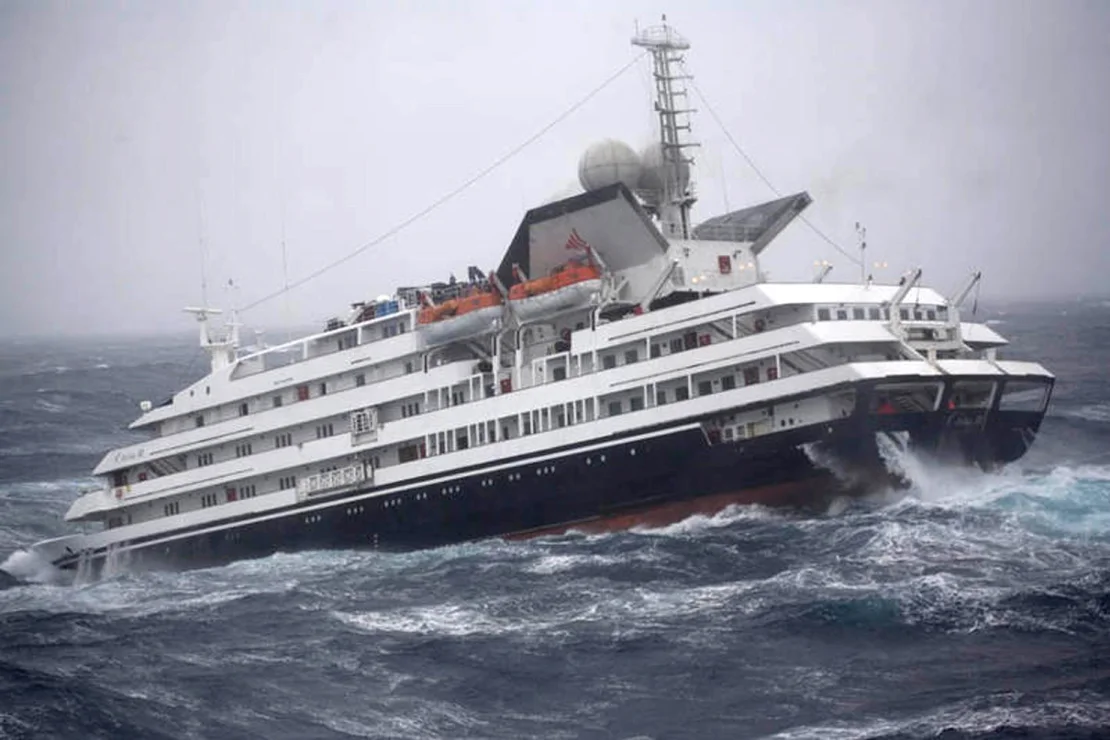
The body of water is a source of both terror and inspiration for sailors. Six hundred miles of open sea and some of the toughest weather on the world, followed by an equally inhospitable country of snow and ice.
“The most dreaded bit of ocean on the globe – and rightly so,” remarked Alfred Lansing of explorer Ernest Shackleton’s 1916 expedition across it in a small lifeboat. The Drake Passage connects the southern extremity of the South American continent to the northernmost point of the Antarctic Peninsula.

The Drake, once the preserve of explorers and sea dogs, is now a formidable barrier for an ever-increasing number of Antarctica visitors, and not just because it can take up to 48 hours to cross. For many, being able to say they survived the “Drake shake” is part of the appeal of visiting the “white continent.”
But what causes those “shakes,” which can result in waves reaching nearly 50 feet and pounding the ships? And how do sailors negotiate the planet’s most treacherous waters?
For oceanographers, the Drake is a fascinating area because of what happens beneath the surface of those raging seas. And ship captains must tackle the issue with a fair amount of apprehension.
The world’s strongest storms

The Drake is a large body of water, measuring over 600 miles in width and up to 6,000 meters (almost four miles) in depth. To us, that is. Less so for the entire world.
The Antarctic Peninsula, where tourists go, isn’t even Antarctica itself. It’s a narrowing peninsula that rotates northwards from the huge continent of Antarctica and reaches the southern tip of South America, the two pointing towards one other, like a tectonic counterpart of Michelangelo’s “Creation of Adam” at the Sistine Chapel.
This causes a pinch point effect, with water compressed between the two land masses – the ocean surges through the space between the continents.
“It’s the only place in the world where those winds can push all around the globe without hitting land – and land tends to dampen storms,” states oceanographer Alexander Brearley, head of open waters at the British Antarctic Survey.
Winds tend to blow west to east, he explains, and latitudes between 40 and 60 are infamous for high winds. Hence their nicknames of the “roaring forties,” “furious fifties,” and “screaming sixties” (Antarctica technically begins at 60 degrees).
Winds are slowed by landmass, leading Atlantic storms to hit Ireland and the UK (as shown with Storm Isha in January) and then diminish as they move east into Europe.
With no terrain to slow them down at the Drake’s latitude anyplace on the earth, winds can hurtle around the world, increasing speed and colliding with ships.
“In the middle of the Drake Passage the winds may have blown over thousands of kilometers to where you are,” said Brearley. “Kinetic energy is converted from wind into waves, and builds up storm waves.” According to him, they can reach heights of up to 15 meters (49 ft). However, before you panic, keep in mind that the average wave height on the Drake is just four to five meters (13-16 feet) high. By comparison, that is still twice as much as you can find in the Atlantic.
And it’s not just the winds that make the seas choppy; the Drake is essentially one massive surge of water.
“The Southern Ocean is very stormy in general [but] in the Drake you’re really squeezing [the water] between the Antarctic and the southern hemisphere,” he said. “That intensifies the storms as they come through.” He calls it the “funneling effect.”
Then there’s the rapidity with which the water rushes through. The Drake is part of the world’s largest ocean current, with up to 5,300 million cubic feet moving each second. The river accelerates as it moves from west to east through the small channel. According to Brearley, at surface level, the current is less perceptible – only a couple of knots – so you won’t notice it onboard. “But it does mean you’ll travel a bit more slowly,” he goes on to say.
For oceanographers, he says, the Drake is “a fascinating place.”
It has what he refers to as “underwater mountains” beneath the surface, and the strong current squeezing through the (relatively) tiny route causes waves to crash against them underwater. These “internal waves,” as he calls them, form vortices that transport colder water from the ocean’s depths to higher elevations, which is critical for the planet’s climate.
“It’s not just turbulent at the surface, though that’s what you feel the most – it’s turbulent all the way through the water column,” explains Brearley, who travels the Drake on a research ship on a regular basis. Does he become scared? “I don’t think I’ve ever been really fearful, but it can be very unpleasant in terms of how rough it is,” he concedes.
Fear breeds fear

Another factor that contributes to the Drake’s terrifying nature is our fear of the Drake itself.
Brearley tells us that before the Panama Canal opened in 1914, ships traveling from Europe to the Americas’ west coast had to pass around Cape Horn, South America’s southern tip, and then trundle up the Pacific coast.
“Imagine you were carrying items from Western Europe to California. You either had to unload them at New York and travel across the United States, or you had to go all the way around,” he explains. Not only did enormous cargo ships travel the same route, but so did passenger ships.
There is even a monument at the point of Cape Horn to commemorate the more than 10,000 sailors who are thought to have died while going through.
“The routes between the south of South Africa and Australia, or Australia or New Zealand to Antarctica, don’t really lie on any major shipping routes,” Brearley said. “The Drake has long been dreaded since it is the only way for ships to reach their destination. Other areas [of the Southern Ocean] can be avoided.
‘We don’t gamble’

Captain Stanislas Devorsine, one of three commanders of Le Commandant Charcot, a polar vessel of adventure cruise firm Ponant, describes navigating the Drake Passage as a complicated undertaking requiring humility and dread.
“You have to have a healthy fear,” he adds about the Drake. “It helps you stay focused, attentive, and sensitive to the ship and the weather. You should be informed that it might be deadly and that it is never routine.”
Devorsine made his Drake debut as a captain more than 20 years ago, when he sailed an icebreaker full of scientists to Antarctica for research.
“We had very, very rough seas – more than 20 meter [66 feet] swells,” he said. “It was very windy, very rough.” Not that Ponant’s clients have to deal with anything like that. Devorsine is keen to stress out that the comfort levels of a research ship, as well as the conditions under which it will sail, differ greatly from those of a cruise ship.
“We are extremely cautious – the ocean is stronger than us,” he goes on to remark. “We can’t go in bad weather. We travel in rough waves, but always with a wide safety margin. “We are not gambling.”
Despite the greater safety margin, he adds that crossing the Drake can be a dangerous experience. “It can be very rough and very dangerous, so we take special care,” he said.
“We need to find the optimal time to cross the Drake. We must adapt our path; occasionally we do not proceed in the intended direction and instead change course to better align with the waves. We may slow down to avoid a low-pressure path ahead, or we may accelerate to pass one before it arrives.”
The ‘Drake shake’ and broken plates

Of course, every time you board a ship, whether it’s a simple ferry ride or a luxurious cruise, the crew will have thoroughly prepared the trip, checking everything from the weather to the tides and currents. However, preparing a Drake crossing takes on a whole new dimension.
Weather forecasting has improved in the two decades since Devorsine’s maiden ride, he says – and these days personnel start arranging the voyage while passengers are making their way to South America from all over the globe.
occasionally they go late, and occasionally they return early to avoid terrible weather. Devorsine, who makes the return journey six to eight times per year, believes that the abnormally tranquil “Drake lake” effect occurs once in every ten crossings, with particularly rough conditions (the “Drake shake”) occurring once or twice in every ten journeys.
Of course, he knows what awaits the passengers well before they board the ship.
“We look forward to find the greatest way to cross. “Normally, I look at the weather 10 days or a week in advance to get an idea of what it might be,” he explains.
“Then I check the forecast once a day, and two or three days before departure, I begin checking it twice a day. If it’s going to be a difficult voyage, you check every six hours. If you have to change your leaving time, you look at it very carefully to ensure accuracy.”
His safety margin indicates that he is planning a route that will not only bring you across alive, but also as comfortably as possible. When he hears another operator’s story about smashed china and furniture, he sighs, “That’s a bit too far for me.”
“Before you have any issue with a storm, you have to keep a comfortable ship,” he goes on to remark. The safety margin ensures that guests have a positive experience in Antarctica and that there are no issues, such as injuries.
In extreme situations, he requests more meteorological guidance from Ponant HQ, but don’t imagine the crew on the bridge anxiously radioing for assistance as waves pound the ship.
“It would never happen to be in the middle of the Drake in terrible weather, requiring assistance from headquarters, because that would indicate we had no safety margin before departure. When we pass, which will be difficult, we have a large safety buffer, and the ship is completely safe.”
They maintain touch with headquarters by high-level satellite antennae during the passage, with both satellite and radio backup available if necessary – Devorsine says he can’t foresee ever losing contact, regardless of the weather.
A dangerous thrill

Devorsine, who now spends 90% of his time sailing in polar waters, feels at ease aboard the Drake. “When I was a little child, I read books about the maritime adventures of sailors and polar heroes,” he explained. “I was drawn to harsh things because I enjoy challenges. This is why I chose the route to be able to sail in these locations.”
As a child, he participated in a “race around the world” aboard a sailboat, sailing south from his home country of France and around Cape Horn.
“It was my dream because it’s difficult, dangerous and challenging,” he said.
He is not the only one. Some tourists are lured to Antarctica tours because of the difficult travel. “I guess [they] are attracted by these areas [of the Southern Ocean] because it’s wild, it can be rough, and it’s a unique experience to go there,” he said.
Not everyone is a thrill seeker, though. Edwina Lonsdale, managing director of Mundy Adventures, an adventure travel service, deals with clients who are used to discomfort, but she says crossing the Drake is a “conversation topic” when booking.
“it’s something we would raise to make sure people are completely aware of what they’re buying,” she said. “[Going to Antarctica] is a huge investment – you need to talk through every aspect and make sure nothing’s an absolute no.”
Lonsdale recommends travelers who are concerned about becoming sick to choose their cruise wisely. Historically, ships bound for Antarctica were typically unpleasant metal boxes designed to withstand harsh conditions. However, in recent years, firms have developed more technically advanced vessels, such as Le Commandant Charcot, which debuted in 2021 as the world’s first passenger vessel with a Polar Class 2 hull, allowing it to travel deeper and further into polar ice.
Two of Aurora Expeditions’ ships, the Greg Mortimer and Sylvia Earle, use a patented inverted bow, which is designed to glide gently through the waves, reducing impact and vibration and improving stability, rather than “punching” through the water as a regular bow shape does, which causes the bow to rock up and down.
According to Lonsdale, the more luxurious the vessel and the amenities on board, the more diversions you’ll have if inclement weather strikes. Newer boats sometimes feature more spacious rooms and larger windows, allowing you to see the horizon and reduce seasickness. If your budget allows, she recommends booking a suite; you’ll not only have more space, but also (likely) floor-to-ceiling windows.
However, she advises you to carefully select not just the ideal operator for you, but also the ship itself.
“Just because a company has a fleet with a very modern ship doesn’t mean the whole fleet will be like that,” she said.
‘Act before you start spewing’

So you’ve conquered your fears, booked your ticket and you’re about to set sail. Bad news: the captain is predicting the Drake shake. What to do?
Hopefully you’ve arrived prepared. During rough weather, most ships provide ginger candies; nevertheless, pack your own, as well as any anti-seasickness medication you wish to take. Some passengers swear by acupressure “seeds”: tiny spikes glued to your ears with a sticking plaster that stimulate acupuncture sites. Some ships provide acupuncture onboard; otherwise, you can have it done beforehand because the seeds stay for a while.
Devorsine’s top advice include keeping your eyes on the horizon, holding onto the handrail when walking, being cautious near doorways, and “don’t jump out of bed.”
Jamie Lafferty, a photographer who leads excursions on Antarctic cruises, says that of his 30+ crossings, “I’ve had one where it felt like I was going to fall out of bed, and that was the second time, way back in 2010, when there was a lot more guesswork involved.” Crossing the Drake Passage is far less dangerous than it ever was, because to the accuracy of modern forecasting models and stabilizers aboard more sophisticated cruise ships. This does not imply that it will be smooth, but it is far less chaotic and unpredictable than it ever was.”
What is his top tip? “Take seasickness medication before heading out into open sea – once you start spewing, tablets aren’t going to be any use.”
Warren Cairns, a senior researcher at the Italian National Research Council’s Institute of Polar Sciences, has some more assistance.
“The only thing that works for me is going to the ship’s medic for a scopolamine patch,” he said. “It’s so rough, normal seasickness pills are just to get me to the infirmary.” Although he has it worse than the typical tourist, on excursions to Antarctica, their research ships must pause to collect samples. “The waves come from all sorts of directions as the thrusters keep it in place,” he said. “When you’re underway it’s a much more regular motion.”
Lonsdale advises not to fight it if you feel ill: “Just go to bed.” However, she cautions against expecting it: “It may be peaceful. You may not feel unwell.
Seasickness affects everyone differently, she explains. “The Pacific has very long, sluggish swells, and crossing the Channel [between the United Kingdom and France] is fairly bouncy. Many people claim that crossing the Drake in extremely bad weather does not make them sick at all. This writer, for example, never became sick during the plate-smashing crossing while viewing 40-foot waves from the observation deck.
Remember that no matter how it feels, you are protected. “There’s an extraordinary level of safety in the build of those ships doing this,” Lonsdale said. When you add in the safety margins built in by companies like Devorsine, you’re in uncomfortable but not dangerous terrain.
If everything else fails, remember why you are there.
“The motivation and excitement to discover those latitudes is very important to fight the seasickness,” Devorsine said. Lonsdale agrees.
“If you were going to the moon, you’d expect the journey to be uncomfortable but it’d be worth it,” she said. “You just have to think, ‘This is what I need to get from one world to another.'”