

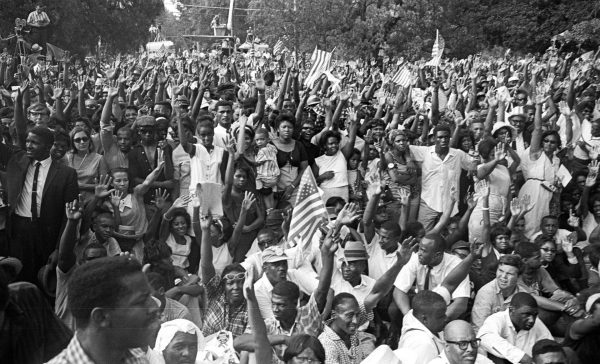

The “March Against Fear” was a 270-mile walk from Memphis, Tennessee to Jackson, Mississippi to protest the deliberate attempt to disenfranchise Black voters. The protagonist of the solitary walk, James Meredith, had already stoked racial tensions by becoming the first African American to attend the University of Mississippi.
According to the National Archives, after desegregating the school, he wanted to respond to a higher call by raising voter registration awareness among African Americans in Mississippi and encouraging them to register.
Meredith was shot by a white sniper, James Norvell, before he could cover a quarter of the mile he had set for himself. Historians explained that going on a solo walk in the segregated South was suicidal. The area was well-known for its violence against African Americans.
Taking on a sensitive subject without the protection or backing of the civil rights movement suggested he had signed his death warrant. He was, however, aware of what he was up against. He only required the political establishment to address a minor issue affecting black voters.
The intimidation did not halt the campaign against racism and intentional voter discrimination. When the civil rights movement learned of his ordeal, it galvanized activists and organizations such as the Medical Committee for Human Rights, Congress of Racial Equality, Student Nonviolent Coordinating Committee, Southern Christian Leadership Conference, and Mississippi Freedom Democratic Party. According to BlackPast, they made sure Meredith was taken to the hospital and then joined forces to continue the walk.
The Deacons for Defense and Justice provided armed escorts as they moved through the designated areas Meredith had planned to walk. While marching, the black community provided food for the demonstrators. Other white institutions, such as the Holy Child Jesus Catholic Church in Canton, Mississippi, assisted in feeding them as well.
When they arrived at Tougaloo College, a historically black college, they were entertained by notable artists such as James Brown, Dick Gregory, Sammy Davis Jr., Burt Lancaster, and Marlon Brando. An estimated 15,000 protestors took part in what was supposed to be a solitary march by Meredith, making it one of the largest civil protests in Mississippi history. When Meredith was fully recovered, he rejoined the march.
After the march ended on June 26, more than 4,000 new voters had registered in Black Mississippi Delta counties. This was despite threats, intimidation, and arrests, as well as leadership conflict and disagreement over the use of the slogan “Black Power” during the march, as reported in Stanford Libraries.
Stokely Carmichael made his “Black Power” declaration at the “March Against Fear” in an address encouraging black pride and self-determination.