

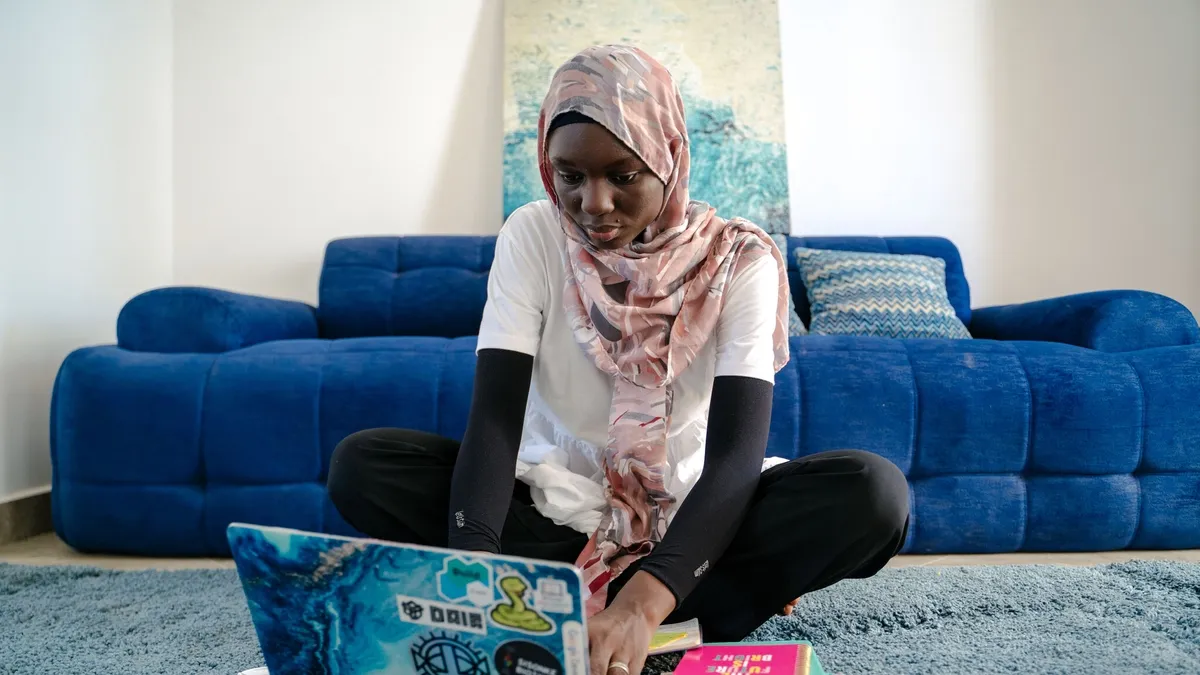
Rokhaya Diagne is a computer science major living in Dakar, Senegal’s capital. She is the founder of a health firm that aims to utilize artificial intelligence to help eradicate malaria by 2030.
Her newest project arose from her love of video games. She used to sneak into her brother’s room and spend hours playing online computer games.
“My mom said, ‘This is an addiction,’” the 25-year-old told the New York Times. “She said if I didn’t stop, she would send me to the hospital to see a psychiatrist.”
Diagne claims that her mother’s assistance assisted her in redirecting her enthusiasm into something more constructive and purposeful. Her idea to employ AI to combat malaria, which kills millions worldwide, is the result. Her project’s aim was also impacted by a variety of childhood diseases that landed her in Dakar hospitals.
Prior to her current endeavor, she assisted in the development of an award-winning networking app for meeting individuals with similar interests — comparable to Tinder but for IT nerds, according to the Times. She also co-founded Afyasense, a company that uses artificial intelligence to diagnose diseases.
“She is someone with whom talking is a pleasure due to the quality of the questions she asks and also the answers she gives,” said Ismaïla Seck, a leader in Senegal’s growing A.I. community.
Malaria is already bringing Diagne honors. According to the Times, she recently received an award at an AI conference in Ghana as well as a national prize for social entrepreneurship in Senegal. She also received $8,000 in funding.
Diagne studied biology at the École Supérieure Polytechnique de Dakar prior to pursuing computer science. She recognized it wasn’t the type of work for her during an internship at Dakar’s Principal Hospital, where she reviewed lab samples.
“I wanted way more challenges than fearing the bacteria in my body,” she said. “What I wanted was innovation and being able to create and use my brain for something instead of predictive results that I just followed.”
As a result, she dropped out of school and spent the following year pondering her next moves. She considered studying bioinformatics. At the same time, the Dakar American University of Science and Technology opened, with a major in computer science. She eventually determined that computer science would give a solid foundation for future bioinformatics investigations.
Her path to developing a technology to detect malaria cases has not been straightforward. According to her, she struggled to find a facility in Senegal that would provide her with a big number of malaria-infected cells to train A.I. to read.
Her school, on the other hand, assisted her in locating a lab that provided her with a cell data set, which she placed into a deep learning tool, teaching it to detect positive cases.