

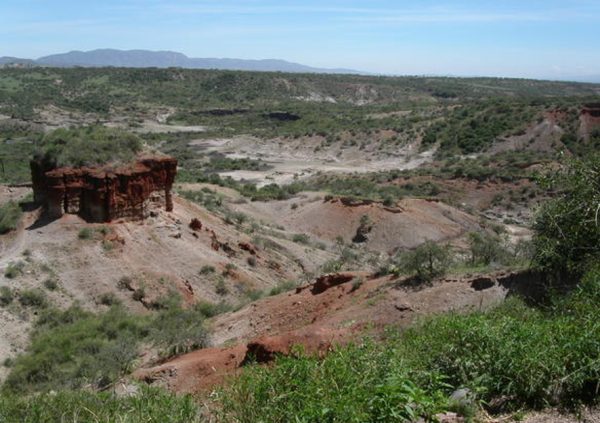

The Olduvai Gorge is located between the Ngorongoro Crater and the Serengeti National Park in the Great Rift Valley. It is close to Laetoli, another fossil-rich enclave.
The gorge was formed two million years ago as a result of intense erosion and geological changes. According to Live Science, the name Olduvai is a corruption of the native Maasai word Oldupai, which means “wild sisal plant” that grows in the area.
The gorge, which is located in Tanzania, East Africa, reveals evidence of early human presence on Earth. Hundreds of fossil bones and stone tools dating back millions of years attest to the evolution of early humans in Africa.
This reality is what has earned the gorge the moniker the “cradle of mankind”. Archaeologists say recent excavations in Ethiopia and South Africa extend the age of the first humans on the planet.
Wilhelm Kattwinkel, a German physician and archaeologist, set out to discover the gorge. In 1911, he decided to travel through German East Africa and visited the enclave in the hopes of discovering ancient artifacts. People were moved to visit the area after discovering several fossil bones of an extinct three-toed horse, according to BlackPast. In 1913, geologist Hans Reck discovered the remains of early humans buried in the gorge. World War I halted the exploration of the gorge.
Louis Leakey, a Kenyan-British archaeologist, led another expedition in 1931 and discovered dozens of hand axes. He returned to the gorge in 1935 with his wife, Mary Leakey, and geologist Percy Edward Kent. They visited the area several times and eventually introduced their son, Jonathan Leakey, to the gorge. They discovered animal bones, human remains, and handcrafted tools.
Jonathan excavated the gorge in 1960 and discovered a jawbone for homo habilis, early humans who lived there 1.9 million years ago.
When Mary Leakey went on an expedition to the gorge in 1978, she discovered footprints of early human ancestors. According to The Getty Conservation Institute, it piqued the scientific community’s interest because it resolved a contentious debate about the study of early humans.
Researchers have spent decades studying the evolution of humans, with a particular focus on fossil bones. The fossils may have provided insight into past events, but archaeologists maintain that there are still unanswered questions about human evolution. One of the nascent questions concerns whether early men possessed the intelligence to walk upright. However, evidence discovered in Olduvai Gorge suggests that early men walked upright.
Olduvai Gorge has a museum that was built in 1976 to commemorate Mary Leakey’s efforts. In 2018, an Olduvai Gorge monument was erected to commemorate the presence of early men in the region. The monument was created by artist Fest Kijo, who used two large concrete tools to represent the first two early humans discovered at the gorge.