

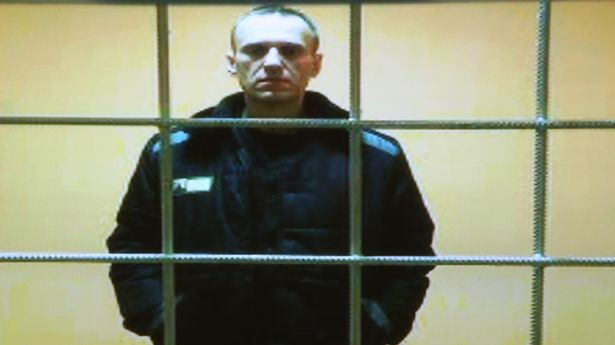
Imprisoned After more than two weeks during which his whereabouts were unclear, associates of Russian opposition leader Alexei Navalny said on Monday that he had been transferred to a prison colony in the Arctic.
Three months before a presidential election that was predicted to award Vladimir Putin an easy five-term win, the authorities moved the most well-known opposition politician in Russia to a remote prison colony.
“We have found Alexei Navalny,” his ally, Kira Yarmysh, said on social media.
“He is now in IK-3 in the settlement of Kharp in the Yamalo-Nenets Autonomous District,” Yarmysh added. “His lawyer visited him today. Alexei is doing well.”
The district of Kharp, home to about 5,000 people, is located above the Arctic Circle.
It is “one of the most northern and remote colonies,” said Ivan Zhdanov, who manages Navalny’s Anti-Corruption Foundation.
“Conditions there are harsh, with a special regime in the permafrost zone” and very little contact to the outside world, Zhdanov said.
Having survived a poisoning attempt, Navalny organized massive anti-government protests before to being imprisoned in 2021.
Originally, he was imprisoned for the most of his time at the IK-6 penal colony, which is located in the Vladimir region 250 kilometers (155 miles) east of Moscow.
His sentence was increased to 19 years by a court due to charges of extremism.
It further ordered that he be transferred to a more severe special regime jail, which often houses inmates who pose a serious threat.
Following weeks of uncertainty, Navalny was discovered at the harsh regime colony known as IK-3, or “Polar Wolf.”
He might be transferred to the far more severe penal camp No. 18, often known as “Polar Owl,” which is close by.
‘Isolate Alexei’
It is common for transfers to take weeks in Russia, as prisoners are slowly moved by rail between far-flung facilities.
But the complete lack of news on his whereabouts had spurred concerns from allies, rights groups and Western governments.
The United States said on Saturday it was “deeply concerned” about the situation.
His allies said they had sent requests to over 600 detention centres.
“There was a complete ban of information about him,” Zhdanov said.
Allies believe the Kremlin aimed to further isolate the vocal critic.
“From the very beginning, it was clear that authorities wanted to isolate Alexei, especially before the elections,” Zhdanov also said.
In March 2024, Russia will hold presidential elections, with Putin certain to win handily for a fifth term.
While the true opposition has been marginalized, a number of groups sympathetic to the Kremlin are scheduled to present candidates for the ballot in March.
Moscow has been undermining Russia’s opposition leaders and activists for years; this crackdown intensified in 2022 after the Kremlin issued an order for Russian forces to enter Ukraine.
The Kremlin has been particularly repressive toward Navalny’s movement.
Navalny’s organization was labeled as extremist even before the offensive in Ukraine, which made it easier to prosecute supporters and members.
Several regional heads of the Anti-Corruption Foundation were jailed.
Among them was Lilia Chanysheva, who was sentenced to seven and a half years in prison this summer. Chanysheva was Navalny’s friend in the central Bashkortostan Republic.
Several prominent allies have left, including Maria Pevchikh, who was the subject of a Russian arrest warrant last week and is the foreign director of the Anti-Corruption Foundation.