

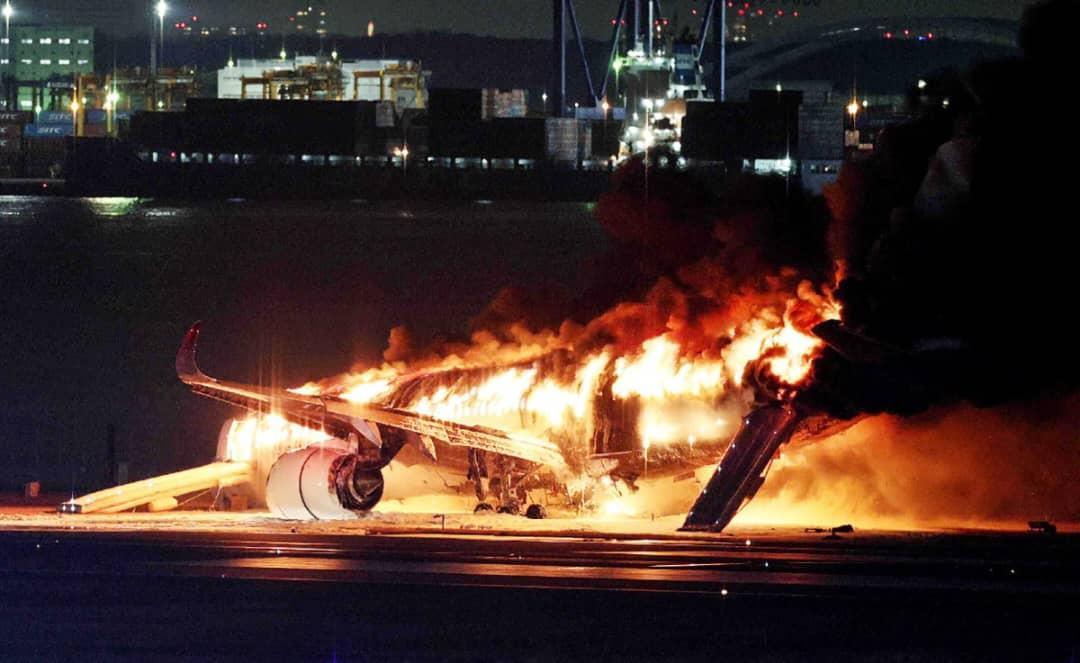
When a Japan Airlines Airbus A350 struck a Coast Guard aircraft as it was landing, five individuals on the aircraft perished, while the other 379 passengers were evacuated.
This is a summary of what is known about the January 2 collision at Tokyo’s Haneda Airport, which resulted in the two planes catching fire.
Sequence of events
Air traffic control approved Japan Airlines flight JAL-516, which was arriving from Hokkaido, to land on runway 34R at 5:44:56 p.m., according to a communications transcript made public by the Japanese government.
Fifteen seconds later, coast guard aircraft JA722A was told to “taxi to holding point C5”, which is at least fifty meters (164 feet) from the runway’s edge, on the tarmac.
Shortly afterward, the pilot of JA722A reported receiving the command.
The Japan Airlines flight touched down and collided with the Coast Guard’s DHC-8 aircraft approximately two minutes later, indicating that the latter had entered the runway itself.
According to broadcaster NHK, the lone survivor of the JA722A, captain Genki Miyamoto, declared he had authorization to take off as soon as could following the disaster.
An airline representative told AFP on Thursday that the JAL flight crew had no “visual contact” with the other aircraft, but one of them saw “an object” shortly before crash.
Black box
Investigators were yet to draw conclusions publicly.
The passenger jet’s flight recorder and voice recorder have been located, however the Coast Guard plane’s flight recorder and voice recorder have not.
“(We) must wait for the thorough accident investigation to be concluded in order to know exactly what happened,” aviation expert Guido Carim Junior from Griffith University told AFP.
“In general, accidents like this one are always the result of multiple factors that influence each other and cannot be reduced to either human error or technology malfunction,” he said.
Ball of fire
As the JAL aircraft raced down the runway, an orange ball of fire and black smoke burst beneath it. The coast guard jet is not easily visible in the incident’s video footage.
Passengers captured footage of the fire beneath the aircraft and smoke entering the cabin while people yelled for the doors to be opened and babies screamed out.
According to NHK, the chief of the nine flight attendants on board notified the pilot of the fire in order to obtain the authorization required for them to open the emergency doors.
Exit
According to international regulations, half of the emergency exits on an aircraft must be able to be used to complete the evacuation in 90 seconds.
There were eight emergency exits in this instance, but due to the fire, only three of them—two at the front and one at the back left—could be used.
The airline claimed that the crew was unable to authorize the use of the rear exit since the intercom system had failed.
As instructed, the back crew opened the rear door even though they didn’t think the passengers needed to get off.
Last man out
The 12 member crew guided all 367 passengers off the aircraft using emergency slides by using megaphones and their own voices.
The pilot was the final person to leave the aircraft at 6:05 p.m., after the whole aircraft took eighteen minutes to escape.
Only two people sustained injuries.
Not long after, the whole airplane was engulfed in flames, with numerous fire engines attempting to extinguish the fire. It took eight hours to complete that process.
Left behind
The fact that the passengers seemed to have forgotten their possessions aboard the aircraft, including a cat and at least one pet dog, shocked experts.
“Passengers seemed to have followed instructions in a textbook manner,” Terence Fan, an airline industry expert from Singapore Management University told AFP.
“This is exactly what evacuation policies are designed for – the airframe itself is not meant to survive the blaze, ultimately.”