

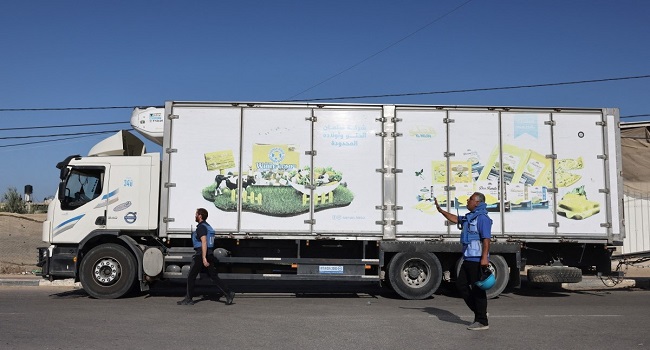
According to AFP correspondents on both sides, the first of 20 trucks bringing humanitarian aid entered the war-torn and besieged Gaza Strip on Saturday through the Rafah border crossing with Egypt.
Martin Griffiths, UN humanitarian head, said he was “confident that this delivery will be the start of a sustainable effort to provide essential supplies… to the people of Gaza” and warned that “this first convoy must not be the last.”
The border crossing reopened following the passage of vehicles from the Egyptian Red Crescent, which is in charge of distributing relief from various UN agencies.

It was the first such delivery since the battle between Israel and Hamas, the Islamist terrorist movement that administers the Palestinian enclave of 2.4 million people, began more than two weeks ago.
Rafah is the only non-Israeli entrance into Gaza, and Israel consented to allow the supplies in after a request from its closest friend, the United States.
Since Hamas’s brutal surprise strike on October 7, Israel has bombed Gaza and declared a comprehensive siege, cutting off most water, food, electricity, gasoline, and other supplies.

According to Israeli sources, Hamas terrorists broke into Israel from Gaza and killed at least 1,400 people, largely civilians who were shot, maimed, or burned to death on the first day of the operation.
According to Gaza’s Hamas-run health ministry, more than 4,100 Palestinians, mostly civilians, have been killed in Israeli bombardments since then.
For days, cargo flights and trucks have been delivering humanitarian aid to the Egyptian side of Rafah, but none has yet arrived in Gaza.
On Friday, UN Secretary-General Antonio Guterres visited the Egyptian side of the border to monitor preparations for relief delivery.
“These trucks are not just trucks, they are a lifeline,” he said. “They are the difference between life and death for so many people in Gaza.”

The UN chief said it must be “a sustained effort” with not just one convoy crossing but for many “to be authorised in a meaningful number to have enough trucks to provide support to Gaza’s people”.
“It is essential to have fuel on the other side… to be able to distribute humanitarian aid for the population in Gaza,” Guterres said, warning against the use of aid deliveries as “bargaining chips”.
Israel is concerned that any gasoline brought into Gaza will be used to produce weapons and bombs by Hamas.
During a solidarity visit to Israel on Wednesday, US President Joe Biden pressed for the trucks to be permitted to pass.
He has stated that the first 20 trucks will be used to test a strategy for distributing aid without benefiting Hamas, with UN organizations distributing it on the Gaza side of the border.
Biden warned that, if Hamas “doesn’t let it get through or just confiscates it, then it’s going to end”.