

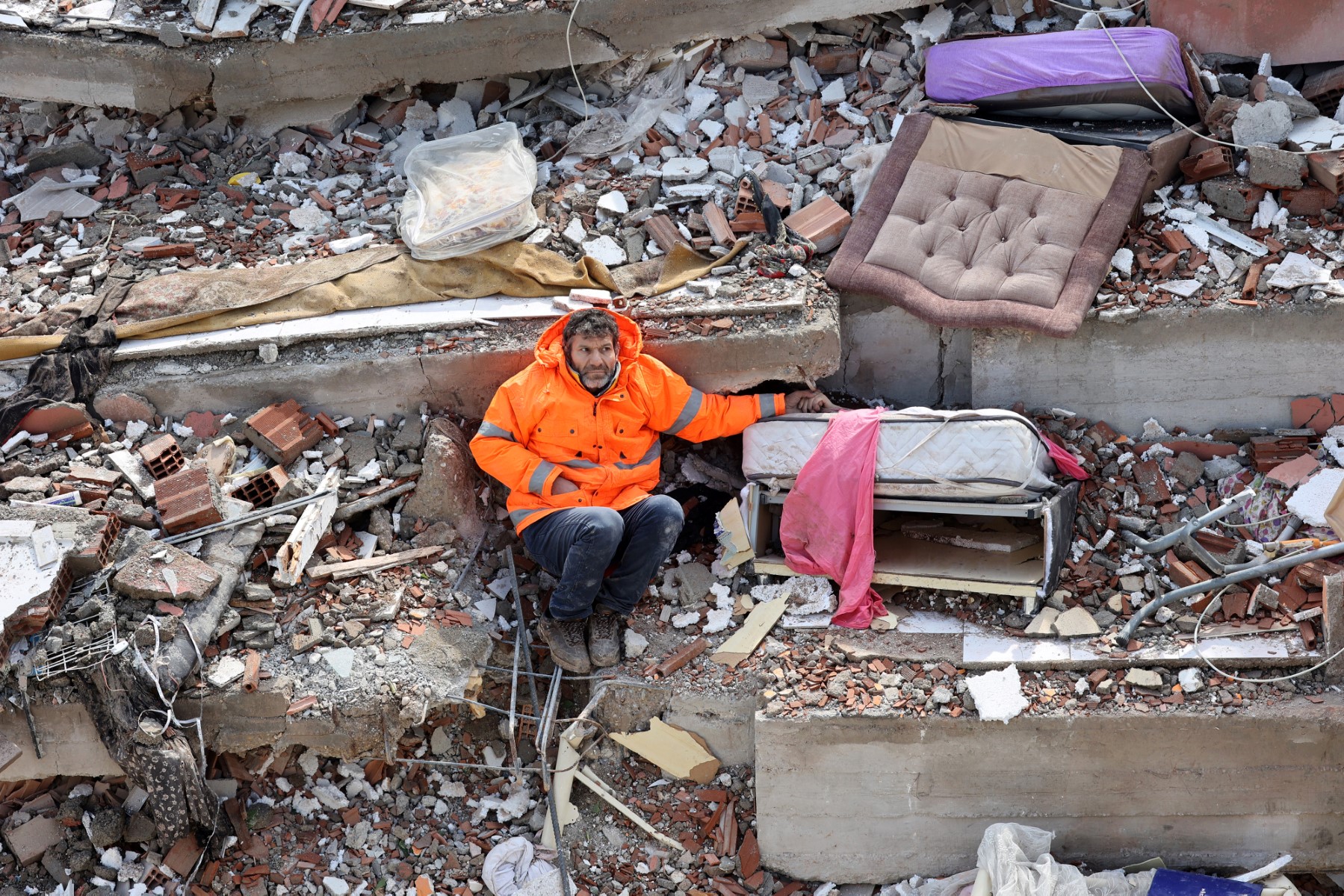

Heartbreaking images of a newborn pulled alive from the rubble and a broken father clutching his dead daughter’s hand have revealed the human cost of violent earthquakes in Syria and Turkey that had claimed nearly 9,000 lives by Wednesday.
An impromptu army of rescuers has worked in freezing temperatures for two days and nights since the 7.8 magnitude quake to find those still entombed among the ruins that pockmark several cities on either side of the border.
The official death toll from the disaster is now 8,700. However, if experts’ worst fears come true, that figure could more than double.
Tedros Adhanom Ghebreyesus, the head of the World Health Organization, has warned that time is running out for the thousands of people who have been injured and those who are still believed to be trapped.
Mesut Hancer, a resident of the Turkish city Kahramanmaras, close to the epicentre, believes it is already too late.
He sat on the icy rubble, unable to speak, clutching his 15-year-old daughter Irmak’s hand as her body lay lifeless among the slabs of concrete and twisted rebar.
– ‘Children are freezing’ –
Even for survivors, the future seems bleak.
Many have taken refuge from relentless aftershocks, cold rain and snow in mosques, schools and even bus shelters — burning debris to stay alive.
Frustration is growing that help has been slow to arrive.
“I can’t get my brother back from the ruins. I can’t get my nephew back. Look around here. There is no state official here, for God’s sake,” said Ali Sagiroglu in Kahramanmaras.
“For two days we haven’t seen the state around here… Children are freezing from the cold,” he said.
In nearby Gaziantep, shops are closed, there is no heat because gas lines have been cut to avoid explosions, and finding petrol is tough.
Sixty-one-year-old resident Celal Deniz said the police had to intervene when impatient crowds waiting for rescue teams “revolted”.
About 100 others wrapped in blankets slept in the lounge of an airport terminal normally used to welcome Turkish politicians and celebrities.
“We saw the buildings collapse so we know we are lucky to be alive,” said Zahide Sutcu, who went to the airport with her two small children.
“But now our lives have so much uncertainty. How will I look after these children?”
Across the border in northern Syria, a decade of civil war and Syrian-Russian aerial bombardment had already destroyed hospitals, collapsed the economy and prompted electricity, fuel and water shortages.
In the rebel-controlled town of Jindayris, even the joy of rescuing a newborn baby was tainted with sadness.
She was still tethered to her mother who was killed in the disaster.
“We heard a voice while we were digging,” Khalil al-Suwadi, a relative, told AFP.
“We cleared the dust and found the baby with the umbilical cord (intact) so we cut it and my cousin took her to hospital.”
The infant faces a difficult future as the sole survivor among her immediate family. The rest were buried together in a mass grave on Tuesday.
– International response –
Dozens of nations including the United States, China and the Gulf States have pledged to help, and search teams as well as relief supplies have begun to arrive by air.
A winter storm has compounded the misery by rendering many roads — some of them damaged by the quake — almost impassable, resulting in traffic jams that stretch for kilometres in some regions.
Turkish President Recep Tayyip Erdogan has declared a three-month state of emergency in 10 southeastern provinces.
The World Health Organization has warned that up to 23 million people could be affected by the massive earthquake and urged nations to rush help to the disaster zone.
The Syrian Red Crescent appealed to Western countries to lift sanctions and provide aid as President Bashar al-Assad’s government remains a pariah in the West, complicating international relief efforts.
Secretary of State Antony Blinken said the United States would not work with the Damascus government.
“These funds, of course, go to the Syrian people — not to the regime. That won’t change,” he said.
Aid agencies have also asked the Syrian government to allow border crossings to be reopened to bring help to rebel-held areas.
The Turkey-Syria border is one of the world’s most active earthquake zones.
Monday’s earthquake was the largest Turkey has seen since 1939, when 33,000 people died in the eastern Erzincan province.
In 1999, a 7.4-magnitude earthquake killed more than 17,000.
Experts have long warned a large quake could devastate Istanbul, a megalopolis of 16 million people filled with rickety homes.