

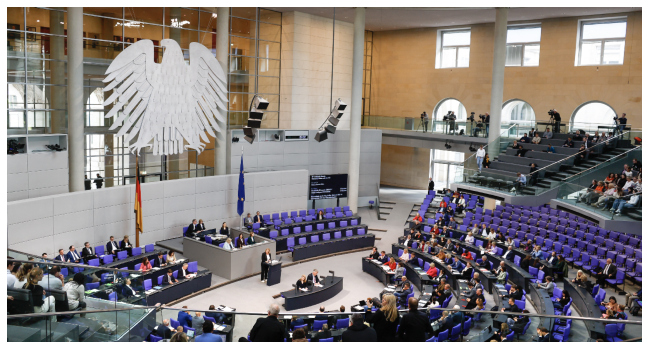
The first members of a far-right gang accused of plotting to attack the German parliament and overthrow the government will face trial in Stuttgart on Monday.
Nine suspected coup plotters will testify in the first round of proceedings in the mammoth court case, which is being heard in three courts across three cities.
The individuals are suspected of belonging to the “military arm” of the organization managed by Prince Heinrich XIII Reuss, a minor prince and businessman.
The suspected plot is the most high-profile recent example of far-right violence, which officials say has escalated into Germany’s most serious extremist danger.
Reuss’ group was an eclectic mix of individuals, including a former special forces soldier, a former far-right MP, an astrologer, and a well-known chef.
Reuss, along with other accused senior members of the gang, will stand trial in the second of three cases, in Frankfurt, in late May.
Following its planned coup, the gang intended to install him as head of state.
According to authorities, the alleged plotters exploited a combination of “conspiracy myths” from the global QAnon movement and the German Reichsbuerger (Citizens of the Reich) scene.
The Reichsbuerger movement consists of right-wing extremists and gun enthusiasts who oppose the validity of the current German republic.
Its supporters typically believe in the continuation of the pre-World War I German Reich, or empire, as a monarchy, and numerous organizations have formed their own states.
Interior Minister Nancy Faeser stated on Sunday in Berlin that Reichsbuerger organizations were motivated by a “hatred of our democracy”.
“We will continue our tough approach until we have fully exposed and dismantled militant ‘Reichsbuerger’ structures,” she added.
‘Treasonous undertaking’
According to investigators, Reuss’s organization believed that Germany was ruled by members of a “deep state” and that the country might be liberated through the use of a covert worldwide alliance.
Prosecutors accuse the nine individuals who will stand trial in Stuttgart of planning a “treasonous undertaking” as part of the Reichsbuerger plot.
As members of the group, they are accused of attempting to “forcibly eliminate the existing state order” and replace it with their own organizations.
Prosecutors claim military personnel were responsible for forming, supplying, and recruiting new members for “territorial defense companies.”
Among the accused is a special forces soldier, only named as Andreas M. due to privacy restrictions, who is suspected of using his access to scout out army camps.
Others were supposedly in charge of the group’s IT infrastructure or charged with coordinating with the imaginary underground “alliance,” which they expected to come to the plotters’ aid when the coup was launched.
The nine include Alexander Q., who is suspected by federal authorities of serving as the group’s propagandist, promoting conspiracy theories using the Telegram chat app.
Markus L. and Ralf S., two of the defendants, have been charged with firearms charges in addition to treason.
Markus L. is also charged with attempted murder after allegedly turning an assault rifle on police and injuring two policemen during a raid at his home in March 2023.
Police swept in to arrest the majority of the group in raids across Germany in December 2022, and the charges were filed at the end of the year.
Three-part trial
The proceedings in Stuttgart are scheduled to continue until early 2025.
In total, 26 people are implicated in the massive investigation against the extremist network, with trials scheduled to begin in Munich and Frankfurt.
Reuss will go on trial in Frankfurt on May 21, alongside another ringleader, an ex-army officer known as Ruediger v.P., and Birgit Malsack-Winkemann, a former MP for the far-right Alternative for Germany (AfD).
The Reichsbuerger gang allegedly formed a “council” to assume command following their intended putsch, with officials warning that preparations were advanced.
According to federal authorities, the alleged plotters had 500,000 euros ($536,000) in finances and a “massive arsenal of weapons”.
Believers in Reichsbuerger-style conspiracies, once derided as malcontents and oddballs, have become increasingly radicalized in recent years, and they are viewed as a major security risk.
Earlier this month, police charged a fresh defendant in connection with another coup plot.
According to authorities, the plotters were dissatisfied with pandemic-era limitations and wanted to kidnap the German health minister.
Last May, five more suspected co-conspirators in the conspiracy faced trial in Koblenz.