

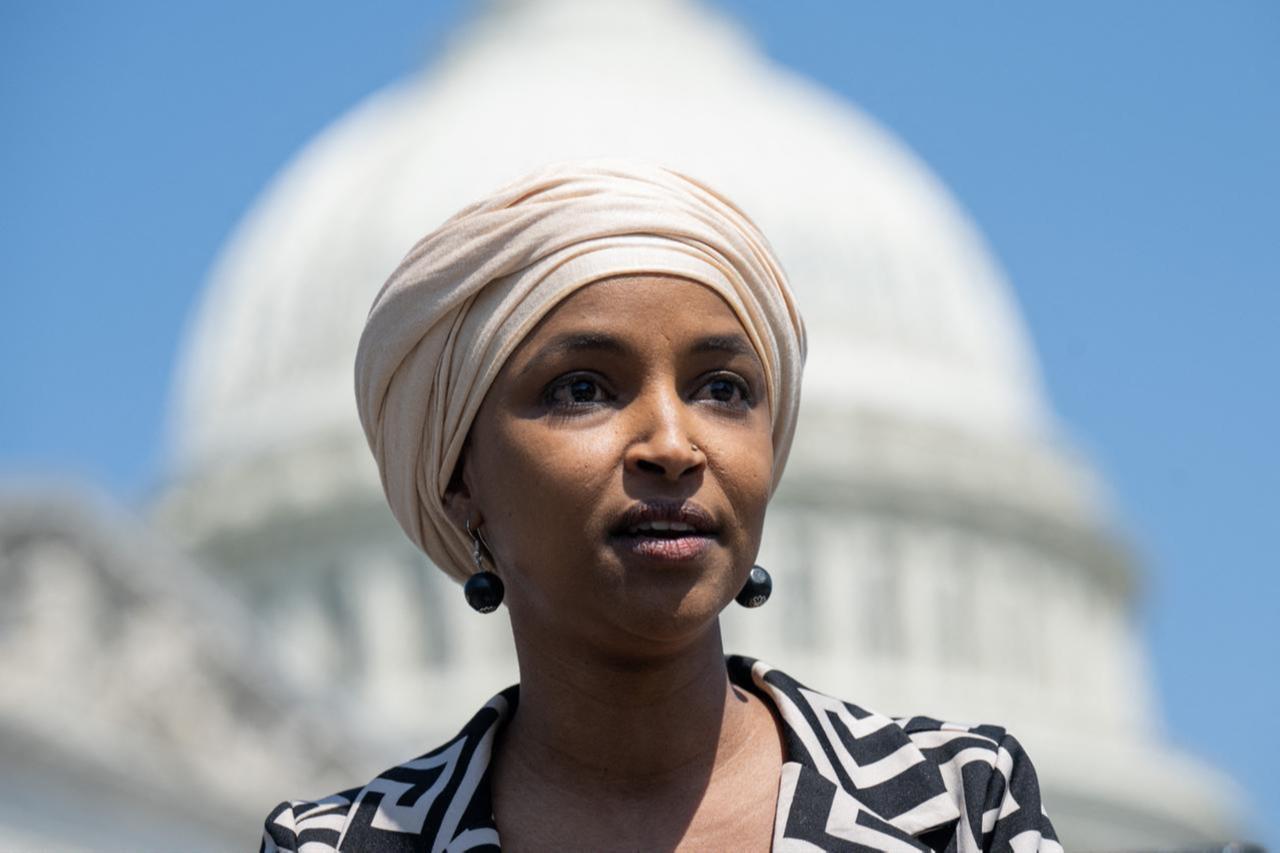
Democratic Congresswoman Ilhan Omar has secured a fifth consecutive term representing Minnesota’s Fifth Congressional District after defeating Republican challenger John Nagel in the November 3, 2026, midterm elections. Her decisive victory reinforces her political influence in Minneapolis and marks another significant milestone in the career of one of the most prominent Somali-American politicians in the United States.
Democratic incumbent Representative Ilhan Omar has won re-election to the United States House of Representatives, comfortably defeating Republican challenger John Nagel in Minnesota’s Fifth Congressional District.
Omar’s victory, announced following Tuesday’s midterm elections, was widely expected given the district’s strong Democratic voting history. Nevertheless, the scale of her success underscores her continued popularity among voters in a constituency she has represented since 2019.
According to the Minnesota Secretary of State’s unofficial election results, with all 217 precincts reporting, Omar received 262,702 votes, representing approximately 76.48 per cent of the total votes cast. Her Republican opponent, John Nagel, secured 55,765 votes, or approximately 16.23 per cent.
Independent candidate DeVelle L. Jackson finished third with 24,110 votes, accounting for approximately 7.02 per cent, while write-in candidates received the remaining votes.
The result gives Omar a commanding lead over her closest challenger and secures her another two-year term in Congress, extending her representation of Minnesota’s Fifth District into a fifth consecutive congressional term.
Her victory also reinforces the Democratic Party’s longstanding dominance in the Minneapolis-based constituency, which is widely regarded as one of the safest Democratic congressional districts in Minnesota and among the most strongly Democratic districts in the country.
A Decisive Victory in a Democratic Stronghold
Minnesota’s Fifth Congressional District is centred on Minneapolis and includes several surrounding communities and inner-ring suburbs. The constituency has a long history of supporting Democratic candidates, making it a particularly challenging electoral environment for Republican contenders.
Omar’s overwhelming victory reflects the district’s political composition as well as the support she continues to enjoy among its electorate.
Although Nagel attempted to present an alternative to the incumbent’s political agenda, he struggled to make significant inroads against Omar’s established support base.
The final results show a substantial difference between the two leading candidates, with Omar winning by more than 206,000 votes. Her performance demonstrates the difficulty Republicans face when attempting to compete in heavily Democratic urban constituencies.
For Omar, the result represents more than simply retaining her congressional seat. It is also an endorsement from voters who have repeatedly entrusted her with representing their interests in Washington.
The victory comes after a political journey that has made her one of the most recognisable progressive Democratic lawmakers in the United States.
From Somali Refugee to the United States Congress
Omar’s political journey is particularly significant because of her personal background and the barriers she overcame before entering American politics.
Born on October 4, 1982, in Mogadishu, Somalia, Omar experienced the consequences of conflict and displacement at a young age. When she was eight years old, her family fled Somalia’s civil war and eventually spent four years in a refugee camp in Kenya before being granted asylum in the United States.
Her family later settled in Minneapolis, Minnesota, where she grew up, attended school and developed an interest in public service.
Omar’s experiences as an immigrant and refugee have played an important role in shaping her political outlook, particularly on immigration, civil rights, economic inequality and the treatment of vulnerable communities.
Before entering Congress, she built her political experience through community organising and public service. She worked as a community educator at the University of Minnesota, served as a policy fellow at the University of Minnesota’s Humphrey School of Public Affairs and worked as a senior policy aide for the Minneapolis City Council.
Her political career gained national attention in 2016 when she was elected to the Minnesota House of Representatives, becoming the first Somali-American legislator in the United States.
Two years later, she made history again by winning election to the U.S. House of Representatives in 2018. She was sworn into office in January 2019, becoming the first African refugee to serve in the U.S. Congress and the first woman of colour to represent Minnesota in the House.
She also became one of the first two Muslim-American women elected to Congress, alongside Michigan Representative Rashida Tlaib.
Since then, Omar has established herself as an influential voice within the Democratic Party, particularly among progressive lawmakers advocating for economic equality, healthcare reform, immigration protections and social justice.
Her latest victory further strengthens her position as one of the most prominent immigrant voices in American national politics.

Her Political Agenda and Legislative Priorities
Throughout her time in Congress, Omar has consistently advocated policies aimed at improving the economic and social conditions of ordinary Americans.
Her political agenda has focused on affordable healthcare, workers’ rights, housing, education, immigration reform, climate change and reducing economic inequality.
One of her most prominent policy positions is her support for Medicare for All, a proposal aimed at establishing a universal, publicly funded healthcare system that would guarantee healthcare coverage to Americans.
She has also advocated expanding access to affordable housing, increasing wages, providing student debt relief and improving educational opportunities for young people.
On immigration, Omar has remained a strong advocate for immigrant and refugee communities. Drawing from her personal experience, she has criticised restrictive immigration policies and called for reforms that provide greater protection for people seeking asylum and opportunities for immigrants to become citizens.
She has also been an outspoken critic of the Immigration and Customs Enforcement agency, commonly known as ICE, and has called for its abolition.
Her supporters argue that her political positions give a voice to communities that are often overlooked in national policymaking. They also see her as a representative who is willing to challenge established political interests.
However, her progressive agenda has attracted criticism from conservative politicians and voters who disagree with her positions on immigration, government spending, foreign policy and other national issues.
Despite these disagreements, Omar has maintained a strong political base in Minnesota’s Fifth District, as demonstrated by her latest election performance.
Political Controversies and Renewed Federal Scrutiny
Omar‘s re-election comes against the background of renewed political controversy and scrutiny surrounding her personal and political life.
For several years, she has been a frequent target of criticism from President Donald Trump and other Republican politicians. Her outspoken positions on immigration, American foreign policy and other controversial political issues have repeatedly placed her at the centre of national political debates.
Trump has made several public attacks against Omar, including comments questioning her place in American society because of her Somali background.
These attacks have attracted criticism from Democrats and civil rights advocates, who have described some of the president’s rhetoric as xenophobic and politically divisive.
The tensions intensified in October 2026 when federal agents searched Omar’s residence in Washington, D.C., as part of an investigation reportedly connected to allegations involving immigration documents filed on her behalf when she was a child.
The investigation has attracted considerable public attention because of its potential political implications and the longstanding hostility between Omar and the Trump administration.
Omar has rejected suggestions of wrongdoing and criticised the federal investigation, describing the search as an abuse of government power and an attempt to intimidate a political opponent.
Importantly, the investigation and the allegations surrounding it should not be interpreted as proof of criminal wrongdoing. As reported by CBS Minnesota, Omar had not been charged with a crime, and no evidence of wrongdoing had been made public at the time of its election coverage.
The controversy nevertheless became an important part of the political environment surrounding her re-election campaign.
While Republicans have continued to raise questions about her background and public record, Omar’s supporters have argued that the investigations and political attacks are part of a broader effort to undermine her influence.
Her decisive victory suggests that the controversy did not significantly weaken her electoral support within Minnesota’s Fifth District.
Democratic Party Endorsement and Primary Victory
Omar’s journey to the November general election began with strong backing from the Minnesota Democratic-Farmer-Labor Party, commonly known as the Minnesota DFL.
The DFL is the Minnesota affiliate of the national Democratic Party and plays a significant role in the state’s electoral politics.
Earlier in 2026, Omar secured the party’s endorsement as she sought another term in Congress.
However, she still had to overcome competition within her own party during the August 11 Democratic primary.
She defeated several challengers, including Julie Trang Le, Latonya Reeves, Nate Schluter and Abena McKenzie, securing approximately 80.7 per cent of the primary vote.
Her commanding primary performance demonstrated that she continued to enjoy substantial support among Democratic voters in the district.
After winning the nomination, Omar advanced to the November general election, where she faced Republican candidate John Nagel and independent contender DeVelle L. Jackson.
Nagel, a former Minnesota State Patrol trooper, campaigned on issues including public safety, border security, education and government spending.
His campaign offered voters a more conservative alternative to Omar’s progressive political agenda.
Nevertheless, the Republican challenger was unable to overcome the district’s strong Democratic voting history and Omar’s established political support.
What the Victory Means for Omar and Minnesota
Omar’s fifth-term victory carries significance beyond the immediate outcome of the Minnesota congressional race.
First, it reinforces her political standing within the Democratic Party and strengthens her position as an influential progressive lawmaker.
Her continued presence in Congress means she will have another opportunity to participate in legislative debates, shape policy discussions and represent the interests of her constituents.
She currently serves on the House Budget Committee and the House Education and Workforce Committee. Her committee assignments give her opportunities to participate in discussions concerning federal spending, education, employment, workers’ protections and other national issues.
Second, her victory represents another important milestone for Somali-Americans and immigrant communities across the United States.
Since entering Congress, Omar has become a prominent symbol of immigrant political participation and representation.
Her journey from a childhood spent fleeing conflict in Somalia to becoming a five-term member of the American legislature has attracted international attention.
For many immigrants, refugees and members of minority communities, her political achievements demonstrate that people from different backgrounds can participate in democratic institutions and attain positions of national influence.
Her re-election may also encourage greater political participation among immigrant communities, particularly those seeking stronger representation in local, state and federal government.
Third, the result sends a message about the political preferences of voters in Minnesota’s Fifth District.
Despite the national controversies surrounding Omar, voters overwhelmingly chose to retain her as their representative.
The result suggests that, within this constituency, her political record, policy priorities and connection with the electorate remain more influential than the criticisms directed against her by political opponents.
Looking Ahead to Her Fifth Term
As Omar prepares to return to Washington for another congressional term, attention will turn to how she intends to use her renewed mandate.
Healthcare affordability, housing, economic inequality, immigration policy, workers’ rights and government accountability are expected to remain central to her political agenda.
She will also face the challenge of navigating an increasingly polarised political environment, where disagreements between Democrats and Republicans continue to shape legislative debates.
Her role in the House Budget Committee and Education and Workforce Committee will provide opportunities to influence discussions on important national issues.
Meanwhile, her outspoken political style suggests that she is unlikely to retreat from controversial debates involving the Trump administration, immigration enforcement and American foreign policy.
For her constituents, the central expectation will be whether she can translate her electoral success into meaningful representation, effective legislative work and tangible improvements in their everyday lives.
Omar’s re-election also comes at a time when questions surrounding immigration, political representation, economic opportunity and the future direction of American democracy remain prominent in national discussions.
Her victory therefore carries both local and national significance.
Conclusion
Ilhan Omar’s landslide victory in Minnesota’s Fifth Congressional District marks another remarkable chapter in her political career.
By defeating Republican challenger John Nagel with approximately 76.48 per cent of the vote, she has secured a fifth consecutive term in the United States House of Representatives and reaffirmed her strong political standing in Minneapolis and surrounding communities.
Her journey from a Somali refugee to one of America’s most recognisable immigrant lawmakers remains an important part of her public identity.
Although she continues to face criticism, political opposition and renewed federal scrutiny, her latest electoral success demonstrates that she retains substantial support among voters in her district.
As she prepares for another two years in Congress, the focus will be on her legislative priorities, her influence within the Democratic Party and her ability to deliver on the issues that matter to her constituents.
For Omar, the election represents not only a personal political victory but also another opportunity to shape America’s national conversation on immigration, equality, healthcare, economic justice and democratic representation.