

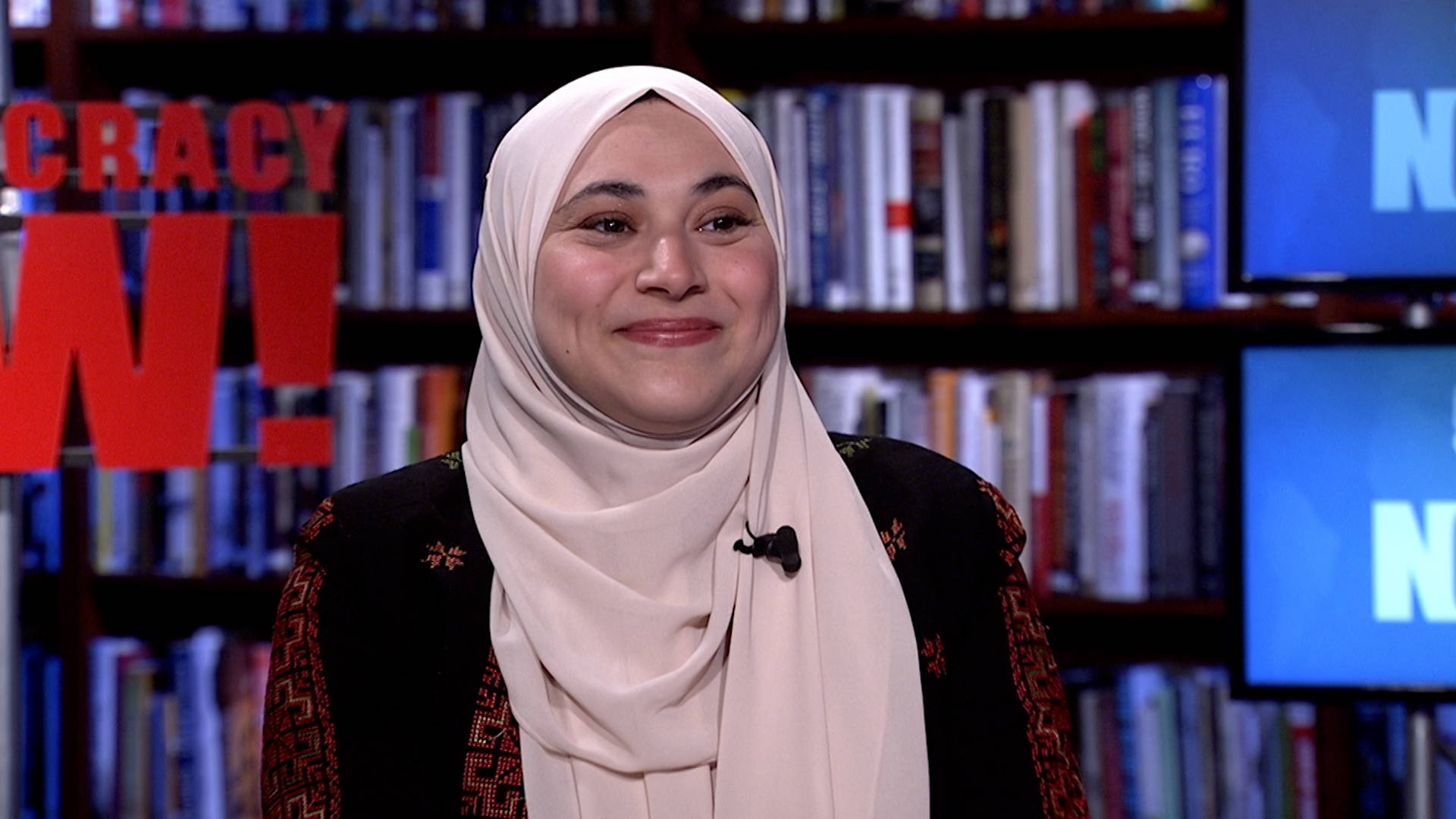
Aber Kawas, a 34-year-old Palestinian-American grassroots activist and community organizer, secured a decisive victory in the November 3, 2026, general election, defeating Republican challenger Han-Khon To in the race for New York State Senate District 12.
Her victory was called by major media outlets after approximately 90 per cent of ballots had been counted. According to the reported results, Kawas secured approximately 75 per cent of the vote, demonstrating overwhelming support in the heavily Democratic district covering parts of Queens, New York City.
Celebrating her historic achievement on social media platform X on Tuesday night, Kawas announced: “We made history. 🇵🇸”
The victory represents more than an electoral success for a first-time candidate. It is a landmark moment for Palestinian-American representation in American politics, particularly at a time when questions surrounding immigration, racial equality, religious identity, housing affordability and US foreign policy have become increasingly prominent in national political discussions.
Who Is Aber Kawas?
Aber Kawas was born and raised in Brooklyn, New York, to Palestinian parents who immigrated to the United States during the 1990s. Growing up in a Palestinian immigrant household in one of America’s most culturally diverse cities helped shape her understanding of the challenges confronting immigrant families, working-class communities and people from marginalized backgrounds.
At 34, Kawas has already established herself as an experienced grassroots organizer, spending more than 15 years working with communities on issues involving workers’ rights, immigrant protection, social justice and Palestinian human rights.
Unlike many politicians whose careers begin within established political institutions, Kawas developed her public profile through community activism and organizing. Her experience involved working alongside ordinary people, advocating for better working conditions, supporting immigrant communities and challenging policies she believed contributed to inequality and social injustice.
Her background in grassroots activism became a central part of her political identity and campaign message. Rather than presenting herself simply as another political candidate, she positioned her campaign as an extension of years of community-based work.
Kawas also pursued academic studies connected to her interests in social justice, religion and liberation movements. She recently completed a Master’s degree in Islamic Liberation Theology at the University of Johannesburg in South Africa before returning to New York in 2024.
Her academic experience added another dimension to her understanding of the relationship between faith, justice, political freedom and the struggles of disadvantaged communities.
For Kawas, her Palestinian heritage, Muslim identity and years of activism have all contributed to the principles that define her political outlook.
A Historic Victory in New York’s 12th Senate District
Kawas contested the New York State Senate District 12 seat, representing communities in Queens, one of the most ethnically and culturally diverse boroughs of New York City.
The district includes communities with significant immigrant populations and residents from different cultural, religious and economic backgrounds. Issues such as affordable housing, access to healthcare, public transportation, workers’ rights and immigration policies are particularly important to many families living in the area.
Her opponent, Republican candidate Han-Khon To, was unable to match the momentum generated by the Kawas campaign.
With approximately 90 per cent of ballots counted, The New York Times called the race for Kawas after she secured roughly 75 per cent of the vote. Subsequent election-night reporting continued to show a commanding Democratic victory.
The result was particularly significant because Kawas had already demonstrated her political strength several months earlier when she won the Democratic primary in June 2026.
She defeated incumbent Assemblyman Steven Raga in a competitive Democratic primary, securing the party’s nomination in a district where the Democratic candidate was widely favoured to win the general election.
In heavily Democratic constituencies, winning the party primary can be the most difficult stage of an electoral contest. Kawas successfully navigated that challenge and translated her primary victory into a decisive general-election result.
Her election will take her from community organizing into the New York State Senate, where she will have the opportunity to participate directly in legislative decisions affecting millions of residents across the state.
The Campaign: “Fund Dignity, Fight Destruction”
One of the defining features of Kawas’s campaign was its emphasis on economic justice, social protection and human dignity.
Running under the slogan “Fund Dignity, Fight Destruction,” she presented a political agenda focused on improving the living conditions of ordinary New Yorkers while challenging policies she believes contribute to inequality, displacement and conflict.
Her campaign argued that government resources should be directed towards essential public services and the welfare of working-class families rather than policies that perpetuate poverty, insecurity and destruction.
The slogan captured two major themes of her political programme: improving people’s everyday lives and opposing the use of public resources to support war and human suffering.
Among the major priorities of her campaign were:
1. Universal healthcare
Kawas advocated expanding access to affordable healthcare, arguing that medical services should be available to everyone regardless of income or employment status. Her position reflects the broader progressive movement’s support for healthcare as a fundamental public service rather than a privilege determined by financial circumstances.
2. Affordable housing
Housing affordability was another central issue. New York is one of the most expensive places to live in the United States, with many working-class families struggling with rising rents and the increasing cost of homeownership.
Kawas campaigned for policies that would make housing more accessible, strengthen protections for tenants and address the pressures forcing low- and middle-income residents out of their neighbourhoods.
3. Reliable public transportation
Recognising the importance of public transportation to millions of New Yorkers, she promised to advocate for faster, more reliable and affordable transit services.
For residents of Queens, where thousands of people commute daily to work, schools and businesses across New York City, improvements to the transportation system remain an important economic and social priority.
4. Climate action
Kawas also placed environmental protection among her major campaign priorities. She supported action against climate change and promoted investment in renewable energy as part of a broader effort to protect communities and create a more sustainable future.
5. Immigrant protection
As the daughter of Palestinian immigrants, Kawas has personal and political connections to the challenges experienced by immigrant families.
Her campaign advocated stronger protections for immigrant communities, access to legal assistance, and measures to prevent local and state institutions from collaborating with federal immigration enforcement in ways that could expose vulnerable residents to detention and deportation.
She also supported protecting the rights of immigrant workers and ensuring that people from different backgrounds could live and work without discrimination or intimidation.
6. Opposition to war and military funding
Perhaps the most politically distinctive aspect of Kawas’s campaign was her position on US foreign policy, particularly American support for military operations and the Israeli-Palestinian conflict.
She argued that public money should prioritise healthcare, education, housing and other essential services instead of supporting wars and military activities that result in civilian suffering.
Her campaign platform also addressed Palestinian human rights, opposition to illegal Israeli settlements and the protection of the right to peaceful protest.
These positions helped distinguish her from more moderate political candidates and strengthened her appeal among progressive voters, anti-war activists and sections of the Palestinian-American and Muslim-American communities.

Grassroots Organising and the Road to Political Success
Kawas’s electoral victory did not happen overnight. It was the result of more than 15 years of community engagement, political activism and organising around issues affecting working-class people.
Her experience working with immigrant and Arab-American communities helped her develop relationships with people who often feel excluded from mainstream political conversations.
She was also involved in campaigns addressing workers’ rights, economic inequality, police surveillance and immigration reform.
Her campaign website highlights her involvement in the Fight for $15 movement, which sought to increase the minimum wage and improve the economic conditions of low-paid workers.
Her personal experiences also influenced her political journey. In an account published on her campaign website, Kawas explained that her father was detained by US Immigration and Customs Enforcement (ICE) and deported, an experience that left her family struggling financially.
That experience gave her a personal understanding of the uncertainty and difficulties that immigration enforcement can create for families.
Rather than separating her family history from her political ambitions, she made it part of her explanation for why she entered public life.
Her campaign effectively connected personal experiences with broader policy questions, particularly the treatment of immigrants, economic inequality and the responsibilities of government.
Her ability to combine community organising with an electoral campaign helped her attract supporters who wanted to see activists with direct experience of social problems represented in government.
Major Endorsements From Progressive Political Figures
Kawas’s campaign also received considerable support from influential progressive figures in American politics.
Among those who backed her candidacy were New York City Mayor Zohran Mamdani, independent Senator Bernie Sanders and Democratic Congresswoman Rashida Tlaib.
These endorsements helped increase her national visibility and connected her campaign to a wider progressive movement seeking changes in American economic and social policies.
Mamdani’s endorsement was particularly significant given his own political success and popularity among progressive voters in New York City. His support helped reinforce the campaign’s message around affordability, working-class representation and social justice.
Senator Bernie Sanders, one of the most recognisable figures associated with democratic socialism in the United States, has consistently advocated policies such as universal healthcare, stronger workers’ rights, economic equality and reducing the influence of wealthy interests in politics.
Congresswoman Rashida Tlaib, who represents Michigan’s 12th Congressional District, also has Palestinian heritage and has become one of the most prominent Palestinian-American voices in the US Congress.
Her support for Kawas carried additional symbolic importance because both politicians have backgrounds connected to Palestinian-American identity and advocacy for Palestinian rights.
Kawas is also a member of the Democratic Socialists of America (DSA), an organisation that supports democratic socialist policies and grassroots political organising.
The organisation’s involvement helped provide campaign infrastructure, volunteers and access to progressive networks that could mobilise voters.
Her victory therefore represents not only an achievement for Palestinian-American political representation but also another electoral success for the progressive movement in New York.
A New Chapter for Palestinian-American Political Representation
For decades, Palestinian-Americans and other Arab-American communities have contributed to American society through business, education, healthcare, public service and community development.
However, their representation in major political institutions has remained relatively limited compared with their contributions to the country’s social and economic life.
Kawas’s election changes an important part of that political landscape.
By becoming the first Palestinian-American elected to the New York State Legislature, she has broken a significant representation barrier for a community whose concerns have frequently featured in American political debates, particularly in discussions about the Middle East, immigration and civil liberties.
Her achievement is also significant because she will enter the legislature as a visibly Muslim woman who wears the hijab.
Her election as the first hijab-wearing woman in the New York State Legislature is another milestone for Muslim women in American public life.
For many Muslim and Palestinian-American women, seeing someone with a similar cultural and religious background win an elected position can provide a sense of recognition and political possibility.
It challenges the assumption that political leadership must conform to a particular cultural, religious or social identity.
It also demonstrates that candidates can bring their personal backgrounds and community experiences into public office while seeking to represent constituents from different walks of life.
Nevertheless, representation alone does not automatically resolve the challenges facing minority communities. The significance of Kawas’s election will ultimately depend on how effectively she translates her campaign promises into legislative action.
Part of a Wider Historic Wave in the 2026 US Midterm Elections
Kawas’s victory is part of a broader wave of significant electoral milestones recorded during the 2026 US midterm elections.
Another major breakthrough came in Michigan, where Democrat Abdul El-Sayed defeated Republican Mike Rogers in the contest for the state’s open US Senate seat.
El-Sayed, a 42-year-old former public health official and son of Egyptian immigrants, became the first Muslim American elected to the United States Senate.
His victory was particularly notable because the campaign attracted national attention over his progressive political positions, including support for universal healthcare, reducing corporate influence in politics and opposition to US military assistance for Israel.
According to reports by Reuters and the Associated Press, El-Sayed’s victory represented a breakthrough for progressive Democrats and an important moment for Muslim political representation.
The victories of Kawas and El-Sayed demonstrate the growing visibility of Muslim and Arab-American candidates in American electoral politics.
They also reflect the increasing participation of younger candidates, grassroots organisers and community activists seeking to challenge established political structures.
Across the country, candidates from immigrant, Muslim, Arab-American and other historically underrepresented communities have continued to seek positions in local, state and federal government.
While each election has its own political circumstances, the broader trend highlights the growing importance of diverse communities in shaping America’s political future.
What Kawas’s Election Means for New York
As she prepares to take up her position in the New York State Senate, Kawas faces the challenge of turning an ambitious campaign programme into practical legislation.
Her district includes communities with different economic circumstances, cultural identities and political priorities. Representing such a diverse constituency will require balancing her progressive political convictions with the everyday concerns of all residents.
Affordable housing, healthcare, transportation, employment opportunities and the cost of living are likely to remain among the most important issues confronting her constituents.
She will also have to work with fellow legislators, negotiate political differences and build support for proposals that may face opposition.
Her position on immigration and Palestinian human rights could also attract considerable attention, particularly given the national debates surrounding US foreign policy and the Israel-Palestine conflict.
Although a New York state senator does not control federal foreign policy, state legislators can influence state-level decisions involving public investment, procurement, civil rights, immigration protections and the activities of institutions operating within their jurisdiction.
Consequently, Kawas’s election could give Palestinian-American advocacy a new platform within one of America’s most influential state legislatures.
Her supporters will expect her to maintain the principles that defined her campaign, while other constituents will judge her according to her ability to deliver improvements in their everyday lives.
Conclusion
Aber Kawas’s historic election is a powerful reminder of how grassroots activism can develop into meaningful political participation.
From her childhood in Brooklyn as the daughter of Palestinian immigrants to more than 15 years of community organising, academic studies in South Africa and eventually a successful campaign for the New York State Senate, her journey reflects a determination to bring community concerns into the political arena.
Her victory is significant for Palestinian-Americans, Muslim women, immigrant communities and progressive political movements across the United States.
By winning Senate District 12, she has broken new ground in New York’s political history and created a new chapter in the story of minority representation in American public life.
However, the real measure of her success will extend beyond the historic nature of her election. It will be determined by the policies she advances, the communities she serves and the extent to which she delivers on her promises.
For now, her message following the election captures the significance of the moment: “We made history.”
For Palestinian-Americans and many others who have long sought greater representation in American political institutions, Aber Kawas’s victory is undoubtedly a moment worth celebrating.