

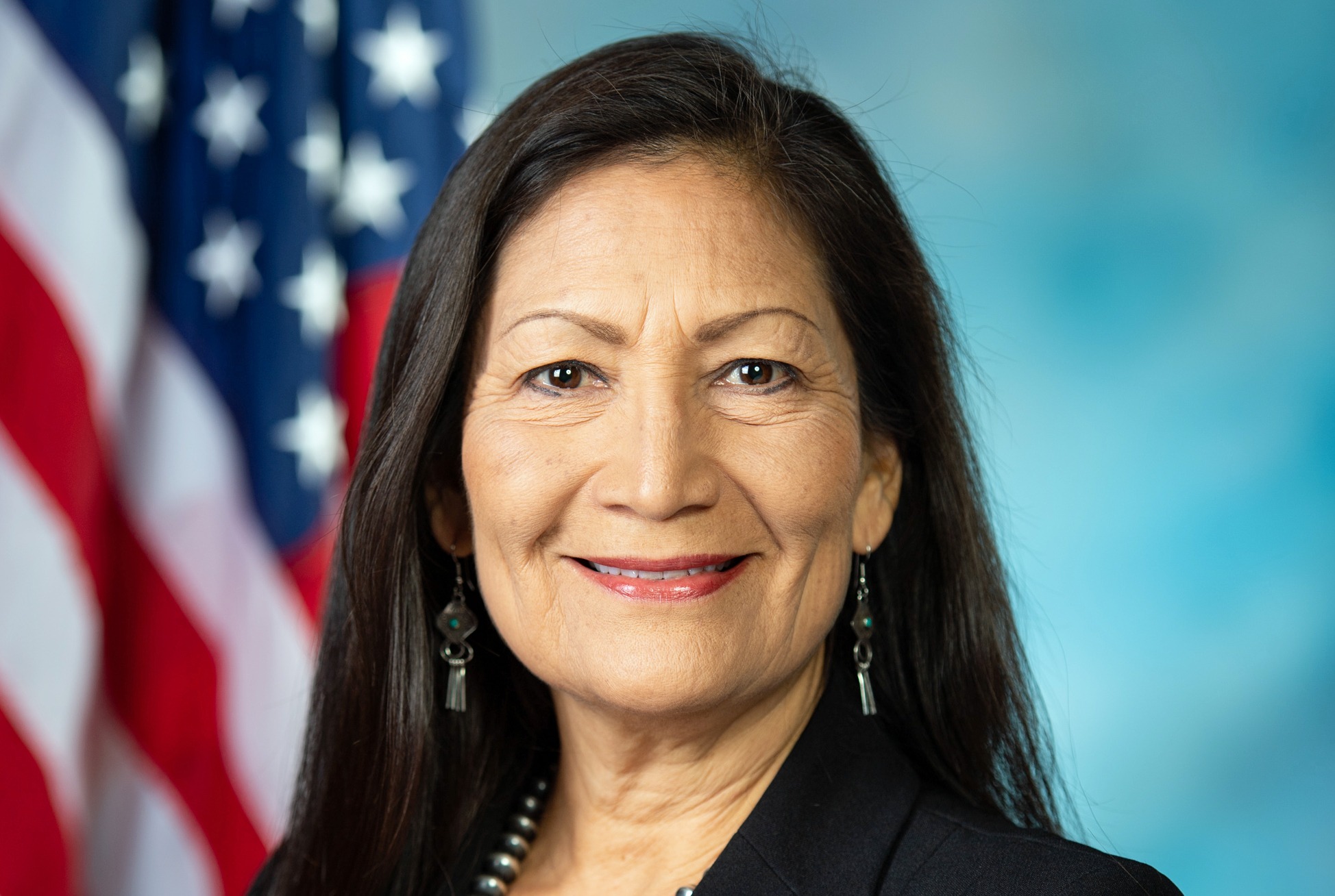
Democratic candidate Deb Haaland has won the New Mexico gubernatorial election, defeating Republican Greggory D. Hull to make history as the first Native American woman elected governor of a state in the United States.
Haaland’s victory in the November 3, 2026, election represents a landmark achievement for Native American communities, particularly Indigenous women who have historically faced significant barriers to political representation in the country.
According to the Associated Press, Haaland was declared the winner after election results showed her maintaining a comfortable lead over her Republican opponent. The latest figures published by the New Mexico Secretary of State’s office showed Haaland and her running mate, Stephanie Garcia Richard, receiving 412,834 votes, representing approximately 57.2 per cent of the total votes cast.
Republican Gregg Hull and his running mate, state Senator David Gallegos, received 308,315 votes, representing approximately 42.8 per cent.
The victory means Haaland will succeed outgoing Democratic Governor Michelle Lujan Grisham, who is unable to seek another term because of the state’s gubernatorial term limits.
Beyond the political implications of the election, Haaland’s achievement carries considerable historical and cultural significance. Her emergence as the first Native American woman elected governor demonstrates the progress made in expanding Indigenous participation in American political institutions.
A Historic Victory for Native American Representation
Haaland’s election is particularly significant because Native Americans have historically been underrepresented in the highest levels of American government.
For generations, Indigenous communities have struggled with political exclusion, discrimination, displacement and policies that undermined their cultural identities and traditional ways of life.
Against this background, Haaland’s victory represents more than a successful political campaign. It provides an opportunity for Indigenous people, especially young Native American girls, to see someone from their community occupying one of the most influential political offices in the country.
In her victory speech, Haaland acknowledged the importance of the moment, telling supporters that she was standing before them as the first Native American woman elected governor in US history.
Her achievement builds on a series of historic milestones throughout her political career.
In 2018, Haaland became one of the first two Native American women elected to the United States Congress, alongside Sharice Davids, a member of the Ho-Chunk Nation who won a congressional seat in Kansas.
The two women broke a significant political barrier by entering the House of Representatives at a time when Native American women remained severely underrepresented in federal elected office.
Haaland subsequently made history again in 2021 when President Joe Biden appointed her as secretary of the Interior, making her the first Native American to lead a US Cabinet department.
Her appointment was widely regarded as an important moment for Indigenous representation because the Interior Department oversees several issues directly affecting Native American communities, including federal relationships with tribal nations, public lands, natural resources and Indigenous affairs.
Her election as governor now adds another remarkable chapter to that political journey.
Haaland’s Background and Connection to Laguna Pueblo
Debra Anne Haaland, popularly known as Deb Haaland, is a member of Laguna Pueblo, one of the Indigenous communities in New Mexico.
Her connection to her Indigenous heritage has played an important role in shaping her political identity, public service and approach to issues affecting Native American communities.
During her victory celebration at the Route 66 Casino Hotel in Albuquerque, Haaland spoke emotionally about her childhood experiences and the historical struggles of her family.
She recalled carrying water from a community spigot and helping irrigate her grandfather’s cornfield, describing experiences that connected her to the land and traditions of her community.
She also reflected on the painful history of Indigenous children being taken away from their families and sent to government-supported boarding schools.
In a particularly emotional moment, she reminded supporters that her grandmother had been taken away to a boarding school located just off the road where the celebration was taking place.
Despite the painful history of forced assimilation and cultural suppression, Haaland emphasised the survival and resilience of Indigenous communities.
Her statement, “yet we are still here,” captured the significance of her election and the determination of Native American communities to preserve their identities, traditions and heritage.
For many Indigenous Americans, her victory represents recognition of a history that has frequently been overlooked in mainstream political discussions.

From Congress to the White House Cabinet
Before entering the gubernatorial race, Haaland had already established herself as an influential figure in American politics.
She previously represented New Mexico’s 1st Congressional District in the House of Representatives, where she served from 2019 until 2021.
During her time in Congress, she became known for her involvement in issues concerning Indigenous rights, environmental protection, economic opportunities and social welfare.
Her political experience attracted national attention, eventually leading to her appointment as secretary of the Interior under President Joe Biden.
As Interior secretary, Haaland occupied a position of considerable responsibility, overseeing an extensive federal department responsible for managing public lands, natural resources and relationships with federally recognised tribal nations.
One of the most important initiatives associated with her tenure was the Federal Indian Boarding School Initiative.
The initiative sought to investigate the historical impact of the federal Indian boarding school system, which separated Indigenous children from their families and sought to assimilate them into mainstream American society.
The boarding school system caused lasting damage to Indigenous families and communities, contributing to the loss of languages, cultural practices and family connections.
By supporting investigations into the system’s history and consequences, Haaland helped bring greater national attention to the experiences of Indigenous children and their descendants.
Her involvement in the initiative also reflected her personal connection to the issue, considering her family’s history with the boarding school system.
Her experience in the federal government is expected to provide her with valuable administrative and political knowledge as she prepares to lead New Mexico.
Campaign Focused on the Cost of Living and Public Welfare
Although Haaland’s historic identity attracted considerable attention throughout the campaign, her election victory was also built around economic and social issues affecting ordinary New Mexicans.
She campaigned on a platform that prioritised reducing living costs, expanding access to healthcare, improving child welfare services and creating greater economic opportunities for residents.
One of her major proposals was the introduction of a public health insurance option.
The proposal is intended to give residents another avenue for obtaining affordable healthcare coverage, particularly those who struggle with the cost of private insurance.
Healthcare affordability remains an important issue in American politics, with many households concerned about rising medical expenses, insurance premiums and access to essential services.
Haaland also promised to overhaul New Mexico’s child welfare agency, signalling her intention to address weaknesses in the state’s system for protecting vulnerable children and supporting families.
Her campaign also addressed the increasing cost of everyday necessities, including housing, food and other essential services.
Drawing on her personal experiences, she argued that hardworking residents should not have to struggle financially despite doing everything expected of them.
Haaland explained that her experience as a single working mother gave her a deeper understanding of the economic difficulties confronting many families.
She spoke openly about raising a child in poverty, working towards sobriety and facing difficult financial circumstances before entering national politics.
She also recalled registering voters on dirt roads and working through dust storms during her early political organising activities.
These experiences became an important part of her campaign message, allowing her to present herself as a candidate who understood the everyday challenges faced by ordinary people.
Addressing supporters after her projected victory, she said New Mexicans were working hard and doing everything expected of them but were still struggling to get ahead.
She maintained that every resident deserved an opportunity to prosper, regardless of their financial background, place of origin or personal challenges.
Opposition to Trump’s Policies and Social Welfare Cuts
Another important feature of Haaland’s campaign was her criticism of policies associated with President Donald Trump.
Having served in Congress during Trump’s first presidential administration, Haaland presented herself as someone familiar with challenging policies she believed could negatively affect vulnerable Americans.
During her victory speech, she declared that she had stood up to Trump before and was prepared to do so again.
She also expressed opposition to proposed reductions in Medicaid and the Supplemental Nutrition Assistance Program, commonly known as SNAP.
Medicaid provides healthcare coverage to eligible low-income individuals and families, while SNAP helps people with limited financial resources purchase food.
Both programmes are important components of America’s social safety net, particularly for vulnerable households, elderly people, children and individuals with disabilities.
Haaland’s pledge to defend these programmes reflects her campaign’s emphasis on protecting access to essential services.
She also suggested that projected Democratic gains in New Mexico and other parts of the country indicated dissatisfaction among voters with the Trump administration’s policies.
Her remarks positioned the election as part of a broader political conversation about healthcare, economic inequality and the future of social welfare programmes in the United States.
Data Centres and Environmental Concerns
Technology development and environmental concerns also featured prominently in Haaland’s campaign.
In September, she pledged to sign an executive order upon assuming office that would temporarily halt new large-scale data centre projects across New Mexico until lawmakers passed legislation establishing regulations for the industry.
Data centres are facilities that store and process enormous quantities of digital information. Their importance has increased significantly with the expansion of artificial intelligence, cloud computing and other digital technologies.
However, their development has generated concerns in several communities because of the substantial amounts of electricity and water required to operate them.
For a state such as New Mexico, where water resources and environmental sustainability are important public policy considerations, the rapid expansion of such facilities presents difficult questions for policymakers.
Haaland’s proposed pause reflects her intention to ensure that technological development takes place within an appropriate regulatory framework.
The proposal could become one of the early policy tests of her administration, particularly as state lawmakers consider how to balance economic development, employment opportunities, environmental protection and the needs of local communities.
A Campaign Against Republican Gregg Hull
Haaland secured the Democratic nomination after defeating Bernalillo County District Attorney Sam Bregman in the June 2026 primary.
She subsequently faced Republican Gregg Hull, a former three-term mayor of Rio Rancho, in the general election.
Hull contested the election alongside Republican state Senator David Gallegos, while Haaland’s running mate was Stephanie Garcia Richard, New Mexico’s commissioner of public lands.
The general election campaign was largely cordial, although disagreements emerged over a proposed televised debate.
Hull criticised Haaland after she withdrew from a debate organised by broadcaster KOB-TV.
Haaland explained that the proposed debate date conflicted with an earlier commitment to meet farmers in southern New Mexico.
Despite the disagreement, the election campaign remained focused largely on competing policy proposals and the future direction of the state.
Haaland also demonstrated considerable fundraising strength, significantly outraising Hull during the general election campaign.
Her campaign finance filings reportedly contained thousands of pages because of the large number of individual contributors. The volume of submissions was so substantial that it occasionally caused technical problems for the New Mexico secretary of state’s website.
The strong fundraising performance demonstrated the level of financial support her campaign attracted from donors.
Ultimately, her victory was secured with a margin of more than 100,000 votes based on the reported statewide results.
What Her Election Means for New Mexico
Haaland’s victory marks a new chapter in New Mexico’s political history.
As she prepares to take over from Michelle Lujan Grisham, she will inherit the responsibility of governing a state facing a range of economic, environmental and social challenges.
Her administration will be expected to address healthcare affordability, child welfare, economic development, infrastructure, public education and the management of natural resources.
She will also have to work with the state legislature to translate her campaign promises into practical policies.
Although her historic election has generated widespread attention, the real test of her leadership will be her ability to deliver meaningful improvements in the lives of New Mexicans.
Her proposed healthcare reforms, child welfare overhaul and plans for regulating large-scale data centre projects will be among the issues closely watched as her administration takes shape.
Her experience in Congress and the federal government could prove useful in navigating relationships with Washington, particularly on issues involving federal funding, Indigenous communities and public lands.
She has also expressed hope about working with other Democratic leaders following the election, including Gina Hinojosa, the projected winner of the Texas gubernatorial race.
A Symbol of Progress for Indigenous Women
For Native American women across the United States, Haaland’s victory represents a powerful demonstration of what is possible despite generations of political and social exclusion.
Her journey from a challenging upbringing to Congress, the presidential Cabinet and now the governorship of New Mexico illustrates the importance of political participation and representation.
Her election also carries a message for younger generations who may have previously viewed the highest levels of American political leadership as inaccessible.
By becoming the first Native American woman elected governor, Haaland has broken a significant historical barrier and created a new reference point for Indigenous representation in American politics.
Her victory is particularly meaningful in a country approaching the 250th anniversary of its independence, as it draws attention to the experiences and contributions of Indigenous communities whose histories predate the establishment of the United States.
However, the significance of her achievement extends beyond symbolism. It also creates an opportunity for greater attention to Indigenous rights, cultural preservation and the challenges facing tribal communities.
As Haaland prepares to assume office, expectations will be high. Supporters will want to see her translate the optimism surrounding her historic election into policies that improve living standards and expand opportunities across the state.
Ultimately, her victory is both a personal political triumph and a milestone in America’s continuing struggle to achieve broader representation in public leadership.
From her early experiences in Laguna Pueblo to serving as a member of Congress and becoming the first Native American Cabinet secretary, Haaland has built a political career defined by historic firsts.
Now, with her election as governor of New Mexico, she has achieved another groundbreaking milestone.
Her story sends a powerful message: despite a history of exclusion and discrimination, Indigenous communities remain an important part of America’s present and future, and their voices can reach the highest levels of political leadership.