

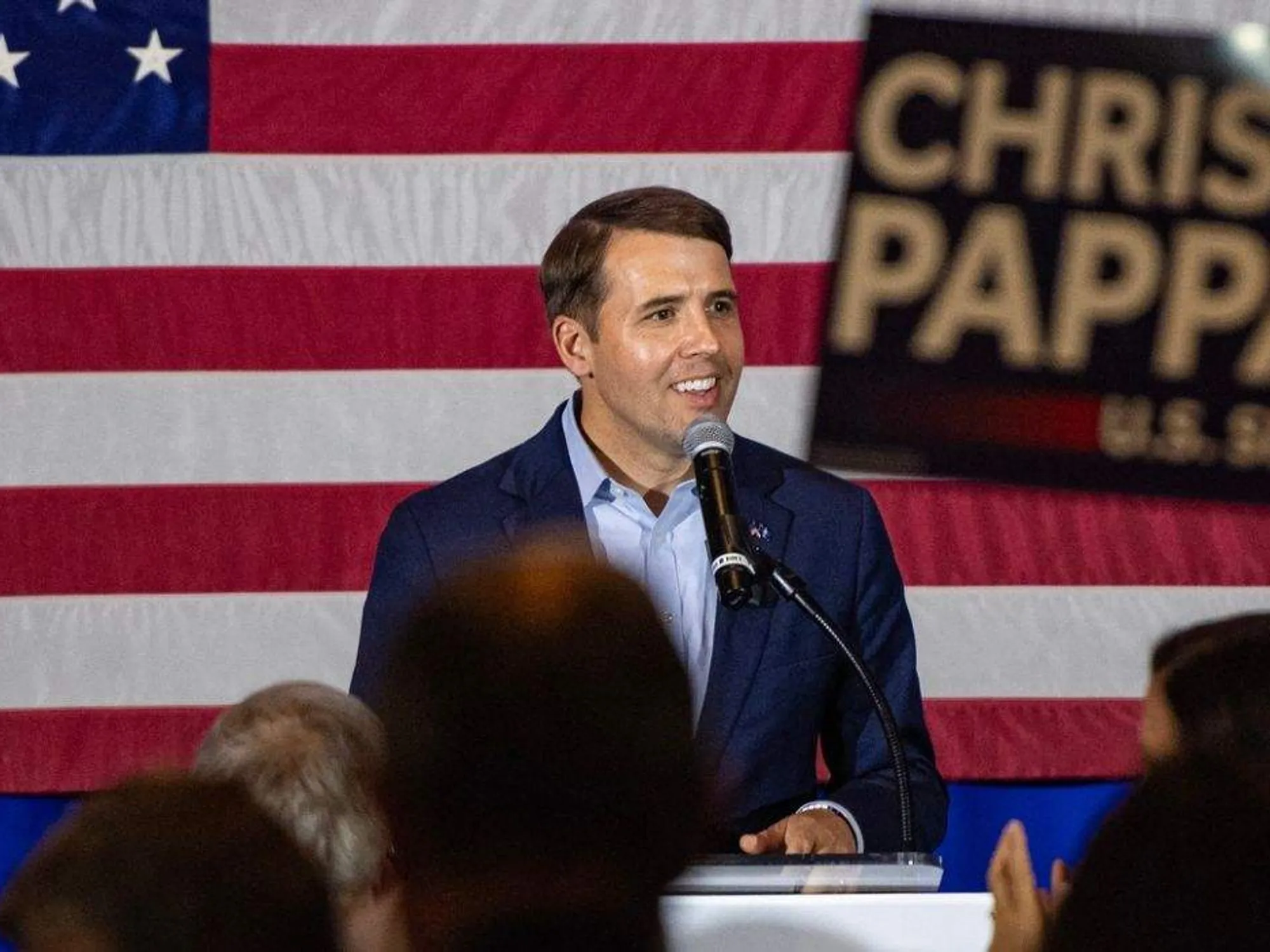
In a historic election result that has attracted attention across the United States and beyond, Democratic Congressman Chris Pappas has emerged victorious in the closely watched New Hampshire Senate race, breaking a long-standing barrier in American political representation.
Pappas defeated Republican challenger and former US Senator John E. Sununu to win the seat previously held by retiring Democratic Senator Jeanne Shaheen. His victory is particularly significant because it makes him the first openly gay man elected to serve in the upper chamber of the United States Congress.
The result marks an important milestone for LGBTQ+ visibility in American politics, demonstrating the growing presence of openly LGBTQ+ individuals in positions of national leadership. It also represents a political victory for Democrats, who successfully defended a seat that Republicans had identified as one of their major opportunities to gain ground in the 2026 midterm elections.
At 46, Pappas brings considerable political experience to the Senate, having represented New Hampshire’s First Congressional District in the US House of Representatives since 2018.
However, beyond the political implications of his victory, his election-night remarks about his husband and the importance of love and truth have become some of the most memorable moments of his historic campaign.
A Historic Victory for LGBTQ+ Representation
For decades, LGBTQ+ advocates have campaigned for greater representation in American political institutions, arguing that elected officials should reflect the diversity of the communities they serve. Pappas’s victory is therefore being viewed as a major achievement in that ongoing struggle.
It is important to distinguish his achievement from an earlier milestone in US political history. Pappas is the first openly gay man elected to the Senate, but he is not the first openly gay person to hold a Senate seat. That distinction belongs to Democratic Senator Tammy Baldwin of Wisconsin, who made history in 2012 as the first openly gay person elected to the chamber.
Baldwin’s election opened an important chapter in LGBTQ+ political representation. Pappas’s victory adds another significant milestone by breaking the barrier that had prevented an openly gay man from being elected to the US Senate.
His achievement also comes at a time when LGBTQ+ rights remain an important subject of national political debate. Issues surrounding equality, discrimination, marriage rights, transgender protections and access to healthcare continue to influence discussions in Washington and across individual states.
For LGBTQ+ advocacy organisations, having an openly gay man in the Senate provides another opportunity to ensure that the experiences and concerns of their communities are represented in national legislative discussions.
Pappas has previously demonstrated his commitment to equality through his public service. As New Hampshire’s first openly LGBTQ+ member of Congress, he has been associated with efforts to promote inclusion and defend the rights of marginalised communities.
His Husband Takes Centre Stage During Emotional Victory Speech
One of the most memorable moments of Pappas’s election-night celebration came when he publicly acknowledged his husband, Vann Bentley, while addressing supporters.
Speaking at his election watch party in Manchester, New Hampshire, the senator-elect expressed gratitude to his husband and described himself as fortunate to be married to someone he deeply loves.
He said:
“I want to thank the guy next to me, my amazing husband. I’m the luckiest guy because I’m married to a man that I love.
“And despite all the negative attacks and the lies, it’s nice to know that love and truth prevailed tonight.”
His remarks were met with enthusiastic cheers from supporters, making the moment particularly significant for LGBTQ+ representation and visibility.
The speech was more than a personal expression of gratitude. It also served as a public statement about acceptance, dignity and the freedom to live openly without being ashamed of one’s identity.
By acknowledging his husband in front of a national audience, Pappas demonstrated that his personal life was not something he needed to hide or separate from his public responsibilities.
His words also carried additional significance in the context of a political campaign that had involved intense competition, criticism and negative advertising.
For many supporters, seeing an openly gay politician celebrate a major electoral victory alongside his husband was a powerful reminder of how far LGBTQ+ representation in American politics has progressed.
The moment also reinforced the broader message that political leadership and public service should not be limited by a person’s sexual orientation.
Who Is Chris Pappas? A Look at His Political Journey
Born on June 4, 1980, in Manchester, New Hampshire, Christopher Charles Pappas is an American Democratic politician who built his career through local and state-level public service before becoming a prominent figure in national politics.
Pappas comes from a Greek-American family and grew up in Manchester, where he developed strong connections to the local community.
Before entering national politics, he was involved in his family’s restaurant business, the Puritan Backroom, a well-known establishment in Manchester with a long history dating back to 1917.
His experience in the family business helped shape his understanding of small businesses, employment and the economic pressures facing ordinary working families.
He attended Manchester Central High School before proceeding to Harvard University, where he graduated in 2002.
Pappas subsequently entered public service, beginning a political career that would take him through several important positions in New Hampshire.
He served in the New Hampshire House of Representatives from 2003 to 2007, where he gained experience in state legislation and public administration.
Between 2007 and 2011, he served as treasurer of Hillsborough County, gaining further experience in public finance and government responsibilities.
He later became a member of the New Hampshire Executive Council, serving from 2013 to 2019.
These positions provided him with an understanding of the political and economic concerns affecting residents of the state and helped establish his reputation as an experienced local politician.
In 2018, Pappas won election to the US House of Representatives, representing New Hampshire’s First Congressional District. He officially began serving in January 2019.
His election to Congress was historic in its own right because he became the first openly LGBTQ+ person elected to represent New Hampshire in the US Congress.
During his time in the House, he developed a reputation as a pragmatic Democrat who was willing to work across party lines on selected issues.
His political experience and familiarity with New Hampshire voters eventually positioned him as a strong contender for the state’s open Senate seat.
Pappas’s Campaign and the Battle Against John E. Sununu
Although Pappas entered the Senate contest with significant political experience, his victory was not guaranteed.
The race attracted considerable national attention because both Democrats and Republicans understood the importance of the New Hampshire seat in determining control of the US Senate.
Pappas faced Republican John E. Sununu, a former senator with considerable political experience and a family name that carries considerable recognition in New Hampshire.
Sununu previously represented New Hampshire in the US Senate from 2003 to 2009. He lost his re-election campaign to Jeanne Shaheen in 2008, and his return to the political stage presented Democrats with a serious challenge.
The Republican candidate also benefited from his family’s longstanding political connections in the state. His father, John H. Sununu, previously served as New Hampshire governor and White House chief of staff, while his brother, Chris Sununu, served as the state’s governor for eight years.
Republicans viewed the election as an opportunity to reclaim a Senate seat they had lost in 2008.
However, Pappas built his campaign around issues he believed were important to New Hampshire residents, particularly the economy, affordability, healthcare and government accountability.
He presented himself as an independent-minded Democrat who understood the concerns of ordinary people and would not simply follow the political establishment.
One of his major campaign strategies involved connecting Sununu to President Donald Trump’s administration.
Pappas argued that Sununu was too closely aligned with Trump and accused him of failing to adequately address the economic concerns of New Hampshire residents.
His campaign sought to frame the contest as a choice between representing the interests of New Hampshire communities and supporting the political direction coming from Washington.
Sununu, meanwhile, attempted to portray Pappas as an ineffective career politician and questioned his ability to deliver meaningful change.
The campaign was also characterised by substantial spending, negative advertisements and accusations from both sides.
Despite the intense political battle, Pappas ultimately emerged victorious, with Sununu conceding defeat shortly after polls closed.
According to the Associated Press, Pappas secured approximately 56.2 per cent of the vote, compared with Sununu’s 41.9 per cent, with independent candidate Edmond Laplante receiving about 1.9 per cent.
The result allowed Democrats to retain the seat while also contributing to their efforts to regain control of the Senate.
Human Rights Campaign and GLAAD Celebrate His Achievement
Pappas’s victory received enthusiastic reactions from major LGBTQ+ advocacy organisations, which described the outcome as an important breakthrough for equality and political representation.
The Human Rights Campaign (HRC), one of America’s leading LGBTQ+ civil rights organisations, had endorsed Pappas during his campaign and welcomed his historic election.
The organisation described him as a dedicated pro-equality champion and praised his commitment to defending the rights of LGBTQ+ Americans.
In its congratulatory message, HRC said:
“We’re ready to keep fighting for the rights of every Granite Stater alongside him.”
The expression Granite Stater refers to residents of New Hampshire, whose official nickname is the Granite State.
HRC’s support for Pappas reflects its wider efforts to promote political representation for LGBTQ+ individuals and elect public officials who support equal rights and protection against discrimination.
Another prominent organisation, GLAAD, also congratulated the newly elected senator, describing his victory as a historic achievement.
GLAAD, which works to promote fair representation of LGBTQ+ people in the media and society, highlighted Pappas’s election as part of a broader wave of political victories for LGBTQ+ candidates during the 2026 midterm elections.
The organisation noted that the election had created opportunities for greater LGBTQ+ representation across different levels of American government.
For these organisations, Pappas’s victory represents more than the success of an individual politician. It demonstrates the increasing visibility of LGBTQ+ candidates and their ability to compete successfully for some of the most influential political positions in the country.
What His Election Means for New Hampshire and the Democratic Party
Beyond its historic significance for LGBTQ+ representation, Pappas’s victory carries considerable political importance for New Hampshire and the Democratic Party.
His election ensures that Democrats retain control of a Senate seat that had been held by Jeanne Shaheen for approximately 18 years.
Shaheen, a prominent Democratic politician, announced that she would not seek another term, creating an open contest that attracted attention from both major political parties.
Her retirement presented Republicans with an opportunity to reclaim the seat, particularly because the Sununu family has a strong political presence in New Hampshire.
However, Pappas successfully defended the Democratic position, demonstrating the importance of his political experience and connections with voters across the state.
His victory also comes at a critical period in American politics, as both parties continue to compete over the direction of the country, national economic policies and the balance of power in Congress.
For Democrats, retaining the New Hampshire seat represents an important achievement in their efforts to strengthen their influence in Washington.
Pappas will now have the opportunity to participate in major legislative discussions affecting millions of Americans, including decisions concerning healthcare, taxation, immigration, employment, national security and civil rights.
He is expected to bring his experience as a member of the House of Representatives to the Senate, where he will have a broader platform to influence national policy.
His election will also provide an additional voice for LGBTQ+ representation in a chamber that has historically had limited diversity in terms of sexual orientation.
A New Chapter for LGBTQ+ Political Representation
Pappas’s historic achievement is likely to remain an important moment in the continuing evolution of LGBTQ+ representation in American politics.
For many years, openly LGBTQ+ individuals faced considerable barriers when seeking elected office. Social prejudice, discrimination and political opposition often made it difficult for candidates to openly discuss their identities while campaigning for public positions.
However, the increasing number of LGBTQ+ politicians entering local, state and national government demonstrates how political representation has gradually expanded.
Tammy Baldwin’s election to the Senate in 2012 was an important breakthrough, while Pappas’s victory introduces another historic first by making him the first openly gay man elected to the chamber.
His achievement may also encourage younger LGBTQ+ Americans who aspire to participate in politics, public administration and other areas of national leadership.
It sends a message that individuals should not have to conceal important aspects of their personal identities to pursue careers in public service.
Nevertheless, his election does not mean that the struggle for LGBTQ+ equality is over. Advocacy organisations continue to raise concerns about discrimination, unequal treatment and the protection of LGBTQ+ rights across different parts of the United States.
As a senator, Pappas will face the responsibility of representing all his constituents, regardless of their political affiliations, backgrounds or personal identities.
His ability to translate his campaign promises into meaningful legislative action will ultimately help determine the impact of his time in office.
Pappas Set to Begin His Senate Journey in January 2027
Following his November 3 victory, Pappas is expected to assume his new responsibilities in January 2027, when the new Senate term begins.
His departure from the House of Representatives will also create an opening in New Hampshire’s First Congressional District.
Democrat Stefany Shaheen, the daughter of retiring Senator Jeanne Shaheen, won the corresponding House race, meaning the state’s congressional representation will also undergo a significant transition.
For Pappas, the transition from the House to the Senate represents the next stage of a political career that began in local government and gradually developed into national leadership.
He will enter the Senate with expectations from Democratic supporters, LGBTQ+ advocacy organisations and voters who believe his victory represents an important step towards greater political inclusion.
However, his responsibilities will extend beyond the historic circumstances of his election. He will be expected to contribute to national policymaking, defend the interests of New Hampshire residents and work towards addressing the economic and social challenges facing the country.
His ability to build relationships with fellow senators, negotiate legislation and deliver results will be important in determining how effectively he serves his new constituency.
Conclusion
Chris Pappas’s victory in New Hampshire’s November 2026 Senate election represents a remarkable milestone in American politics.
By defeating Republican John E. Sununu, he has become the first openly gay man elected to the United States Senate, breaking a significant barrier in the country’s political history.
His achievement is particularly meaningful because it combines a major electoral victory with a broader message about acceptance, representation and equal opportunities in public life.
His emotional acknowledgement of his husband, Vann Bentley, during his victory speech further highlighted the personal significance of the moment and the importance of being able to live openly without fear of discrimination.
While his election does not automatically resolve the challenges facing LGBTQ+ Americans, it represents another important step towards a more inclusive political system.
For the Democratic Party, the result is a strategic victory that preserves an important Senate seat. For LGBTQ+ advocates, it is an opportunity to strengthen representation at the highest levels of government.
And for Chris Pappas himself, the victory marks the beginning of a new chapter in public service, one that will place him among the influential lawmakers responsible for shaping America’s political and legislative future.
Ultimately, his historic election sends a powerful message: political leadership should be determined by a candidate’s ability to serve the people, their experience, integrity and commitment to public service, rather than their sexual orientation.
Chris Pappas has made history, and his journey into the United States Senate will be closely watched by political observers and equality advocates around the world.