

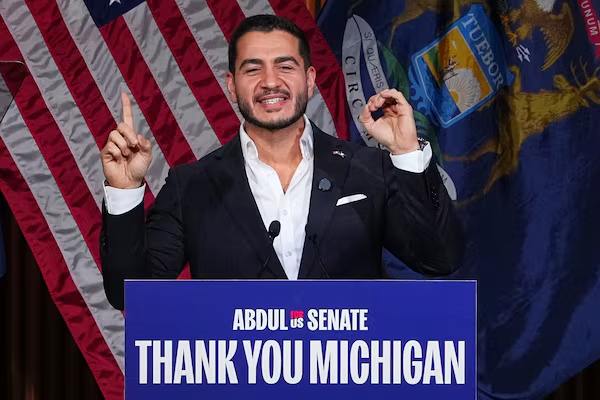
Democratic candidate Abdul El-Sayed has made American political history after defeating Republican challenger Mike Rogers in Michigan’s closely watched United States Senate election, becoming the first Muslim American ever elected to the US Senate.
The Associated Press projected El-Sayed as the winner of the high-stakes contest on Wednesday, November 4, 2026, following Tuesday’s midterm elections. His victory represents a major political milestone for Muslim Americans, who have historically had limited representation in the highest levels of the United States government.
Beyond its historic significance, El-Sayed’s victory is also being viewed as an important breakthrough for the progressive wing of the Democratic Party. His successful campaign demonstrated that a candidate with strong left-leaning political positions can secure electoral support in a competitive state that voted for President Donald Trump in the 2024 presidential election.
The 42-year-old former public health official defeated Rogers, a former Republican congressman and FBI agent, after a fiercely contested campaign dominated by debates about healthcare, economic affordability, immigration, foreign policy, religious identity and the future direction of American politics.
His victory also prevented Republicans from capturing a Senate seat that had been held by Democrats for years following the retirement announcement of incumbent Senator Gary Peters.
According to election projections, the outcome represents a significant setback for Republicans, who had invested considerable political resources in winning the Michigan seat.
Who Is Abdul El-Sayed?
Abdul El-Sayed is a Democratic politician, public health expert and former public health official whose political career has been shaped by his interest in healthcare reform, economic inequality and improving opportunities for ordinary Americans.
The son of Egyptian immigrants, El-Sayed emerged as one of the prominent progressive voices in Michigan politics through his work in public health and his commitment to policies aimed at addressing social and economic inequalities.
Before entering the Senate race, he served as Detroit’s health director, a position that provided him with experience in managing public health challenges and understanding the difficulties facing communities with limited access to quality healthcare.
His background in public health became one of the defining elements of his political identity. Rather than presenting himself as a conventional Washington politician, he positioned himself as someone whose professional experience had exposed him to the everyday struggles of ordinary people.
That experience also influenced his campaign’s emphasis on universal healthcare, affordable medical services and policies designed to reduce the financial pressure on working families.
El-Sayed had previously contested Michigan’s Democratic gubernatorial primary eight years ago but suffered a significant defeat. His eventual emergence as the winner of the state’s Senate election represents a remarkable political turnaround.
From an unsuccessful gubernatorial campaign to becoming the first Muslim American elected to the US Senate, his political journey highlights how candidates can rebuild their political influence and eventually achieve major electoral breakthroughs.
A Historic Victory for Muslim Representation in American Politics
One of the most important aspects of El-Sayed’s victory is its significance for Muslim Americans and minority representation in the United States.
For decades, Muslim communities have participated in American political, economic and social life, but their representation in the country’s highest legislative institutions has remained relatively limited.
El-Sayed’s election changes that historical narrative by creating a new milestone in the composition of the US Senate.
His achievement is particularly significant because the Senate is one of the most influential political institutions in the United States. Its members participate in shaping national legislation, approving presidential appointments, overseeing government activities and making decisions that affect millions of Americans.
As the first Muslim American elected to the chamber, El-Sayed’s victory represents an important moment for communities that have long sought greater political inclusion.
It also demonstrates that religious identity does not necessarily prevent a candidate from building a broad electoral coalition in a diverse and politically competitive state.
Throughout the campaign, El-Sayed faced attacks and questions concerning his Muslim faith and background. Nevertheless, he maintained that his campaign should be judged by its policy proposals, professional experience and commitment to representing Michigan residents.
In his victory speech, he criticised the personal attacks directed at him during the election campaign, arguing that his name and religious identity were not responsible for the economic difficulties facing American families.
His message was an attempt to redirect attention towards issues such as rising living costs, healthcare affordability and the financial pressures affecting ordinary households.
The outcome could also encourage greater participation among Muslim Americans and other minority communities who see political representation as an important part of their place in American democracy.
Progressive Policies at the Centre of His Campaign
El-Sayed’s campaign was built around an ambitious progressive political agenda that sought to address economic inequality, healthcare challenges and the influence of wealthy interests in American politics.
One of his most prominent campaign promises was Medicare for All, a proposal aimed at establishing a universal, government-funded healthcare system.
The policy, which has long been championed by progressive Democrats, seeks to expand healthcare access by moving away from the existing combination of private and public insurance arrangements towards a single-payer system.
El-Sayed argued that healthcare should be treated as an essential service rather than a privilege determined by an individual’s income or employment status.
His public health background helped him present the proposal as more than a political talking point. He used his professional experience to explain why access to medical care should be central to discussions about economic security and social development.
Another major component of his platform involved increasing taxes on billionaires and wealthy individuals.
He argued that the country’s economic system should ensure that those with the greatest financial resources contribute a fairer share towards public services and national development.
His proposals also included measures to reduce corporate influence in politics, particularly the role of wealthy donors and outside organisations in financing political campaigns.
The issue became especially important during the Democratic primary, when outside groups spent substantial sums opposing his candidacy.
El-Sayed’s campaign presented itself as a grassroots movement capable of challenging powerful political and financial interests.
He also advocated debt relief and policies intended to reduce the financial pressure on working families.
Taken together, these proposals formed the foundation of his argument that America’s economic challenges required more fundamental changes than conventional tax reductions and limited government intervention.
His victory is likely to strengthen the confidence of progressive Democrats who believe that ambitious economic and social policies can attract voters beyond traditionally liberal constituencies.

The Battle Against Mike Rogers
El-Sayed’s Republican opponent, Mike Rogers, entered the election with considerable political experience and strong support from national Republican figures.
Rogers is a former congressman and former FBI agent who previously chaired the House Intelligence Committee. His professional background in national security and law enforcement formed an important part of his political appeal.
He also contested Michigan’s 2024 Senate election but narrowly lost to Democratic candidate Elissa Slotkin.
Determined to secure another opportunity, Rogers returned to the political battlefield in 2026, seeking to win the seat being vacated by Senator Gary Peters.
Republicans viewed Michigan as an important opportunity to strengthen their position in the Senate, particularly because the state is known for its competitive political environment.
Rogers attempted to portray El-Sayed as too politically extreme for Michigan voters.
He questioned whether the progressive candidate’s policy positions reflected the priorities of moderate Democrats, independent voters and other groups whose support would be essential to winning a statewide election.
His campaign also sought to raise concerns about El-Sayed’s positions on Israel and his associations with controversial political commentators.
El-Sayed, however, responded by presenting Rogers as a Washington political insider whose positions were closely aligned with President Trump and the Republican establishment.
He argued that Michigan needed a senator focused on the economic challenges facing residents rather than a politician defending the interests of powerful political figures.
The contest consequently became a broader debate about the kind of political leadership Michigan voters wanted to send to Washington.
Haley Stevens’ Unexpected Endorsement of Rogers
One of the most controversial developments in the election occurred during the final days of the campaign, when Democratic Representative Haley Stevens unexpectedly endorsed Republican Mike Rogers.
Stevens had previously contested the Democratic Senate primary against El-Sayed but narrowly lost in August.
Her decision to support Rogers rather than the Democratic nominee generated considerable anger within sections of the Democratic Party.
The endorsement was particularly surprising because political parties generally expect their members to support the candidate who emerges from their primary election process.
Stevens’ decision created additional divisions within an already competitive Democratic coalition.
Several members of her political team reportedly resigned following the endorsement, including her chief of staff.
The development also raised questions about party unity and the difficulties Democratic leaders faced in bringing together supporters of different political positions.
El-Sayed had already navigated a divisive primary campaign against Stevens, during which outside political spending played a significant role.
According to the Associated Press, the primary attracted nearly $60 million in outside spending, with the American Israel Public Affairs Committee (AIPAC) spending nearly $30 million opposing El-Sayed.
His criticism of Israel was a major source of disagreement during the primary, particularly among some voters within Michigan’s Jewish community.
Stevens’ eventual endorsement of Rogers further exposed the divisions within the Democratic Party, creating a challenging situation for El-Sayed as he attempted to unite different voting groups ahead of the general election.
Despite these difficulties, he managed to secure victory, demonstrating the strength of the coalition that ultimately supported his candidacy.
Trump’s Attacks and Controversy Over El-Sayed’s Muslim Faith
President Donald Trump also became involved in the controversy surrounding the Michigan Senate election.
During the final weeks of the campaign, Trump and other Republicans repeatedly attempted to associate El-Sayed with extremist organisations and questioned his loyalty to the United States.
These allegations became a significant talking point in the election, particularly because they focused on the candidate’s Muslim identity and political associations.
El-Sayed firmly rejected the allegations, while Democrats criticised the attacks as Islamophobic and politically motivated.
According to reporting by the Associated Press and Reuters, there was no supporting evidence for the alleged terrorist connections raised against him.
The controversy highlighted the challenges facing Muslim political candidates in an environment where religious identity can become a subject of political campaigning.
Rather than allowing the attacks to dominate his campaign entirely, El-Sayed continued to emphasise his economic and healthcare proposals.
His victory speech also addressed the personal nature of the campaign, criticising opponents for focusing on his name and faith instead of the economic concerns affecting Michigan residents.
The outcome suggests that the attacks did not prevent him from building sufficient electoral support to win the race.
It also raises broader questions about the role of religious identity, discrimination and political rhetoric in contemporary American elections.
Economic Affordability: The Major Issue Dividing Both Candidates
Although the candidates held sharply different ideological positions, economic affordability remained one of the most important issues throughout the campaign.
American voters have faced continuing concerns about the cost of living, healthcare expenses, housing, energy prices and the financial pressures affecting working families.
Both candidates recognised that economic issues would play a major role in determining the outcome of the election.
However, their proposed solutions were significantly different.
El-Sayed argued that government intervention and stronger public programmes were necessary to address the country’s economic inequalities.
His proposals included universal healthcare, debt relief, higher taxes on billionaires and measures to reduce corporate influence in government.
He presented these policies as ways of creating a fairer economic system in which ordinary workers would have greater access to essential services and financial opportunities.
Rogers, on the other hand, promoted a more conservative economic approach.
His campaign emphasised tax cuts, domestic manufacturing, border security and greater transparency in healthcare pricing.
He argued that reducing financial pressure on businesses and encouraging American manufacturing would help strengthen the economy and create more opportunities for workers.
The candidates therefore offered Michigan voters two contrasting approaches to solving many of the same economic problems.
Ultimately, El-Sayed’s progressive message proved successful in the statewide contest.
His victory also came against the backdrop of concerns about inflation, the economic consequences of Trump’s tariffs and rising fuel prices linked to the war in Iran.
These issues created additional difficulties for Rogers, who had to maintain his political alignment with Trump while addressing voter dissatisfaction over the administration’s economic policies.
What El-Sayed’s Victory Means for the Democratic Party
El-Sayed’s victory carries implications that extend far beyond Michigan.
For the Democratic Party, it represents an important opportunity for its progressive wing to demonstrate that candidates advocating ambitious reforms can compete successfully in politically divided states.
For years, moderate and progressive Democrats have disagreed over the best strategy for winning national elections.
Moderates have often argued that candidates must adopt more centrist positions to attract independent and conservative-leaning voters.
Progressives, meanwhile, have maintained that bold policies addressing healthcare, wealth inequality and corporate influence can mobilise younger voters and working-class communities.
El-Sayed’s victory provides progressives with a significant example to support their argument.
His campaign demonstrated that a candidate can maintain strong progressive positions while appealing to voters in a state that remains highly competitive between Republicans and Democrats.
His success could also influence discussions about the Democratic Party’s strategy ahead of the 2028 presidential election.
Progressive political figures, including Senator Bernie Sanders and Representative Alexandria Ocasio-Cortez, supported his campaign.
Their involvement demonstrated the national importance attached to the Michigan contest.
The Associated Press also reported that Democrats achieved significant victories in other parts of the country during the midterm elections, strengthening the party’s position in Congress.
El-Sayed’s victory therefore forms part of a broader political development that could reshape the balance of power in Washington.
What Happens Next?
Following his projected victory, El-Sayed is expected to take over the Michigan Senate seat after Senator Gary Peters’ term ends.
His election victory does not mean he immediately assumes office. Under the normal congressional timetable, newly elected senators begin their terms on January 3 following the election.
Once sworn in, he will become part of the United States Senate, where he will face the difficult task of translating his campaign promises into legislative action.
Passing major reforms such as Medicare for All will require substantial political support, negotiations and the ability to build coalitions within Congress.
His position on corporate influence, wealth taxation and economic inequality will also face scrutiny from political opponents and interest groups that disagree with his proposals.
Furthermore, his views on foreign policy, particularly concerning American support for Israel, are likely to remain important subjects of national debate.
Michigan residents will also expect him to address practical issues affecting their communities, including employment, healthcare access, manufacturing, infrastructure and the cost of living.
His success at the ballot box has given him an opportunity to influence national politics, but the real test of his leadership will be how effectively he represents his constituents and delivers on his commitments.
Conclusion
Abdul El-Sayed’s victory over Mike Rogers represents a defining moment in American political history.
By becoming the first Muslim American elected to the United States Senate, he has achieved a milestone that carries significance beyond party politics and electoral competition.
His success also demonstrates the growing importance of diverse political representation and the ability of candidates with unconventional backgrounds to compete at the highest levels of American government.
From his experience in public health to his unsuccessful gubernatorial campaign and eventual Senate victory, El-Sayed’s political journey has been marked by determination, controversy and an ambitious vision for economic and social reform.
His campaign faced substantial financial opposition, divisions within his own political party, attacks over his Muslim faith and fierce criticism from Republican opponents.
Nevertheless, he emerged victorious in one of the country’s most closely watched Senate contests.
For the Democratic Party, his victory offers renewed confidence in progressive politics. For Muslim Americans, it represents a historic breakthrough in national political representation. And for Michigan, it marks the beginning of a new chapter in its representation in Washington.
As the United States prepares for the next phase of its political journey, El-Sayed’s election will likely remain an important reference point in discussions about religious diversity, political inclusion, healthcare reform and the future of progressive leadership.
His historic achievement has opened a new door in American politics. The challenge ahead will be turning the expectations generated by his victory into meaningful results for the people he has been elected to represent.