

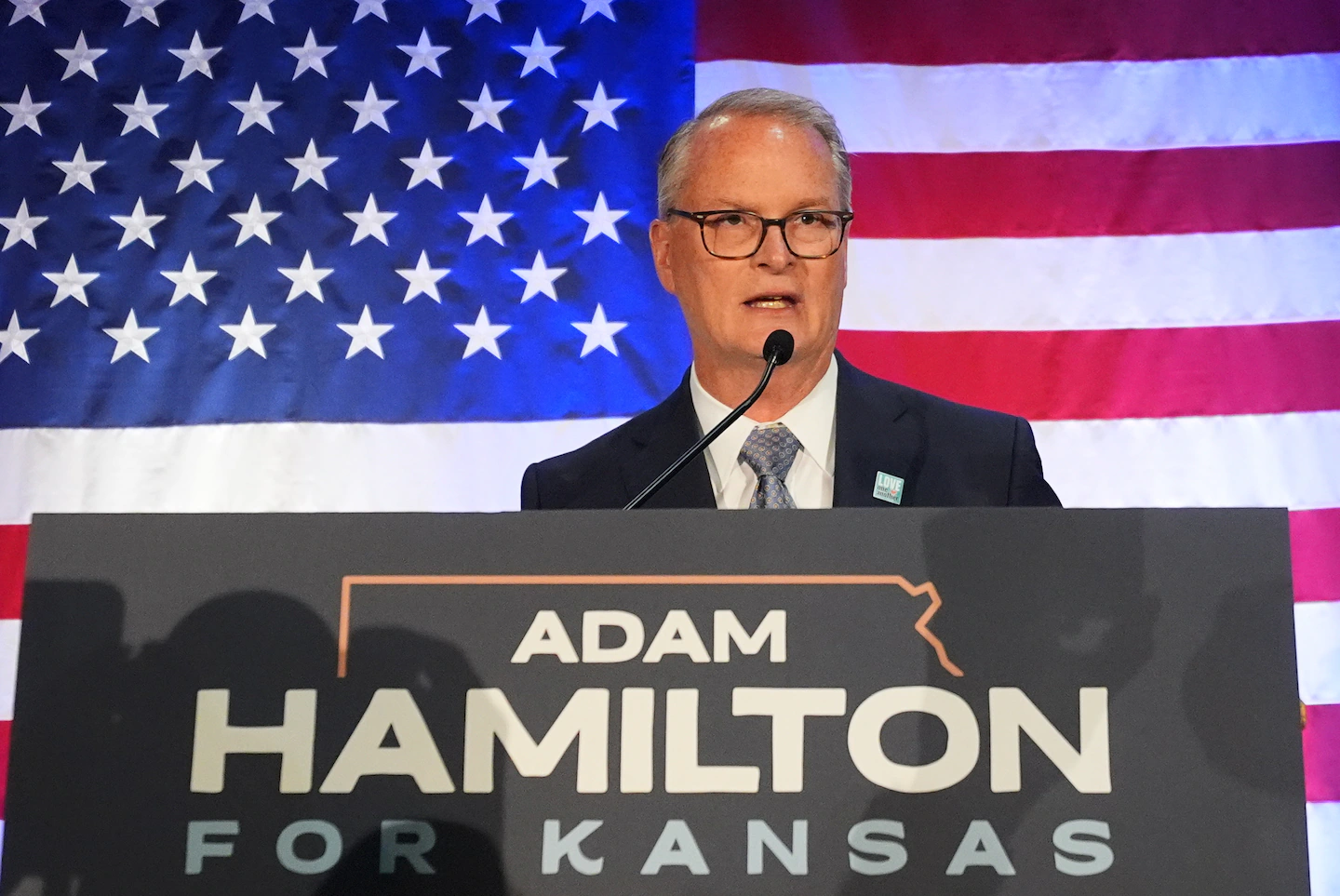
In a historic political upset, Democratic candidate Adam Hamilton has defeated Republican incumbent Senator Roger Marshall in Kansas, becoming the first Democrat elected to represent the state in the United States Senate since 1932. His victory ends a 94-year Democratic drought in Kansas Senate elections and represents one of the most remarkable political developments of the 2026 US midterm elections.
The result is particularly significant because Kansas has long been regarded as a stronghold of the Republican Party. Despite growing political competition in some parts of the country, the state has consistently supported Republican presidential candidates in recent elections. President Donald Trump carried Kansas by double-digit margins in the 2016, 2020 and 2024 presidential elections, reinforcing its reputation as a reliably conservative state.
However, Hamilton’s victory demonstrates that political loyalties are not necessarily permanent and that candidates who can connect with voters beyond traditional party divisions may have a realistic opportunity to challenge established political power.
Hamilton, a prominent Methodist pastor who leads one of the largest United Methodist congregations in the United States, built his campaign around moderation, fairness, listening to opposing viewpoints and putting the interests of Kansas residents ahead of national political arguments. His approach helped him attract support from Democrats, independent voters and several influential Republicans, making his campaign particularly unusual in a deeply Republican state.
A Historic Victory After Nearly a Century of Republican Dominance
Hamilton’s election victory marks the end of an extraordinary period of Republican dominance in Kansas Senate politics. Since 1932, no Democrat had successfully won a US Senate election in the state, making Kansas one of the most difficult political environments for Democratic Senate candidates.
For decades, Republican candidates have enjoyed a significant electoral advantage in the state. Conservative values, strong Republican political networks and consistent support for GOP presidential candidates have contributed to the party’s longstanding influence.
Before the 2026 election, Republican Senator Roger Marshall appeared well-positioned to retain his seat. Marshall first won election to the Senate in 2020, defeating Democratic challenger Barbara Bollier by more than 11 percentage points. His victory reinforced the assumption that Kansas would remain safely Republican in federal elections.
Hamilton’s emergence as a serious challenger changed that political calculation.
His campaign gradually gained momentum, attracting national attention and significant financial support. Although many political observers initially viewed the race as difficult for Democrats, the contest developed into one of the most closely watched Senate elections in the country.
According to reporting by the Associated Press, Hamilton defeated Marshall in the November 3 election, delivering a major victory for Democrats and ending the state’s 94-year Senate losing streak.
The outcome also highlights the importance of local political dynamics. While Kansas voters have repeatedly supported Republican presidential candidates, they have demonstrated a willingness to elect moderate Democratic leaders at the state level.
Democratic Governor Laura Kelly, for example, won election and subsequently secured re-election, showing that voters in Kansas can distinguish between national party politics and the leadership qualities of individual candidates.
Who Is Adam Hamilton?
Adam Hamilton is not a conventional political candidate. Before entering the Senate race, he was widely recognised for his religious leadership and work as a pastor.
He is the founding pastor of Church of the Resurrection, a prominent United Methodist congregation based in the Kansas City metropolitan area. The church has grown significantly under his leadership and operates multiple campuses, making it one of the largest United Methodist congregations in the country.
Hamilton’s background gave him a distinctive advantage during the campaign. His years of pastoral work exposed him to people from different economic, social, religious and political backgrounds. This experience became an important part of his political message.
Rather than presenting himself as a politician interested in promoting one political ideology, Hamilton positioned himself as a leader willing to listen to people with different opinions and work towards practical solutions.
His campaign repeatedly emphasised the importance of bringing people together at a time when American politics has become increasingly polarised.
Hamilton also demonstrated a willingness to distance himself from some positions associated with the national Democratic establishment. He criticised national Democrats, supported calls for congressional term limits and presented himself as an independent-minded Democrat rather than a candidate who would automatically follow party instructions.
This positioning helped him appeal to moderate Republicans and independent voters who were dissatisfied with the increasingly confrontational nature of American politics.
The Independent-Minded Democrat Strategy
One of the most interesting aspects of Hamilton’s campaign was his decision to run as a Democrat despite initially considering an independent candidacy.
Given Kansas’s long history of Republican dominance, Hamilton understood that winning as a traditional Democratic candidate could be difficult. An independent campaign might have allowed him to appeal more directly to voters who were uncomfortable with both major political parties.
However, the possibility of running independently created another problem.
Some supporters feared that an independent candidacy would divide voters who wanted to remove Marshall from office. If Hamilton ran outside the Democratic Party while another Democrat remained on the ballot, the division could potentially give the Republican incumbent an advantage.
After considering the political implications and conducting a statewide listening tour, Hamilton ultimately entered the race as what he described as an “independent-minded Democrat.”
This decision allowed him to benefit from the organisational and financial support of the Democratic Party while maintaining a political identity that appealed to voters beyond its traditional base.
His approach was particularly effective in a state where many residents identify with conservative values but are not necessarily satisfied with every Republican candidate or policy.
Hamilton’s message was straightforward: voters should not be expected to agree with every position taken by a political party, and elected representatives should be accountable to the people they serve rather than simply to party leadership.
Winning Support Beyond Traditional Democratic Voters
Hamilton’s victory was not based solely on Democratic support. His ability to attract voters across party lines became one of the defining features of his campaign.
Several prominent Kansas Republicans endorsed him, including a former governor. Such endorsements were significant because they challenged the traditional assumption that Republican voters would automatically support the Republican candidate.
His campaign also benefited from the support of moderate voters who were looking for a candidate they believed could provide a more balanced approach to governance.
One voter, Andi Welch of Johnson County, explained why she supported Hamilton despite not always voting for Democratic candidates.
“I think he’s going to be fair,” she said. “I think he’s running as a Democrat for the reasons he states, and I think he really is going to be looking out for Kansas citizens.”
Her comments reflected a broader argument at the centre of Hamilton’s campaign: political affiliation should not be the only consideration when voters choose their representatives.
For many voters, issues such as healthcare, economic stability, public accountability and the quality of political leadership were more important than strict loyalty to a political party.
Hamilton’s religious background may also have helped him connect with sections of the electorate that traditionally lean Republican. His experience as a pastor provided him with an established public profile and a reputation that extended beyond conventional political circles.
The Most Expensive Senate Election in Kansas History
Hamilton’s victory did not come without an extraordinary financial investment. The contest became the most expensive Senate election in Kansas history, with campaign spending estimated at approximately $110 million.
Hamilton broke several fundraising records, receiving substantial financial contributions from supporters and Democratic organisations. His fundraising performance demonstrated the level of national interest in the race and the determination of Democrats to challenge Republican dominance in Kansas.
His financial advantage also allowed his campaign to communicate its message to a wider audience through television advertisements, political events, digital campaigns and grassroots mobilisation.
Republicans, meanwhile, recognised the growing threat posed by Hamilton and increased their investment in Marshall’s campaign. National Republican leaders redirected resources towards Kansas, while President Donald Trump and Vice President JD Vance made campaign appearances in the state to encourage voters to support the incumbent senator.
Trump reportedly visited Kansas twice during the campaign, as did Vance. Their involvement demonstrated how seriously the Republican Party viewed the possibility of losing a Senate seat that had previously been considered relatively safe.
Nevertheless, the national Republican campaign effort was unable to reverse Hamilton’s growing momentum.
His fundraising success, combined with support from local voters and prominent political figures, helped transform what initially appeared to be a difficult Democratic challenge into a historic electoral victory.
Medical Debt Controversy Puts Roger Marshall Under Pressure
While Hamilton’s campaign focused on moderation and bringing people together, Marshall’s campaign faced increasing scrutiny over his professional history.
Before entering politics, Marshall worked as an obstetrician-gynaecologist and built a medical career spanning several decades. He was elected to the US House of Representatives in 2016 before winning a Senate seat in 2020.
However, his previous medical practice became a major issue during the 2026 election campaign.
A report published by The New York Times revealed that Marshall and his medical practice had sued more than 700 former patients over unpaid medical bills. The report also stated that 81 patients had been arrested for missing court dates connected to the debt cases.
The revelations generated significant public debate about the responsibilities of medical professionals, the treatment of patients experiencing financial difficulties and the use of legal proceedings to recover unpaid healthcare bills.
Hamilton’s campaign quickly seized on the report, arguing that Marshall’s actions raised questions about his commitment to ordinary Kansans struggling with the cost of living.
One of Hamilton’s campaign advertisements featured a former patient who had been involved in the debt-collection controversy. Five days before Election Day, the former patient filed a lawsuit against Marshall, alleging that he had charged a predatory interest rate.
The allegations became another source of pressure on the Republican senator at a time when voters were already concerned about healthcare affordability and the rising cost of essential services.
Marshall defended his professional record, arguing that he had provided care to thousands of patients and that collecting outstanding medical bills was necessary to keep his medical practice operating.
He also rejected the criticism directed at him, describing the reporting as a misrepresentation of his medical career.
Nevertheless, the controversy remained an important feature of the election, with voters being forced to consider questions about the relationship between healthcare, financial responsibility and public service.
The issue also presented Hamilton with an opportunity to connect his campaign message to the everyday experiences of Kansas residents.
Controversy Surrounding Church Camp Allegations
Hamilton’s religious leadership also became a subject of political controversy during the election campaign.
Marshall’s campaign released an advertisement accusing Hamilton of protecting a church camp volunteer who had reportedly attempted to sexually abuse boys attending one of the church’s annual camps.
The allegations concerned incidents reported in 2005 and 2006. According to court records, the church conducted an initial investigation following the first report but reached an inconclusive outcome because the victims could not positively identify the alleged perpetrator.
The volunteer was subsequently allowed to return the following year, when another report of alleged abuse was made.
The second report prompted church leaders to contact law enforcement authorities and provide records relating to the earlier incident. However, the local prosecutor did not pursue criminal charges.
The controversy created a difficult situation for Hamilton, who had spent much of his public life building a reputation as a religious leader and community figure.
During a televised debate, Hamilton said he had not been involved in the decision that allowed the volunteer to return to the church camp. However, he acknowledged that the authorities should have been contacted after the first report.
He also recognised that the church should have done more to ensure that the individual did not return to the camp while concerns remained unresolved.
The church subsequently strengthened its child-protection policies, requiring incidents to be reported to law enforcement authorities.
Although the allegations became a significant campaign issue, the controversy also raised wider questions about institutional accountability, safeguarding procedures and the responsibility of religious organisations to protect children.
For Hamilton, the episode demonstrated that a candidate’s professional and personal history can become a central part of public scrutiny, particularly when seeking elected office.
It also showed how difficult it can be for candidates with prominent backgrounds outside politics to separate their previous responsibilities from the demands of political leadership.
Why Kansas Voters Chose a Democrat
Hamilton’s victory raises an important question: how did a Democrat defeat a Republican incumbent in a state that has consistently supported Republican presidential candidates?
Several factors appear to have contributed to the result.
First, Kansas has a substantial population of moderate voters who do not always follow national political trends. Although Republicans remain influential across much of the state, moderate voters have demonstrated that they are willing to support Democratic candidates when they believe those candidates offer credible leadership.
The success of Democratic Governor Laura Kelly provides an important example. Her election and subsequent re-election demonstrated that Democratic candidates could remain competitive in statewide contests despite the state’s conservative reputation.
Second, the changing political landscape around the Kansas City metropolitan area helped Democrats strengthen their position. Suburban communities have increasingly become important battlegrounds, providing Democratic candidates with opportunities to build support beyond traditional party strongholds.
Third, economic concerns played an important role in shaping voter attitudes. Rising living costs, healthcare expenses, fuel prices and concerns about government policies became major issues during the campaign.
Hamilton appealed to voters who wanted greater attention paid to affordability and practical solutions rather than continued political confrontation.
Fourth, his moderate campaign strategy allowed him to reach people who might otherwise have rejected a Democratic candidate. By criticising elements of his own party and promising to maintain an independent approach, he sought to establish himself as a representative of Kansas rather than simply a representative of the Democratic Party.
Finally, the controversies surrounding Marshall’s medical debt-collection history created additional challenges for the incumbent. The allegations gave Hamilton’s campaign an opportunity to question whether Marshall’s record reflected the interests and experiences of ordinary residents.
Together, these factors created an electoral environment in which a Democratic candidate could overcome the state’s longstanding Republican advantage.
Trump’s Endorsement Could Not Save the Republican Campaign
Another major dimension of the Kansas election was the involvement of President Donald Trump and his administration.
Trump had consistently enjoyed strong electoral support in Kansas, winning the state by double-digit margins in his presidential campaigns. His endorsement of Marshall was therefore expected to provide a considerable advantage to the Republican incumbent.
However, the 2026 election demonstrated that presidential popularity does not automatically translate into victory for every candidate endorsed by the president.
Trump and Vice President JD Vance actively campaigned for Marshall, making appearances intended to energise Republican voters and discourage supporters from switching allegiance.
Republicans also attempted to portray Hamilton as closely connected to the national Democratic leadership, particularly Senate Minority Leader Chuck Schumer. Vance reportedly described Hamilton as Schumer’s political ally, while Marshall repeatedly attempted to associate his opponent with national Democratic policies.
Hamilton rejected that portrayal and made it clear that he would not automatically support the existing Democratic leadership in Washington. He also stated that he would not support retaining Schumer in another leadership position.
This position reinforced his campaign’s central message that he intended to exercise independent judgement rather than simply follow party instructions.
Ultimately, the Republican strategy failed to prevent Hamilton’s victory. His success suggests that even in states with strong Republican traditions, voters may prioritise individual candidates, economic concerns and local interests over national political endorsements.
What Hamilton’s Victory Means for the US Senate
Hamilton’s election represents more than a historic achievement for Kansas Democrats. It also carries significant implications for the balance of political power in Washington.
By defeating Marshall, Democrats secured another important Senate seat at a time when control of the chamber was a major focus of the 2026 midterm elections.
The result strengthened the Democratic Party’s position in Congress and demonstrated its ability to compete in states that have traditionally been considered Republican territory.
For Kansas, Hamilton’s victory means the state will have a Democratic representative in the Senate for the first time since George McGill won election in 1932.
His arrival in Washington will also provide an opportunity to test whether his campaign promises of moderation and bipartisanship can translate into practical legislative achievements.
Voters who supported him will expect him to address issues such as healthcare affordability, economic opportunity, the rising cost of living and government accountability.
His promises to support congressional term limits and challenge excessive political partisanship will also attract attention as he begins his Senate career.
However, governing will present challenges that are different from campaigning. Winning support from voters across political divisions is one thing; building legislative coalitions in a deeply divided Congress is another.
Hamilton will have to demonstrate that his independent-minded approach can produce meaningful results without alienating the political groups that helped him secure victory.
Roger Marshall Concedes Defeat
For Roger Marshall, the election brought an end to his attempt to secure a second Senate term.
Following the announcement of the result, Marshall conceded defeat and reflected on his time serving in the US Senate.
He described serving in the chamber as the great honour of his life, while promising to continue fighting for the country.
His defeat represents a major setback for Kansas Republicans, particularly because the state had been considered one of the party’s more dependable Senate strongholds.
The outcome also raises questions about the effectiveness of national Republican campaign strategies in states where economic dissatisfaction and changing voter attitudes are becoming increasingly important.
Marshall’s defeat should not necessarily be interpreted as a complete rejection of conservative politics in Kansas. Rather, it demonstrates that Republican voters and independent-minded residents may be willing to support an alternative candidate when they believe that individual leadership and accountability matter more than party loyalty.
What Lies Ahead for Adam Hamilton?
As Kansas prepares to welcome its first Democratic senator in nearly a century, attention will increasingly shift from the historic nature of Hamilton’s victory to the responsibilities that come with representing the state in Washington.
His campaign created expectations among a diverse group of supporters. Democrats will expect him to contribute to their legislative agenda, while moderate Republicans and independent voters will want him to maintain the political independence that attracted them to his candidacy.
His background as a pastor could also influence how he approaches public service. Throughout his campaign, Hamilton emphasised listening, reconciliation and the importance of finding common ground among people with different beliefs.
Whether these values can influence the often confrontational environment of American politics remains to be seen.
His position on major national issues, including healthcare, immigration, economic policy and government spending, will receive considerable attention as he moves from campaigning to legislative work.
There will also be interest in how he balances his political responsibilities with his long-established religious leadership.
Ultimately, his performance in office will determine whether the coalition that delivered his historic victory can remain united beyond Election Day.
Conclusion
Adam Hamilton’s victory over Roger Marshall is one of the defining political stories of the 2026 US midterm elections. By becoming the first Democrat elected to the US Senate from Kansas since 1932, he has ended a 94-year political drought and challenged the long-standing assumption that the state is an automatic Republican stronghold.
His success was built on a combination of moderate political messaging, substantial fundraising, cross-party endorsements and a campaign that focused on listening to voters rather than simply defending a party’s traditional positions.
Although the election was marked by controversies involving both candidates, Hamilton ultimately persuaded enough voters that he represented a credible alternative to the Republican incumbent.
The result also sends a wider message about American democracy: political history does not guarantee future outcomes, and even deeply established party strongholds can become competitive when voters demand different leadership.
For Democrats, Hamilton’s victory represents a significant breakthrough. For Republicans, it is a reminder that traditional political advantages cannot be taken for granted.
For the people of Kansas, however, the most important question is what comes next.
Hamilton now faces the challenge of turning an extraordinary campaign victory into effective representation. His ability to deliver on promises of fairness, moderation, accountability and bipartisan cooperation will determine how history ultimately judges his time in the US Senate.
One thing is already certain: the election of Adam Hamilton has opened a new chapter in Kansas political history, ending nearly a century of Democratic defeats in Senate elections and giving voters a new political direction to consider.