

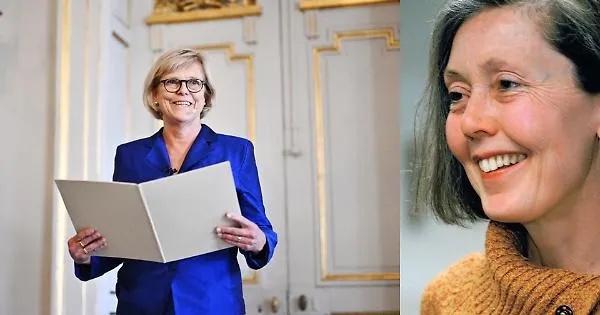
Canadian poet, translator and classical scholar Anne Carson has won the 2026 Nobel Prize in Literature, becoming one of the most celebrated literary figures of her generation to receive the prestigious international honour.
The Swedish Academy announced the award on Thursday, October 8, 2026, recognising Carson for her “bold and inventive” body of work, which has created new forms of contemporary literature through a playful engagement with classical traditions. The Academy highlighted the distinctive combination of rigorous scholarship, poetic imagination and experimentation that defines her writing.
Carson, 76, is widely admired for challenging the boundaries between poetry, prose, translation, literary criticism and performance. Her works frequently draw on ancient Greek literature while exploring universal human experiences, including love, desire, grief, loneliness, betrayal, identity and the complexities of human relationships.
Her Nobel Prize recognises a literary career built around the transformation of ancient stories, languages and philosophical questions into strikingly original works for contemporary readers.
Who Is Anne Carson?
Anne Patricia Carson was born on June 21, 1950, in Toronto, Ontario, Canada. She is a poet, essayist, translator, classicist and academic whose writing has earned international recognition for its intellectual depth and unconventional style.
Unlike writers who work primarily within a single literary genre, Carson has developed a distinctive approach that brings together poetry, philosophy, history, mythology, drama and visual art. Her publications often resist conventional classifications, combining different forms and presenting ideas through fragments, dialogue, short essays, translations and experimental arrangements.
Carson’s reputation rests partly on her ability to make classical literature feel emotionally immediate without removing its historical complexity. Ancient Greek poets and playwrights remain central to her work, but she uses their stories to investigate questions that continue to matter in modern life.
Over several decades, she has become an influential figure in contemporary poetry, admired by readers, scholars, translators and fellow writers for her unusual treatment of language and literary form.
Early Life and Education
Carson’s interest in classical literature began during her teenage years in Ontario. A high-school Latin teacher introduced her to ancient Greek and helped her develop the language skills that would eventually shape her academic and literary career.
This early encounter with Greek literature proved decisive. Carson became fascinated by the language, its history and the works of ancient writers whose ideas about love, suffering, beauty and human behaviour continue to influence literature.
She attended St. Michael’s College at the University of Toronto, although her academic journey was not entirely straightforward. She left university twice before returning to complete her education.
Carson earned her Bachelor of Arts degree in 1974, her master’s degree in 1975 and her doctorate in Classics in 1981. She also studied Greek metrics at the University of St Andrews in Scotland.
Her doctoral research focused on the ancient Greek poet Sappho, whose surviving fragments explore love, desire, beauty and emotional vulnerability. This research helped establish the scholarly foundation for Carson’s later writing, particularly her investigations into the relationship between language and desire.
Her academic background is important to understanding her literary style. Carson does not simply borrow characters or plots from ancient literature; she examines the language, structure, cultural assumptions and philosophical implications of classical texts, then uses those discoveries to create new literary experiences.
According to Georgetown University’s Lannan Center for Poetics and Social Practice, Carson completed her doctoral degree in 1981 and went on to build a career combining classical scholarship with poetry and translation.
From Classical Scholar to International Literary Figure
Carson’s rise to international recognition was gradual, emerging from years of academic research, literary experimentation and engagement with ancient Greek texts.
Her early publications established her as a writer capable of combining scholarly argument with poetic expression. Rather than separating academic analysis from creative writing, she developed a style in which both could operate together.
Her work began attracting significant international attention during the 1980s and 1990s, particularly following the publication of Eros the Bittersweet and her subsequent collections of poetry and essays.
Her long poem “Kinds of Water,” published in 1987, also helped bring her work to a wider audience.
As her career developed, Carson became known for refusing to follow conventional expectations about what a poem, novel or essay should look like. Her books could contain translations, philosophical reflections, dramatic scenes, historical references and personal observations, sometimes within the same work.
This willingness to experiment became one of the defining features of her literary identity.
Academic Career and Teaching
Alongside her writing, Carson has maintained a substantial academic career.
She taught at Princeton University from 1980 to 1987 and later held teaching positions at several institutions in Canada and the United States, including McGill University, Emory University, the University of California, Berkeley, California College of the Arts and the University of Michigan.
At McGill University in Montreal, she served as Director of Graduate Studies in Classics.
Her academic work covered classical languages, literature and related areas of literary study. Her experience teaching ancient texts also strengthened the connection between her scholarship and creative writing.
Carson’s career demonstrates that academic research and artistic invention do not necessarily have to remain separate. In her work, close attention to a word’s history or the structure of an ancient poem can become the starting point for an entirely new literary form.
She has also worked across disciplines, collaborating with artists and performers and producing texts intended for theatrical and musical presentation.
Carson has maintained connections with both North American and European literary communities. She lives in Iceland, where she has also held citizenship since 2022, while her career has continued to span international literary and academic circles.
Her Literary Style: Where Poetry Meets Scholarship
One of the most distinctive features of Carson’s writing is her refusal to respect rigid boundaries between literary genres.
Her books may combine poetry, prose, translation, criticism, dialogue, autobiography and visual elements. Some works resemble conventional books, while others are deliberately constructed as collections of fragments, separate booklets or artistic objects.
This approach challenges readers to reconsider how literary meaning is created.
Rather than always explaining an idea directly, Carson often presents images, quotations, silences and fragments that invite readers to make connections for themselves. Her writing can be intellectually demanding, but it also explores deeply personal emotions.
Her style is frequently characterised by:
- Classical influence: Ancient Greek mythology, poetry and drama provide recurring sources of inspiration.
- Linguistic precision: She pays close attention to words, etymology, translation and the relationship between language and meaning.
- Genre experimentation: Poetry, prose, criticism and dramatic writing frequently overlap.
- Emotional complexity: Love, desire, grief, betrayal, loneliness and loss appear throughout her work.
- Visual imagination: Page layouts, images, fragments and physical arrangements can form part of the literary experience.
- Philosophical inquiry: Her writing often examines what people know, what they misunderstand and what remains uncertain about human experience.
Carson has described the act of making a poem as creating an object, comparing her poems to drawings that readers can enter through language. This perspective helps explain why the physical design and arrangement of her books can be as significant as their words.
Her approach has earned her a reputation as one of the most formally adventurous writers in contemporary literature.
Major Books and Literary Works
1. Eros the Bittersweet (1986)
Carson’s first major book, Eros the Bittersweet: An Essay, explores love and desire through ancient Greek literature.
Drawing on classical poetry and philosophy, she examines the nature of erotic longing and the relationship between desire and distance. One of the central ideas is that desire frequently depends on absence: people may long most intensely for what they cannot fully possess.
The book demonstrates Carson’s distinctive method of combining literary scholarship with philosophical reflection and poetic insight.
It also established themes that would recur throughout her later work, including the relationship between language, longing and the limits of human understanding.
2. Short Talks (1992)
Short Talks is a collection of brief prose pieces that demonstrate Carson’s ability to communicate complex ideas through compressed, imaginative writing.
The pieces frequently resemble miniature essays or poetic observations. Rather than developing lengthy arguments, they use concise passages to explore subjects through unexpected associations and vivid imagery.
The book reflects Carson’s interest in brevity, experimentation and the expressive possibilities of prose that behaves like poetry.
3. Glass, Irony, and God (1995)
This collection of poetry and essays is among Carson’s best-known early works.
It includes “The Glass Essay,” a long poem that combines reflections on the nineteenth-century novelist Emily Brontë, the speaker’s personal experiences and the emotional consequences of a relationship ending.
The work moves between literary analysis, memory, emotional pain and philosophical reflection. Its shifts in subject and form illustrate Carson’s ability to make literary criticism part of an intensely personal poetic experience.
“The Glass Essay” is particularly important because it demonstrates how a writer can use another author’s work to illuminate contemporary emotional experiences without reducing literature to autobiography.
4. Autobiography of Red: A Novel in Verse (1998)
Perhaps Carson’s most widely recognised work, Autobiography of Red reimagines an ancient Greek myth through the form of a modern verse novel.
The story draws on the myth of Geryon, a red, winged monster associated with the labours of Heracles. In ancient tradition, Geryon is defeated by Heracles, but Carson transforms the figure into a complex modern character with emotional vulnerabilities and a distinctive inner life.
Her version explores love, rejection, desire, identity, violence and the difficult process of growing up.
The relationship between Geryon and Heracles becomes a way of examining emotional dependence and the pain that can arise when affection is mixed with betrayal or unequal power.
The book also incorporates photography and questions of artistic self-expression, connecting the character’s experiences to broader reflections on memory and identity.
Its originality lies in the way Carson uses an ancient myth as the starting point for a story that feels psychologically contemporary. Rather than simply retelling the legend, she changes its emotional centre and asks readers to see the supposedly monstrous figure from a different perspective.
The novel has become a landmark in experimental contemporary literature and is frequently cited as a defining example of Carson’s ability to combine classical material with modern storytelling.
5. The Beauty of the Husband (2001)
Subtitled A Fictional Essay in 29 Tangos, this work explores marriage, attraction, betrayal and the instability of romantic love.
Its structure draws on the rhythm and movement of the tango, using the dance as a framework for examining a relationship marked by desire and disappointment.
Carson combines philosophical reflection with a narrative voice that investigates the contradictions of loving someone who may also cause emotional harm.
The book won the T. S. Eliot Prize for Poetry in 2002, further establishing her reputation as an innovative literary artist.
6. If Not, Winter: Fragments of Sappho (2002)
Carson’s translation of the surviving fragments of Sappho is among her most important contributions to classical literature.
Sappho, who lived in ancient Greece around the seventh and sixth centuries BCE, is celebrated for lyric poetry that explores love, longing, beauty and emotional intimacy. Much of her work survives only in fragments because the original poems have been lost or damaged over time.
In If Not, Winter, Carson preserves the gaps and broken passages rather than attempting to reconstruct missing words wherever possible.
This approach allows readers to encounter the uncertainty and incompleteness of the surviving texts. The blank spaces become part of the reading experience, reminding readers that the ancient past reaches us through damaged and partial records.
The book illustrates Carson’s understanding that translation is not simply a matter of replacing words from one language with words from another. It also involves decisions about rhythm, ambiguity, historical distance and what cannot be recovered.
Her translations have been admired for combining scholarly precision with poetic sensitivity.
7. Men in the Off Hours (2000)
Men in the Off Hours brings together poetry, historical references, literary criticism and reflections on death, art and human experience.
The collection moves between different historical periods and figures, demonstrating Carson’s interest in the relationship between the past and the present.
Its structure resists a single, continuous narrative. Instead, individual pieces create connections across literature, philosophy and history.
The book received significant critical attention and was shortlisted for major literary honours, including the Griffin Poetry Prize.
8. Decreation: Poetry, Essays, Opera (2005)
In Decreation, Carson expands her experiments across poetry, philosophy, essays and performance.
The collection engages with questions of identity, selfhood, spirituality and the possibility of moving beyond the boundaries of the individual ego.
Its title invokes the idea of relinquishing or undoing the self, a subject explored through historical, philosophical and religious perspectives.
The work also illustrates Carson’s ability to bring together forms of writing that are usually treated separately, making it a significant example of her interdisciplinary approach.
9. Nox (2010)
Nox is one of Carson’s most personal and formally distinctive books.
Created in response to the death of her brother, the work combines mourning with an investigation of memory, family history, language and the limits of translation.
The book takes the form of an accordion-folded collection of images, handwritten notes, documents, quotations and other fragments. Rather than presenting grief as a straightforward narrative, Carson constructs a physical object that reflects the broken and uncertain nature of remembering someone who has died.
The work also incorporates a Latin poem by Catullus and explores the difficulty of translating words across languages, generations and personal experience.
Nox demonstrates how Carson can transform private loss into an artistic exploration of the ways people attempt to recover the past.
10. Red Doc> (2013)
In Red Doc>, Carson revisits the world of Autobiography of Red through a new narrative.
The book returns to figures associated with Geryon and Heracles but moves them into a different emotional and imaginative landscape.
It continues Carson’s exploration of trauma, desire, memory and identity while adopting a more fragmented and experimental narrative structure.
The title itself reflects her interest in unusual forms and the relationship between literary language and visual presentation.
11. Float (2016)
Float is a collection of 22 separate booklets, each presenting a different piece of writing.
The individual booklets can be read in different orders, making the physical structure of the work part of its artistic concept.
The collection demonstrates Carson’s continuing interest in how readers encounter texts and how the arrangement of material can influence meaning.
Rather than presenting a single, uninterrupted narrative, Float invites readers to explore connections between separate pieces and to construct their own reading experience.
Its format is a striking example of Carson’s belief that a book can be an artistic object as well as a container for words.
12. Norma Jeane Baker of Troy (2019)
This performance work brings together two seemingly distant figures: Helen of Troy, whose beauty is central to ancient Greek mythology, and Marilyn Monroe, the twentieth-century actress whose public image became a defining feature of modern celebrity culture.
Carson draws on Euripides’ play Helen and reinterprets its questions about appearance, identity, desire and the relationship between reality and illusion through Monroe’s life and image.
The work demonstrates her ability to connect classical drama with modern popular culture without treating the two traditions as entirely separate.
By placing Helen and Monroe in dialogue, Carson explores how women can become symbols onto which societies project their expectations, desires and anxieties.
The piece also reflects her continuing interest in performance and collaboration beyond the conventional printed page.
13. Wrong Norma (2024)
Wrong Norma is a collection of experimental writing that further demonstrates Carson’s refusal to be confined by traditional literary categories.
Published in 2024, the book brings together different forms of writing, including poetry, prose and imaginative reflections on literature, art and everyday experience.
Its pieces frequently move between observation, philosophical speculation and playful engagement with other writers and cultural figures.
The collection was a finalist for the National Book Award and was longlisted for a National Book Critics Circle Award, according to Georgetown University’s Lannan Center.
Wrong Norma shows that Carson’s commitment to experimentation remains central to her work, even after decades of critical recognition.
A Translator Who Reimagines the Classics
Translation is one of the most important parts of Carson’s literary achievement.
Her work with ancient Greek authors, including Sappho, Euripides and Sophocles, reflects both her academic training and her creative imagination.
Among her notable translations and adaptations are Electra (2001), If Not, Winter: Fragments of Sappho (2002) and An Oresteia (2009).
In An Oresteia, Carson contributes to a modern presentation of the ancient Greek dramatic tradition by translating plays associated with the Oresteia story. The project demonstrates how classical drama can be reinterpreted through contemporary language and performance.
Her translations do not aim merely to make ancient texts easier to read. They seek to preserve their strangeness, ambiguity and emotional power while allowing modern readers to experience them in new ways.
Carson’s approach has helped draw attention to the creative possibilities of translation, showing that it can be a literary art in its own right.
The Influence of Ancient Greek Literature
Ancient Greek literature is central to Carson’s writing, but her interest in it extends beyond mythology and historical storytelling.
She frequently returns to Greek writers because their works investigate fundamental questions about love, suffering, power, justice, memory and human limitations.
Sappho provides a language for exploring desire and emotional intimacy. Euripides offers dramatic situations in which identity, deception and social expectations are questioned. Homer supplies epic stories that examine conflict, courage, loss and the consequences of human decisions.
Carson’s work transforms these classical materials by placing them in conversation with contemporary experience.
Her treatment of Geryon in Autobiography of Red, for example, changes the perspective of an ancient myth so that a figure traditionally remembered as a monster becomes the emotional centre of a modern story.
Similarly, Norma Jeane Baker of Troy creates a dialogue between Helen of Troy and Marilyn Monroe, examining the relationship between beauty, celebrity and public expectations.
These works demonstrate why Carson’s relationship with classical literature is so distinctive: she neither simply preserves the past nor abandons it. Instead, she uses the past to create new ways of thinking about the present.
Major Awards and Recognition Before the Nobel Prize
Before winning the 2026 Nobel Prize in Literature, Carson had received numerous prestigious awards and fellowships in recognition of her contributions to poetry, translation and literature.
Her previous honours include:
- MacArthur Fellowship (2000): A major American fellowship often associated with exceptional creativity and intellectual achievement.
- Guggenheim Fellowship: Recognition supporting her literary and scholarly work.
- T. S. Eliot Prize (2002): Awarded for The Beauty of the Husband.
- Griffin Poetry Prize: One of the significant poetry awards associated with her career.
- Lannan Literary Award: Recognition for her contributions to literature.
- Pushcart Prize: An honour associated with literary publishing.
- Princess of Asturias Award for Literature (2020): An international recognition of her literary achievement.
- Member of the Order of Canada (2005): An honour recognising her contribution to Canadian literature and culture.
- PEN/Nabokov Award: Recognition of her achievement in international literature.
These honours reflect the breadth of Carson’s influence across poetry, scholarship and translation. Her Nobel Prize adds the highest level of international recognition to a career already distinguished by major literary awards.
Anne Carson’s Personal Life and Life in Iceland
Although Carson’s writing often explores intimate emotions, she maintains a relatively private public profile.
She is married to artist Robert Currie, with whom she has shared artistic and personal connections across North America and Iceland.
The couple developed a connection with Iceland following the country’s 2008 financial crisis and gradually began spending more time there. Carson obtained Icelandic citizenship in 2022 while retaining her Canadian identity.
Her life across different countries reflects the international character of her literary career, although her writing remains deeply connected to the languages, texts and traditions she has studied throughout her life.
Carson has also spoken publicly about her understanding of poetry as a visual and physical art, an idea that is reflected in works such as Nox and Float.
Her approach suggests that the meaning of a literary work can emerge not only from what is written but also from how the text is arranged, presented and encountered by the reader.
What the 2026 Nobel Prize Means for Anne Carson
The Nobel Prize in Literature is among the world’s most prestigious literary honours. Awarded by the Swedish Academy, it recognises outstanding contributions to literature and has honoured writers whose work has shaped literary culture across languages and generations.
Carson’s 2026 award recognises a body of work that has challenged conventional divisions between creative writing and academic scholarship.
The Swedish Academy’s citation emphasises her inventive engagement with classical traditions and her role in creating new forms for contemporary literature.
The recognition also draws international attention to poetry and experimental writing at a time when literary audiences encounter stories through an increasingly wide range of media.
Carson’s career demonstrates that poetry can remain intellectually ambitious while engaging with personal emotions and contemporary questions. Her work also illustrates how translation and classical scholarship can become sources of artistic innovation rather than merely academic pursuits.
The award is therefore not simply recognition of individual books. It honours a distinctive literary method that has influenced how writers and readers understand the possibilities of contemporary literature.
Canadian Literature and the Nobel Prize
Carson’s Nobel Prize places her among the internationally recognised writers associated with Canada and its literary tradition.
Canadian literature encompasses a wide range of voices, languages, cultural experiences and literary forms. Carson’s work contributes to that diversity through its combination of classical scholarship, experimental poetry and international artistic collaboration.
Another major Canadian literary figure, Alice Munro, won the Nobel Prize in Literature in 2013 for her mastery of the short story. Munro’s achievement brought international recognition to a literary form often overshadowed by the novel.
Carson’s work is markedly different in style, but both writers demonstrate how literary innovation can emerge through close attention to human experience.
Carson’s award also reinforces the international reach of contemporary Canadian writing and the ability of poetry to achieve global recognition.
Africa’s Connection to the Nobel Prize in Literature
Carson’s achievement also provides an opportunity to reflect on the Nobel Prize’s significance beyond Europe and North America.
Nigeria’s Wole Soyinka won the Nobel Prize in Literature in 1986, becoming the first African writer to receive the award. His recognition was a landmark for African literature and brought international attention to the continent’s rich traditions of drama, poetry, political writing and storytelling.
Soyinka’s work has explored colonialism, political power, cultural identity, injustice and the complexities of human freedom. His achievement remains an important milestone in the history of African literature.
For Nigerian readers, Carson’s award offers another opportunity to consider how writers from different parts of the world draw on history, mythology, language and cultural memory to create literature that speaks across national boundaries.
Although Carson and Soyinka have distinct literary styles and cultural backgrounds, their work demonstrates the enduring importance of experimentation and engagement with inherited traditions.
How the Nobel Prize Is Awarded
The Nobel Prize in Literature is administered through a formal nomination and selection process overseen by the Swedish Academy.
Eligible nominators include qualified members of literary academies, university professors in relevant fields, previous Nobel laureates in literature and certain literary organisations.
Writers cannot nominate themselves. The nomination process is confidential, and the Nobel Foundation’s rules generally keep nomination information secret for 50 years.
Following nominations, candidates undergo an assessment process that includes literary evaluation and deliberation before the Swedish Academy selects the laureate.
Carson’s selection therefore represents recognition by the Academy of the significance and originality of her literary achievement.
The Nobel Prize ceremony is traditionally held in Stockholm in December, when laureates receive their awards and deliver associated speeches.
A Literary Career Defined by Experimentation
Anne Carson’s career stands out because she has consistently questioned the boundaries of literary expression.
From her early investigation of desire in Eros the Bittersweet to the mythological reimagining of Autobiography of Red, the grief-filled fragments of Nox and the unconventional structure of Float, she has explored how literature can communicate experiences that resist simple explanations.
Her writing brings together the intellectual discipline of a classical scholar and the imaginative freedom of a poet. She draws on ancient texts not as relics of a distant past but as sources of questions that remain open, difficult and emotionally relevant.
Carson’s work may challenge readers who prefer straightforward narratives, but its experimental qualities are also central to its appeal. Her books encourage readers to slow down, reconsider familiar ideas and discover connections between seemingly unrelated subjects.
The 2026 Nobel Prize in Literature recognises this distinctive contribution to contemporary writing.
At 76, Carson joins the ranks of Nobel laureates whose work has expanded the possibilities of literature. Her achievement underscores the enduring power of poetry, translation and classical scholarship to generate new artistic forms.
For Carson, the past is never simply finished. Through language, imagination and experimentation, ancient stories can continue to reveal new meanings to each generation of readers.