

From being born into slavery on a Jamaican sugar plantation to becoming the servant, student, companion and eventual heir of one of England’s greatest men of letters, Francis Barber lived a life that crossed some of the most important fault lines of 18th-century Britain: slavery and freedom, race and class, education and exclusion.
More than two centuries after his death, his remarkable story is finally receiving permanent recognition in the heart of London.
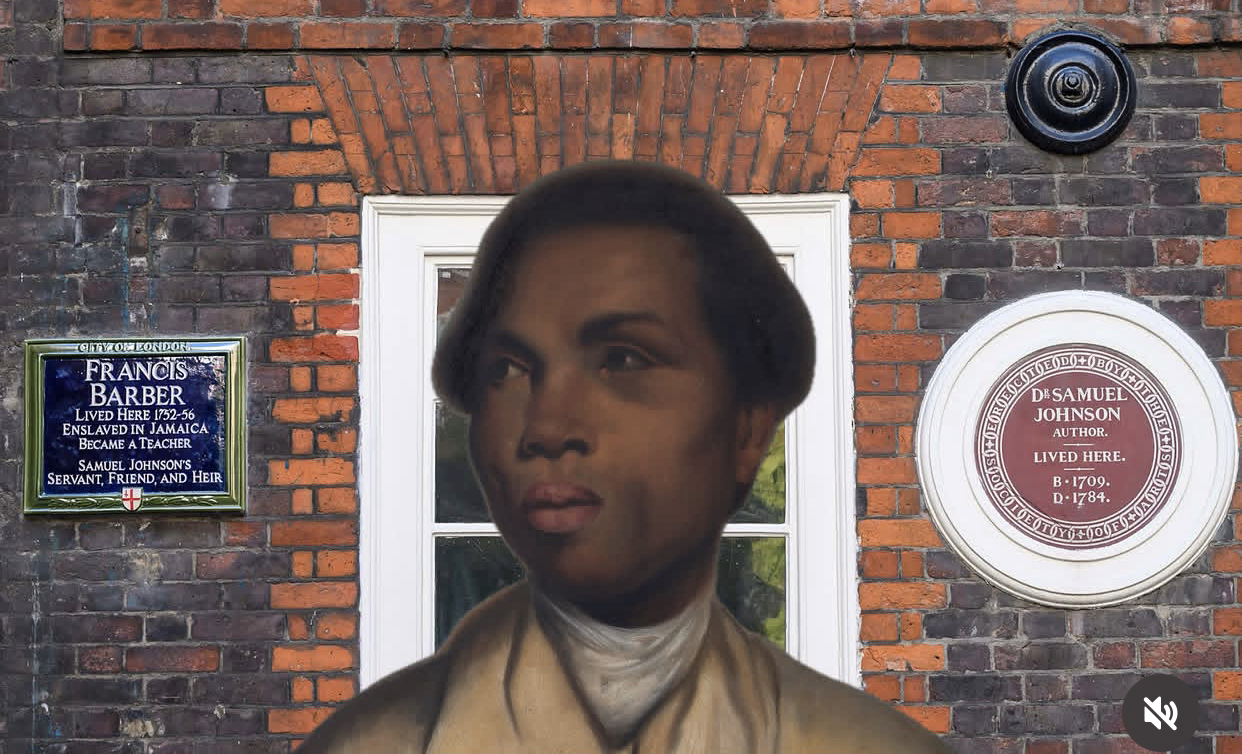
On 15 September 2026, a City of London Blue Plaque was unveiled at 17 Gough Square, the historic home of Samuel Johnson, commemorating Barber’s extraordinary journey from an enslaved Jamaican child to what historians describe as Britain’s first known Black schoolteacher. The ceremony also marked the relaunch of the City of London’s redesigned Blue Plaques Scheme.
The plaque is especially significant because Dr Johnson’s House is believed to be the only surviving property in the City of London known to have been home to a person who was born into slavery and later lived there as a free person.
A Child Born Into Slavery
Francis Barber was born in Jamaica around 1742, although the precise year and circumstances of his birth remain uncertain. His original name was believed to be Quashey, a name associated with West African, particularly Coromantee, origins.
He was born into slavery on the Orange River sugar plantation, associated with Colonel Richard Bathurst. More than 150 enslaved people lived and worked on the plantation. Barber’s parents were enslaved, meaning that from birth he was legally treated as property under Jamaica’s slave system.
Almost nothing is known about his biological parents or his earliest childhood. Even his precise birth date remains a mystery.
There has also been speculation that Barber may have been Colonel Bathurst’s son, or that he had worked within Bathurst’s household rather than solely on the plantation. However, historians have never established this as fact.
This uncertainty is one of the frustrating aspects of researching the lives of enslaved people. Plantation records generally treated them as property rather than as individuals whose family histories, childhoods and personal experiences deserved to be recorded.
From Jamaica to England
Around 1750, when Barber was still a young boy, Colonel Bathurst experienced financial difficulties and sold the Jamaican estate. Bathurst left Jamaica for England and took Quashey with him.
The journey dramatically changed the boy’s life.
After arriving in England, Quashey was baptised and given the name Francis Barber. Bathurst then sent him to school in Yorkshire, an extraordinary development for a child who had been born into slavery.
But his education was only beginning.
In April 1752, Barber was sent to the household of Samuel Johnson, one of the most celebrated writers and scholars of 18th-century England.
Johnson lived at 17 Gough Square, the townhouse that still stands today.
Barber was about eight to ten years old.
Meeting Samuel Johnson
The connection came through Dr Richard Bathurst, the son of Colonel Bathurst and a friend of Samuel Johnson. Richard Bathurst shared Johnson’s opposition to slavery and arranged for the young Barber to enter Johnson’s household.
Barber initially served as a household servant.
His duties included running errands, answering the door, fetching and carrying items and waiting at table. Like other servants of the period, he probably slept in the basement area of the house.
But something unusual happened.
The relationship between Johnson and Barber developed beyond the conventional master-servant relationship.
Johnson became deeply invested in Barber’s education and future.
The boy who had arrived from a Jamaican plantation was being taught to read and write and was being exposed to the intellectual world of one of Britain’s greatest literary figures.
Johnson reportedly told him:
“You can never be wise unless you love reading.”
Johnson even took care over Barber’s feelings in seemingly small matters. Historic England records the famous story that Johnson bought food for his cat, Hodge, himself rather than asking Barber to do it, because he did not want Barber’s dignity hurt by having him serve an animal.
Whether every detail of their relationship can be reconstructed today is impossible to know. But the surviving evidence makes clear that Barber became an unusually important member of Johnson’s household.
Barber’s Freedom
One important correction to many simplified versions of Barber’s story is that his freedom did not come immediately when he entered Johnson’s household.
He remained legally enslaved until the death of Colonel Richard Bathurst.
Bathurst’s will eventually granted Barber his freedom and left him £12.
This happened in the mid-1750s.
It was a crucial turning point.
Barber had arrived in England as a child whose life was controlled by other people. He was now legally free.
But freedom did not mean that racial prejudice or economic insecurity disappeared.
His life would continue to move between opportunity and vulnerability.
Leaving Johnson — and the Navy
In 1756, Barber left Johnson’s household and went to work for an apothecary in Cheapside.
Johnson famously complained that:
“My boy is run away.”
But the relationship was not broken. Barber continued to visit Johnson.
Around 1758, Barber joined the British Navy during the Seven Years’ War.
His time at sea was relatively brief. Johnson eventually used his influence to have Barber discharged in 1760. One concern was reportedly that Barber could be placed in danger of being captured and enslaved if his ship entered the West Indies.
Barber returned to Johnson’s orbit.
The boy who had once served him was now becoming an educated young man who could contribute to Johnson’s intellectual and personal life.
Education: Johnson Invests in Barber’s Future
Perhaps the most extraordinary part of Barber’s education came later.
In 1767, Johnson arranged for him to attend Bishop’s Stortford Grammar School in Hertfordshire.
Johnson paid substantial fees for Barber’s education, and Barber spent several years studying there. Surviving material includes examples of Barber’s handwriting practice, providing rare physical evidence of his education.
He studied subjects that could prepare him for a more intellectually demanding life, including languages.
This matters because Barber’s story was not simply one of an enslaved child becoming a free servant.
He became literate and educated in an era when educational opportunities for Black people were extremely limited.
His education would eventually help lead him to another historic role: teacher.
From Servant to Companion and Assistant
Barber eventually returned to Johnson’s household and remained associated with him for the rest of Johnson’s life.
He was no longer simply a household servant.
He became an assistant, companion and trusted member of Johnson’s inner circle.
He helped with practical matters, received documents, arranged journeys and assisted Johnson with his work. He was also familiar enough with Johnson’s life and habits to later provide information to James Boswell, whose famous biography The Life of Samuel Johnson became one of the most important records of Johnson’s life.
In this sense, Barber became more than a witness to literary history.
He helped preserve it.
Barber and Samuel Johnson’s Anti-Slavery Views
The relationship also has a wider historical significance.
Samuel Johnson was an outspoken critic of slavery. Barber’s own experiences of slavery in Jamaica would have given Johnson direct access to the realities of the institution through someone living within his household.
Dr Johnson’s House notes that conversations about Barber’s experiences in Jamaica are likely to have influenced Johnson’s anti-slavery views and writings.
This does not mean that Barber’s life can be reduced to its influence on Johnson.
Quite the opposite.
His story provides a rare opportunity to look at 18th-century Britain from the perspective of a Black man who had experienced slavery, achieved freedom, received an education and participated in British society.
Marriage and Family
In 1773, Barber married Elizabeth Ball, an English woman.
Their interracial marriage took place at a time when racial prejudice was widespread, and the relationship attracted both hostility and support.
Johnson welcomed Elizabeth and the Barber family into his household. The couple eventually had five children, although their first son, named Samuel after Johnson, died in infancy. A later son was also named Samuel.
By 1783, Francis, Elizabeth and their children were living with Johnson at Bolt Court, close to Gough Square.
The relationship had now come full circle.
The Jamaican boy who had arrived at Johnson’s house decades earlier as a servant had become a husband, father, educated man and trusted companion within Johnson’s household.
Johnson’s Extraordinary Will
Then came one of the most remarkable moments in Barber’s life.
Samuel Johnson died in 1784.
His will left Barber a substantial provision.
Johnson granted him an annual income of £70, with the remainder of his estate placed in trust for Barber’s benefit. Barber was also left books, papers and a gold watch.
The arrangement was extraordinary.
Johnson had no surviving children, and Barber became the principal beneficiary of his estate.
For an 18th-century Black man who had been born into slavery, becoming the heir of one of England’s most famous literary figures was almost unimaginable.
Johnson had reportedly joked about the amount, saying that if a nobleman might leave a faithful servant a £50 annuity, then he intended to be “noblissimus” and leave Frank £70 a year.
The inheritance was not simply financial.
It represented Johnson’s confidence in Barber and the depth of their relationship.
A New Life in Staffordshire
Johnson had advised Barber to leave London and settle in Lichfield, Johnson’s birthplace.
Following Johnson’s death, Francis and Elizabeth moved to Staffordshire.
At first, they lived relatively comfortably and operated a draper’s shop. Barber also became involved in the local community and was elected a Dozener, a local official with ceremonial and civic responsibilities.
But the family’s financial situation eventually deteriorated.
Barber struggled to manage the inheritance and expenses. Some of Johnson’s possessions that had been left to him were eventually sold to raise money.
The family later moved to Burntwood, near Lichfield.
And there, Barber began the work that would secure his own place in British educational history.
Britain’s First Known Black Schoolteacher
Francis Barber established a school in Burntwood.
The surviving historical evidence about the school itself is frustratingly limited. We know that Barber taught, but relatively little survives about his curriculum, pupils or daily teaching methods.
Nevertheless, historians regard him as the first known Black schoolteacher or schoolmaster in Britain.
The word known is important.
There were Black people living in Britain long before Barber, and other Black people may have taught or performed educational roles whose records have disappeared. Consequently, historians generally avoid claiming that Barber was unquestionably the first Black person ever to teach in Britain.
Instead, he is more accurately described as Britain’s first known Black schoolteacher.
His achievement is extraordinary when viewed against the world into which he had been born.
He had begun life as an enslaved child in Jamaica.
He became free.
He learned to read and write.
He received formal schooling.
He became a literary man’s assistant and companion.
He married and raised a family.
He inherited from one of Britain’s most celebrated writers.
And finally, he became a teacher himself.
The transformation is remarkable.
The Irony of Barber’s Education
There is also a powerful irony in Barber’s story.
The child who had once been denied control over his own life eventually became someone who helped educate others.
His experience with education began when Bathurst sent him to school after bringing him to England. Johnson then continued investing in his education, eventually sending him to Bishop’s Stortford.
Years later, Barber established a school of his own.
In effect, education became one of the mechanisms through which Barber transformed his life.
The exact nature of his teaching remains unclear, but his career suggests a remarkable reversal: the formerly enslaved child became a man entrusted with educating the next generation.
His Final Years
Barber’s later years were less comfortable than his extraordinary inheritance might suggest.
The family’s financial difficulties continued, and his health deteriorated.
Francis Barber died in Staffordshire in January 1801, aged roughly 58 or 59.
Dr Johnson’s House records his death as 13 January 1801, while some older sources give a different date. He was buried at St Mary’s Church in Stafford.
Elizabeth survived him and continued the family’s educational work. Their descendants remained connected to Staffordshire, and members of Barber’s family still maintain links with the story of Francis and Samuel Johnson.
The Portrait That May — or May Not — Be Francis Barber
There is another fascinating mystery surrounding Barber.
At Dr Johnson’s House hangs a portrait of a young Black man traditionally identified as Francis Barber.
It has long been associated with him and has sometimes been attributed to Sir Joshua Reynolds.
But historians are not certain that the sitter is actually Barber.
The identity of the man in the portrait remains debated; some scholars believe he may instead have been Reynolds’s own servant.
That uncertainty itself tells us something important.
For all the fame surrounding Samuel Johnson, comparatively little visual or documentary evidence survives about Barber.
His story has had to be reconstructed from wills, letters, school records, household documents, biographies and fragments preserved by institutions.
Why Francis Barber’s Story Matters
Francis Barber was not the only Black person living in 18th-century Britain.
There were thousands of Black Britons during this period.
But the documentary record of their lives is often thin.
Barber’s life is therefore unusually valuable.
Through him, we can see several worlds intersecting:
Jamaica and Britain.
Slavery and freedom.
Black identity and 18th-century British society.
Domestic service and intellectual life.
Education and social mobility.
Race and interracial family life.
Literature and the everyday lives of people who supported literary figures.
His story also complicates the way British history is sometimes presented.
Black history in Britain did not begin with the Windrush generation in the 20th century.
Black people had lived in Britain for centuries, including during the Roman period and throughout the medieval and early modern eras. Barber belonged to an established, if frequently overlooked, Black presence in Britain during the 18th century.
From Gough Square to a London Blue Plaque
In 2023, Barber’s story received recognition in Lichfield, where a plaque was unveiled at Cruck House in Stowe Street, close to where he lived after leaving London. The plaque was unveiled by direct descendants of Francis Barber.
But the 2026 London commemoration carries particular symbolic weight.
On Tuesday, 15 September 2026, more than 270 years after Barber entered Samuel Johnson’s household, a new Blue Plaque was unveiled at 17 Gough Square.
The location matters.
This was the house where the young Barber arrived as a servant.
It was where he learned under Johnson’s influence.
It was where his relationship with Johnson began.
And it is one of the few physical places that connects the different chapters of his extraordinary life.
The ceremony also coincided with the 150th anniversary of the oldest City of London Blue Plaque, dedicated to Samuel Johnson at the same site.
The symbolism could hardly be stronger.
The man whose name once dominated the history of the house now shares that historical space with the Black child whose life was intertwined with his.
A Legacy Long Overdue
Francis Barber’s story is ultimately not simply the story of Samuel Johnson’s servant.
For many years, Barber was remembered primarily in relation to the famous white writer whose household he entered as a child.
But Barber deserves to be remembered in his own right.
He was an enslaved Jamaican child.
A free man.
A student.
A sailor.
A husband.
A father.
A literary assistant.
A trusted companion.
An heir.
A community member.
A schoolteacher.
And a Black Briton whose life crossed the Atlantic world at a moment when slavery, empire, race and freedom were shaping Britain’s future.
His life also demonstrates how much history can be hidden in the margins.
The documents left behind by powerful people often survive.
The lives of the people who served them, lived alongside them and influenced them are much easier to overlook.
Francis Barber refused to remain merely a footnote.
His life carried him from the plantation fields of Jamaica to the literary world of 18th-century London and eventually to a classroom in Staffordshire.
Now, more than two centuries after his death, his name has been placed permanently on the streets of London.
The Blue Plaque at 17 Gough Square is more than a memorial to a former servant of Samuel Johnson. It is a marker of a Black life that began in slavery, passed through freedom and education, and ultimately became part of Britain’s history.
And perhaps the most powerful part of Francis Barber’s story is this:
A child who was once treated as property grew into a man whose life, education and legacy could no longer be owned by anyone.
Historical note
Some details of Barber’s early life remain uncertain. His exact birth date, his parents’ identities and the precise circumstances of his early years in Jamaica are not securely documented. Even the identity of the man in the famous portrait associated with him remains disputed. For that reason, the most historically defensible description is “Britain’s first known Black schoolteacher”, rather than an absolute claim that he was the first Black teacher ever.
The most substantial modern biography is Michael Bundock’s The Fortunes of Francis Barber: The True Story of the Jamaican Slave Who Became Samuel Johnson’s Heir, published by Yale University Press. The biography draws together the surviving evidence to reconstruct Barber’s extraordinary life and his relationship with Johnson.