

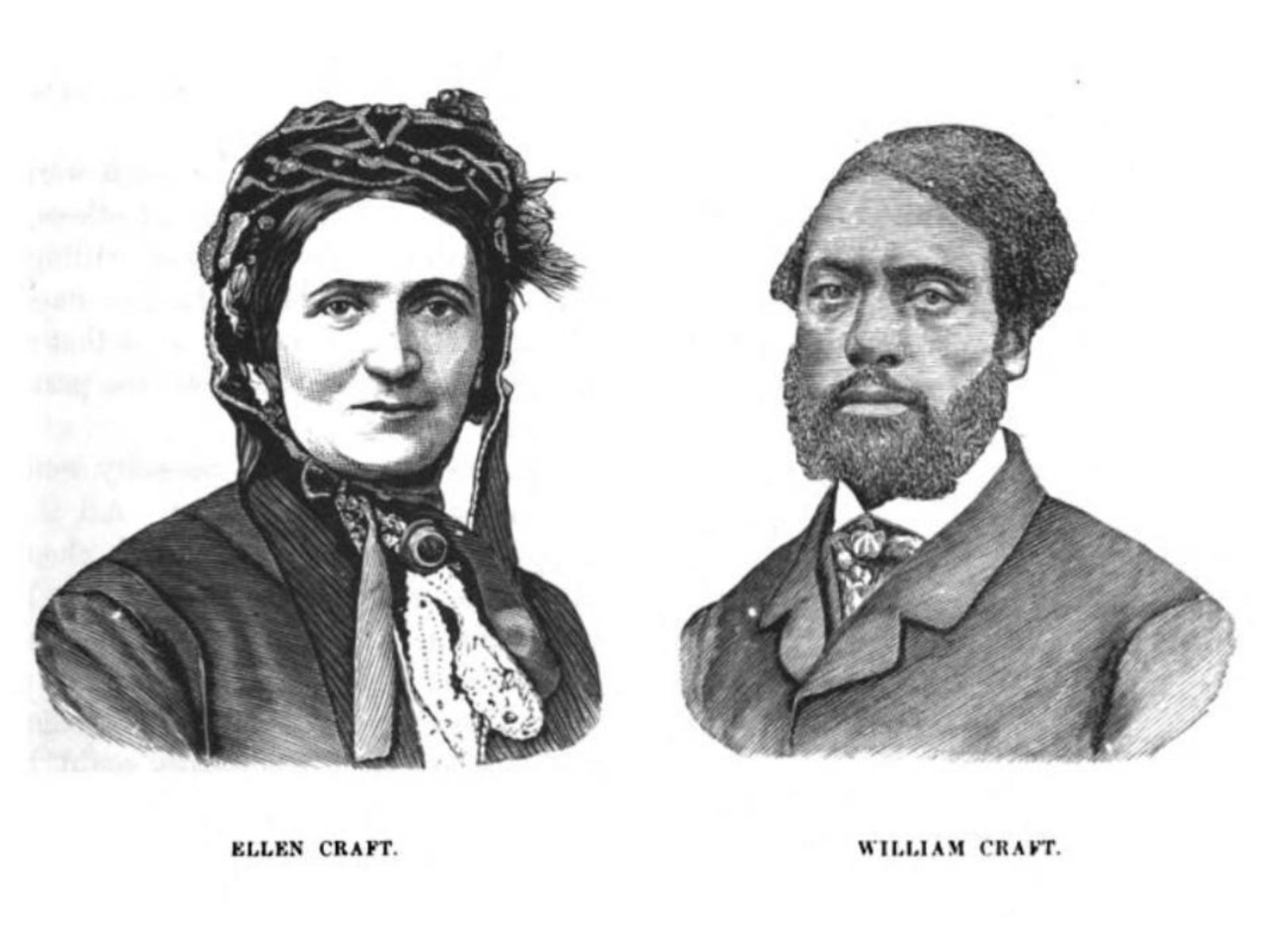
Their extraordinary escape in 1848 saw an enslaved Black woman disguise herself as a wealthy white male slaveholder while her husband pretended to be her servant. Their daring journey challenged the racial and social order of the American South and became one of the most remarkable stories of freedom in American history.
The history of slavery in the United States is filled with extraordinary stories of courage, resistance, determination, and the relentless pursuit of freedom. Among the most remarkable are the stories of enslaved African Americans who risked their lives, defied slaveholders, and developed ingenious plans to escape the brutal system that denied them their basic human rights.
One such story is that of William and Ellen Craft, an enslaved African American couple who made history in December 1848 through an escape plan that was as daring as it was unusual.
Unlike many enslaved people who attempted to escape under the cover of darkness, through forests, or along secret routes, William and Ellen Craft chose a different approach. They travelled openly through several slaveholding states, using trains and steamships, with Ellen disguised as a wealthy, sickly white man and William posing as her enslaved servant.
Their plan was particularly remarkable because the disguise required Ellen to conceal not only her gender but also her true racial identity. As a light-skinned woman born to an enslaved mother and a white slaveholder, Ellen was able to pass as white. Her husband, William, played the role of a loyal Black servant accompanying his supposed master.
The couple’s journey from Macon, Georgia, to Philadelphia, Pennsylvania, in December 1848 became one of the most celebrated escapes from slavery in American history. However, their struggle did not end when they reached freedom. They would later become influential abolitionists, travel to England, publish an account of their escape, and dedicate part of their lives to educating formerly enslaved African Americans.
Their remarkable story demonstrates how determination, intelligence, cooperation, and courage could challenge even the most oppressive systems.
Early Life: Growing Up Under Slavery
William Craft was born in 1824 in Macon, Georgia, where he spent his early years under the institution of slavery.
Like millions of enslaved African Americans, William had little control over his life. Enslaved people were legally treated as property, meaning their owners could sell, transfer, or separate them from their families without their consent.
William experienced this cruelty firsthand during his childhood. His enslaver experienced financial difficulties and eventually sold members of William’s family, including his parents and siblings.
One particularly painful experience involved the separation from his sister. William recalled witnessing her being taken away after an auction, an experience that left a lasting emotional impact on him.
The separation of families was one of the most devastating aspects of American slavery. Husbands could be separated from wives, parents from children, and siblings from one another, sometimes permanently.
William was also apprenticed to a cabinetmaker, where he developed valuable woodworking and craftsmanship skills. Although his apprenticeship provided him with an opportunity to learn a trade, it did not change his legal status as an enslaved person.
His experiences with family separation and the injustice of slavery strengthened his desire for freedom.
Ellen Craft, whose maiden name was Smith, was born in Georgia in 1826. Her background was different from William’s, although she also experienced the oppression of slavery.
Ellen was the daughter of Maria, an enslaved African American woman, and Major James Smith, a white slaveholder.
Because of her mixed-race ancestry, Ellen had a very light complexion and was frequently mistaken for a white woman. William later described her appearance as being almost white.
This unusual circumstance would eventually become central to the couple’s escape plan.
Although Ellen’s light complexion sometimes caused confusion among white people, it did not protect her from slavery. She remained legally enslaved and had no freedom to determine her future.
How William and Ellen Met and Fell in Love
William and Ellen met in Macon, Georgia, while both were living under slavery.
Despite their difficult circumstances, they developed a romantic relationship and eventually married around 1847.
Like other enslaved couples, their marriage offered them emotional companionship and a sense of stability in a society that denied them basic human rights.
However, their relationship existed under constant threat.
Enslaved husbands and wives had no legal guarantee that they would remain together. Slaveholders could sell either partner whenever they wished, regardless of the emotional and family consequences.
The possibility of being separated was a constant source of anxiety for William and Ellen.
They also understood that having children under slavery would expose their future family to the same oppression. Their children could be sold, abused, or separated from them at any time.
These fears strengthened their determination to escape.
Initially, the couple considered escaping before getting married. However, they understood that escaping from Georgia was extremely dangerous and that their chances of success were uncertain.
They eventually decided to marry while continuing to hope for an opportunity to obtain their freedom.
Their circumstances, however, soon pushed them to develop a more ambitious plan.
The Extraordinary Escape Plan
In 1848, William Craft developed an ingenious plan that would eventually make the couple famous throughout the United States and beyond.
He realized that Ellen’s light complexion could provide them with an unusual advantage.
Rather than attempting to escape as two enslaved Black people travelling together, William suggested that Ellen disguise herself as a white male slaveholder while he pretended to be her enslaved servant.
The idea was based on the racial hierarchy of the American South.
During that period, white slaveholders routinely travelled with enslaved Black servants. Consequently, railway employees, hotel workers, ship captains, and other travellers were accustomed to seeing white men accompanied by Black servants.
William and Ellen intended to exploit these assumptions.
Their plan was for Ellen to assume the identity of a sickly young white plantation owner travelling north to Philadelphia for medical treatment. William would accompany her as her loyal personal attendant.
The disguise would allow them to move through public spaces without immediately attracting suspicion.
However, executing the plan required extraordinary preparation.
Ellen needed to look convincing enough to avoid being identified as a woman. She also needed to behave like a white male slaveholder, including maintaining the appearance of authority over William.
To achieve this, William secretly purchased the necessary clothing and accessories from different locations to avoid attracting attention.
Ellen cut her hair short and dressed in men’s clothing. She wore a hat and green-tinted spectacles to complete her appearance.
She also wrapped a handkerchief around her face and tied it above her head to conceal her facial features and make her appear unwell.
To strengthen the impression that she was suffering from an illness, she carried a cane and pretended to have difficulty walking.
One of the most important parts of the disguise involved her right arm.
Ellen could not read or write, and she understood that railway officials, hotel employees, or other authorities might ask her to sign documents or register her name.
To avoid exposing her inability to write, she placed her right arm in a sling and pretended that it was injured.
She also pretended to be hard of hearing, reducing the possibility of being drawn into conversations that might expose her identity.
The disguise was carefully designed to ensure that Ellen would have as few reasons as possible to speak, write, or engage in unnecessary interactions with strangers.
William also had to maintain his role convincingly. He was expected to behave like a servant attending to his master’s needs, even though the supposed master was actually his wife.
The couple obtained permission from their respective enslavers to travel during the Christmas holiday period. They used this opportunity to secure a few days away from their normal duties, hoping that their absence would not immediately raise suspicion.
With their clothing, travel arrangements, and identities prepared, William and Ellen were ready to take one of the greatest risks of their lives.
December 21, 1848: The Journey to Freedom Begins
On December 21, 1848, William and Ellen Craft began their journey from Macon, Georgia.
Before leaving, William reportedly encouraged his wife with the words:
“Come my dear, let us make a desperate leap for liberty!”
The couple travelled separately to the railway station to avoid attracting suspicion.
Ellen, dressed as a white male plantation owner, purchased tickets for herself and William. They boarded a train heading towards Savannah, Georgia, approximately 200 miles away.
Their first journey was already filled with danger.
On the train, William noticed the cabinetmaker he had previously worked for. The man appeared to be looking for someone before eventually leaving the train.
Ellen also recognized a friend of her enslaver who knew her personally.
The man sat beside her, creating a frightening situation because a prolonged conversation could expose her identity.
However, Ellen remembered that her disguise included pretending to be hard of hearing. She used this part of the plan to avoid engaging with him.
Her performance worked, and the journey continued.
Upon arriving in Savannah, the couple boarded a steamboat called the General Clinch, which was travelling towards Charleston, South Carolina.
During the voyage, Ellen continued pretending to be ill. She went to bed early to avoid unnecessary conversations with other passengers.
The following morning, she sat beside the ship’s captain during breakfast.
In one particularly remarkable moment, the captain and a slave trader discussed the risks of taking enslaved people into free states. They warned Ellen, believing her to be a white slaveholder, that her servant might escape once they reached the North.
The slave trader even attempted to purchase William, arguing that taking him into free territory could result in losing him.
Ellen refused to sell him.
The irony of the situation was extraordinary. The people discussing the possibility of William escaping were unknowingly speaking directly to the two individuals who had already devised a plan to achieve exactly that.
Dangerous Encounters Along the Journey
After reaching Charleston, South Carolina, the couple faced another significant challenge.
They initially hoped to travel directly towards Philadelphia by steamship. However, they discovered that the last steamer scheduled for the winter had already departed.
They also learned that a fugitive enslaved person had reportedly been discovered aboard that vessel.
This information made their situation even more dangerous because it reminded them that other people were also attempting to escape and that slaveholders and authorities were actively watching for fugitives.
The Crafts therefore had to change their travel arrangements.
They purchased tickets for another route that would take them through Wilmington, North Carolina.
At the ticket office, another problem emerged.
The official requested Ellen’s signature, but she could not provide one because her right arm was supposedly injured.
She asked the official to sign on her behalf, but he initially refused.
Fortunately, a fellow passenger from their earlier journey intervened and signed for her.
The couple escaped that potentially disastrous situation and continued their journey.
From Wilmington, they travelled by train towards Richmond, Virginia, and then to Fredericksburg. They continued by steamer to Washington, D.C., before proceeding by train to Baltimore, Maryland.
Each stage required them to maintain their false identities.
The most frightening moment came when they reached Baltimore on Christmas Eve, December 24, 1848.
Baltimore was particularly dangerous because Maryland was a slave state, and officials were determined to prevent enslaved people from escaping into Pennsylvania.
As they prepared to board their final train to Philadelphia, an officer stopped William.
He explained that a person travelling with an enslaved individual into Pennsylvania had to provide evidence of ownership and financial security in case the supposed enslaved person later turned out to be a fugitive.
This presented an enormous problem.
If Ellen could not convince the officer that she was William’s legitimate owner, their entire plan could collapse.
The couple faced the possibility of arrest, exposure, and forced separation.
However, an unexpected opportunity emerged when the conductor of their previous train entered the office and confirmed that the two passengers had travelled together.
The officer eventually allowed them to proceed.
William and Ellen boarded their final train, leaving Baltimore behind and heading towards Pennsylvania.
Christmas Day 1848: The Couple Finally Reaches Freedom
On Christmas morning, December 25, 1848, William and Ellen Craft arrived in Philadelphia, Pennsylvania.
After four days of travelling through several slaveholding states, the couple had finally crossed into a free state.
For William, the sight of Philadelphia represented the beginning of a completely different life.
He later described the overwhelming feeling of relief, comparing his freedom to the removal of a heavy burden from his shoulders.
Their first destination was an abolitionist boarding house where Ellen could remove her disguise.
The landlord was reportedly surprised when he discovered that the supposed white male plantation owner was actually a Black woman.
The couple received assistance from abolitionists who recognized the importance of protecting them.
Because they believed Boston offered a safer environment for formerly enslaved people, the Crafts eventually continued north.
They spent time recovering at the home of an abolitionist family in Pennsylvania before moving to Boston.
During their stay, the daughters of the family helped William and Ellen improve their reading and writing skills. By the time they left, the couple had made progress towards becoming literate.
Their escape was successful, but the dangers associated with their former enslaved status had not completely disappeared.
Life in Boston and the Fight Against Slavery
After reaching Boston, William and Ellen settled into the city’s African American community.
Boston had a well-established population of free Black residents and a strong abolitionist movement.
The couple found accommodation at the home of Lewis and Harriet Hayden, prominent abolitionists who provided shelter and assistance to people escaping slavery.
William returned to his trade as a cabinetmaker and eventually established his own furniture business.
Ellen worked as a seamstress.
For the first time, they could earn money through their labour without being legally controlled by slaveholders.
They also began sharing their experiences with the public.
The Crafts attended anti-slavery meetings throughout Boston and other parts of New England. Their extraordinary escape attracted considerable attention, and audiences were fascinated by the details of Ellen’s disguise.
They spoke alongside prominent abolitionists, including Frederick Douglass, William Lloyd Garrison, Samuel May, and William Wells Brown.
Their story became a powerful tool in the campaign against slavery.
By explaining how they had been forced to disguise themselves to escape, the Crafts exposed the cruelty of a system that denied human beings the right to control their own lives.
However, their growing popularity also made them targets.
The Fugitive Slave Act of 1850: Another Threat to Their Freedom
In September 1850, the United States Congress passed the Fugitive Slave Act, a controversial law that significantly strengthened the ability of slaveholders to recover people who had escaped slavery.
The legislation required officials and residents in free states to assist in the capture and return of alleged fugitives.
It also imposed penalties on people who helped escaped enslaved individuals and offered financial incentives to those involved in their capture.
The law effectively weakened the protection that many formerly enslaved people had hoped to find in northern states.
For William and Ellen, this development was particularly frightening.
Their former enslavers in Georgia had not forgotten them. Two men, Willis Hughes and John Knight, travelled from Macon to Boston with the intention of capturing the couple and returning them to slavery.
The men obtained a warrant for their arrest in October 1850.
However, Boston’s abolitionist community responded quickly.
Members of the Boston Vigilance Committee, alongside other Black and white supporters, organized efforts to protect William and Ellen.
The couple were moved between different safe houses to prevent the slave catchers from locating them.
Ellen received shelter from George and Susan Hillard, while William sought protection from other abolitionist supporters.
William also prepared to defend himself against a possible forced capture.
The situation became so tense that some of their supporters were reportedly prepared to use force to prevent the couple from being returned to slavery.
Lewis Hayden and William even kept gunpowder beneath Hayden’s house as a last resort if slave catchers attempted to seize them.
The resistance of Boston’s Black community and abolitionists eventually forced Hughes and Knight to leave the city without capturing the couple.
Nevertheless, William and Ellen understood that remaining in the United States was still dangerous.
They therefore decided to seek permanent safety outside the country.
Before leaving Boston, they remarried on November 7, 1850, under the laws of a free state, in a ceremony conducted by abolitionist minister Reverend Theodore Parker.
They subsequently began their journey to England.
Life in England and Their Contribution to the Abolitionist Movement
In late 1850, William and Ellen Craft arrived in England, where they found a safer environment and continued their fight against slavery.
Their arrival did not mark the end of their public activities. Instead, it provided them with an international platform to expose the realities of American slavery.
The couple travelled around England, Scotland, and other parts of Britain, speaking at anti-slavery meetings and sharing their personal experiences.
Their story attracted considerable attention because it demonstrated the lengths to which enslaved people were forced to go to obtain freedom.
They became respected figures within Britain’s abolitionist movement and received support from several influential anti-slavery campaigners.
In June 1851, William and Ellen participated in an anti-slavery demonstration at the Great Exhibition in London.
They attended the exhibition alongside fellow abolitionist William Wells Brown and other British anti-slavery supporters.
Their presence was significant because the exhibition attracted visitors from different parts of the world, including Americans who supported or benefited from slavery.
By walking alongside white abolitionists as equals, the Crafts challenged the racial prejudices that underpinned slavery.
Their message was simple but powerful: Black people deserved the same dignity, respect, and freedom as everyone else.
During their years in England, the couple also pursued education and professional development.
They attended Ockham School in Surrey, where they continued learning while contributing their own practical skills.
William taught carpentry, while Ellen taught sewing.
They eventually raised five children and established a family life that would have been extremely difficult under slavery.
William also became involved in commercial activities connected to West Africa, including efforts to encourage legitimate trade as an alternative to the slave trade.
Their activities demonstrated that their commitment to freedom extended beyond their personal escape. They wanted to contribute to a world in which slavery and human exploitation would no longer exist.
Publishing Their Story: Running a Thousand Miles for Freedom
In 1860, William Craft published an account of their escape under the title Running a Thousand Miles for Freedom; or, The Escape of William and Ellen Craft from Slavery.
The book was published in London and provided a detailed description of the couple’s experiences under slavery, their preparations for escape, their journey through the American South, and the threats they faced after reaching Boston.
It became an important contribution to the literature produced by formerly enslaved African Americans.
Personal narratives played an important role in the abolitionist movement because they allowed readers to understand slavery through the experiences of those who had suffered under it.
Rather than relying only on political arguments or reports from outsiders, the Crafts provided a firsthand account of the cruelty and injustice of slavery.
Their book also exposed the contradictions within American society.
The United States presented itself as a nation founded on liberty and equality, yet its laws permitted human beings to be owned, bought, sold, and separated from their families.
The story of a woman forced to pretend to be a white man to secure her freedom illustrated the absurdity and brutality of this system.
Although the memoir was published under William’s name, historians have also examined Ellen’s contribution to shaping their shared story, recognizing her important role in the experiences described in the book.
Returning to America and Helping Formerly Enslaved People
The American Civil War, fought between 1861 and 1865, eventually brought about the abolition of slavery in the United States.
The Union victory and the ratification of the Thirteenth Amendment in 1865 legally abolished slavery, except as punishment for a crime.
After spending nearly two decades in England, William and Ellen Craft decided to return to the United States.
They returned to Georgia around 1870, determined to contribute to the development of formerly enslaved African Americans.
Their attention turned towards education, economic independence, and opportunities for people who had recently emerged from slavery.
In 1873, they established the Woodville Co-operative Farm School in Bryan County, Georgia.
The institution was designed to provide education and employment opportunities for newly emancipated Black men and women.
The project reflected the Crafts’ belief that freedom required more than simply ending legal slavery.
Formerly enslaved people needed access to education, land, professional skills, and economic opportunities to build independent lives.
The school combined agricultural activities with educational instruction, offering a model through which members of the Black community could improve their circumstances.
The Crafts hoped that the institution would help formerly enslaved people become self-sufficient and establish a stronger foundation for future generations.
However, their efforts encountered significant difficulties.
In 1876, some financial supporters accused William of personally using funds intended for the school.
William rejected the allegations and subsequently filed a libel lawsuit in an attempt to clear his name.
He lost the case in 1878, and the controversy damaged his reputation and relationships with several supporters.
The school also struggled with financial difficulties, declining cotton prices, and the increasingly hostile racial environment in the American South.
These challenges eventually forced the institution to close.
Despite the difficulties, the Crafts’ commitment to education and economic empowerment remained an important part of their legacy.
Their Final Years and Deaths
After the closure of the Woodville Co-operative Farm School, William and Ellen faced increasing financial challenges.
The economic conditions of the post-Reconstruction South, combined with racial discrimination and limited opportunities for Black landowners, made it difficult to sustain their agricultural activities.
In 1890, the couple moved to Charleston, South Carolina, where they spent their remaining years living with their daughter’s family.
Ellen Craft died in 1891, leaving behind a remarkable legacy of courage, intelligence, and determination.
William survived her by several years and died in 1900.
Although their lives had been shaped by slavery, separation, displacement, and discrimination, they had accomplished something extraordinary.
They escaped a system designed to control every aspect of their existence, became internationally recognized abolitionists, raised a family in freedom, and contributed to the education of formerly enslaved people.
The Legacy of William and Ellen Craft
The story of William and Ellen Craft remains one of the most inspiring accounts of resistance to slavery in American history.
Their escape was remarkable not simply because of the disguise Ellen used, but because of the intelligence, cooperation, courage, and determination required to execute the plan.
Their journey also reveals important realities about the institution of slavery.
First, it demonstrates how enslaved people continuously searched for ways to challenge their oppression. Although slaveholders and authorities created laws and systems designed to prevent escape, enslaved people never completely surrendered their desire for freedom.
Second, their story highlights the importance of African American resistance networks and abolitionist communities. The support they received in Philadelphia, Boston, and later England helped them survive the threats that continued after their escape.
Third, the Crafts demonstrated that freedom involved more than simply crossing a geographical boundary. Their subsequent work as abolitionists, educators, and advocates for economic independence showed their determination to help others build better lives.
Their story also challenges the assumption that successful escapes from slavery always required travelling secretly at night or hiding in remote locations. William and Ellen demonstrated that careful planning and an understanding of the society around them could create unexpected opportunities.
Ellen’s disguise was particularly significant because it exposed the racial and gender assumptions that shaped nineteenth-century American society. People readily accepted her authority because they believed she was a white male slaveholder, while William was treated as a servant because he was a Black man.
The couple used those assumptions against the very system that oppressed them.
Today, their story is remembered through historical scholarship, educational institutions, abolitionist archives, and public history projects. Their 1860 memoir remains an important primary source for understanding the experiences of freedom seekers before the American Civil War.
Conclusion
William and Ellen Craft’s escape from slavery in 1848 was more than an extraordinary journey from Georgia to Pennsylvania. It was an act of resistance against a system that treated human beings as property and denied them the right to determine their own destinies.
By disguising herself as a white male slaveholder, Ellen challenged the racial boundaries that defined American society, while William’s role as her supposed servant demonstrated how the couple used their understanding of those boundaries to outwit the people who enforced them.
Their successful escape was followed by years of public activism, international advocacy, family life, and educational work.
Even after slavery was abolished, they continued fighting for the advancement of formerly enslaved African Americans, recognizing that freedom without education and economic opportunity would remain incomplete.
Their lives remind us that the history of slavery is not only a history of suffering and oppression. It is also a history of resistance, courage, intelligence, and the extraordinary human desire to live freely.
William and Ellen Craft risked everything to escape slavery, and their remarkable story continues to inspire generations as a testament to the power of determination and the unbreakable pursuit of freedom.
Historical references and further reading
The article draws on historical accounts and research from the following sources:
1. National Park Service: A Desperate Leap for Liberty: The Escape of William and Ellen Craft. Provides a detailed account of their escape, experiences in Boston, journey to England, and later activities.
National Park Service+1
2. New Georgia Encyclopedia: William and Ellen Craft. A historical biography written by Barbara McCaskill of the University of Georgia.
New Georgia Encyclopedia
3. William Craft (1860): Running a Thousand Miles for Freedom; or, The Escape of William and Ellen Craft from Slavery. Their original firsthand account of their escape and experiences under slavery.
4. National Geographic: This Woman Escaped Slavery by Hiding in Plain Sight—Disguised as a White Man. Additional historical context about Ellen’s disguise and their escape.
National Geographic