

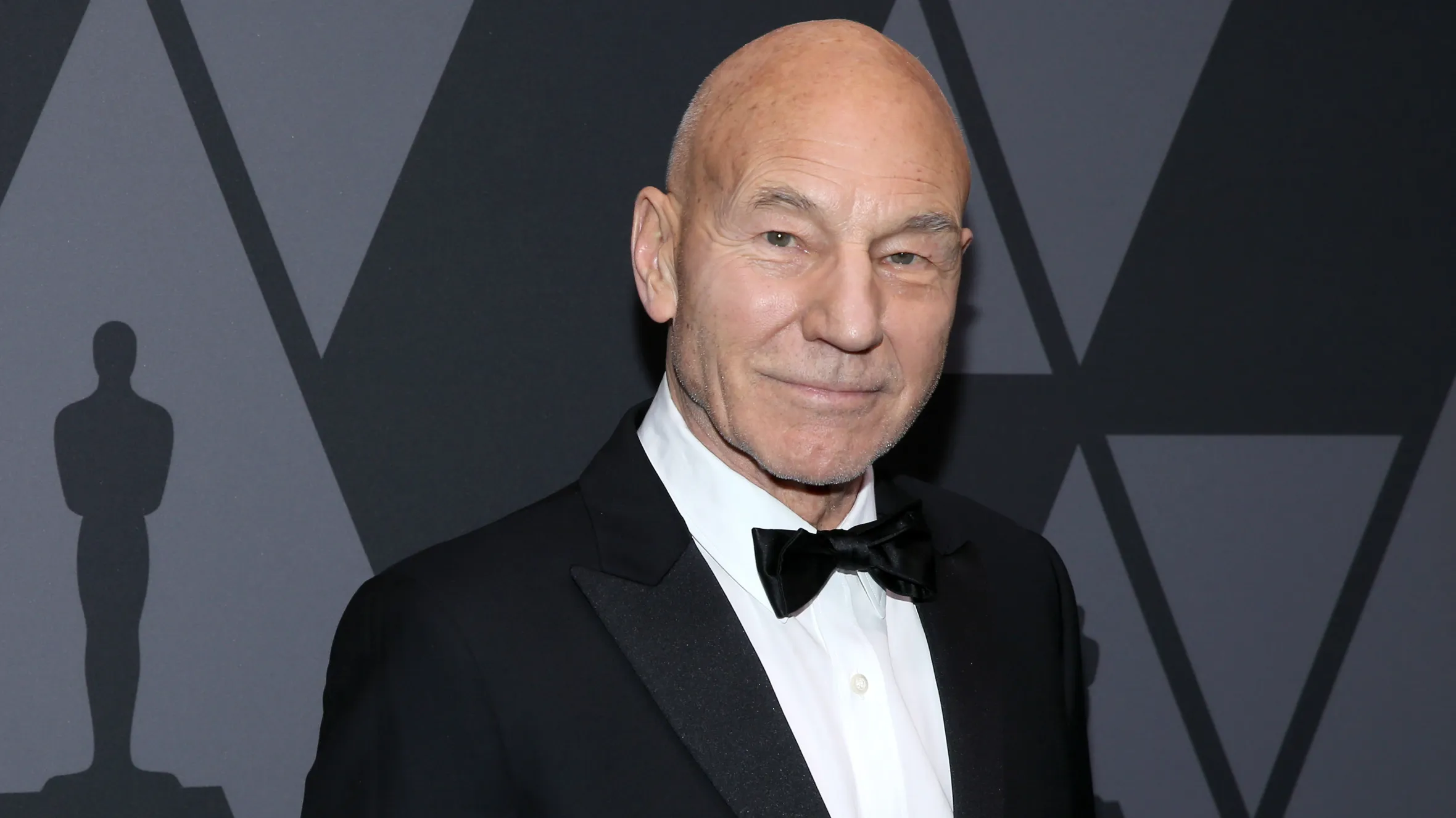
The entertainment industry has been thrown into mourning following the death of legendary British actor Sir Patrick Stewart, the internationally celebrated star whose unforgettable performances in Star Trek and the X-Men film franchise made him one of the most recognisable faces in television and cinema.
Stewart died on Wednesday, October 28, 2026, at the age of 86, at his home in Los Angeles, California. His death was announced on Thursday, October 29, by his longtime spokesperson, Kelly Bush Novak, who disclosed that the veteran actor had been living with Alzheimer’s disease and Lewy body dementia.
According to a statement shared on Stewart’s social media accounts, the actor passed away peacefully in the loving care of his wife, Sunny Ozell, following what was described as a brief and poignant journey with the two neurological conditions.
The statement read:
“We announce with great sorrow the passing of Sir Patrick Stewart yesterday at his home in Los Angeles, in the loving care of his beloved wife Sunny, following a brief and poignant journey with Alzheimer’s Disease and Lewy Body Dementia.
“He has been held in the warm embrace of family and friends, surrounded by live music, prayer, tears, laughter, and the kind of profound emotion that only he could inspire after a lifetime of devotion to us all.”
The announcement has sparked an outpouring of tributes from fans, fellow actors, entertainment personalities and admirers across the world, many of whom have celebrated Stewart’s extraordinary contribution to the performing arts.
Although millions knew him as Captain Jean-Luc Picard, the thoughtful and commanding leader of the USS Enterprise, or Professor Charles Xavier, the wise mentor of the X-Men, Stewart’s accomplishments extended far beyond Hollywood.
He was a highly respected Shakespearean actor whose career spanned more than six decades, encompassing theatre, television, film, voice acting and numerous acclaimed stage productions.
His passing marks the end of an extraordinary chapter in British and international entertainment.
Early Life and Background of Patrick Stewart
Sir Patrick Stewart was born on July 13, 1940, in Mirfield, West Yorkshire, England. He grew up in a working-class family, far removed from the glamour and international recognition that would eventually define his career.
His father, Alfred Stewart, served in the British Army, while his mother, Gladys, worked as a textile worker. He also grew up alongside his two older brothers, Geoffrey and Trevor.
Stewart’s childhood was not without difficulties. In later interviews and his autobiography, he spoke openly about growing up in a household affected by domestic violence. His father’s treatment of his mother became an important part of his personal story, and Stewart later used his public platform to support organisations working to combat domestic abuse.
Despite the challenges of his early years, he developed a passion for acting at a young age.
He attended Crowlees Church of England Junior and Infants School before continuing his education at Mirfield Secondary Modern School. His interest in drama grew through school performances and involvement in local theatre.
At the age of 15, Stewart left school and began working as a junior reporter and obituary writer for a local newspaper. However, his love for acting remained strong, and he eventually decided to pursue it professionally.
He trained at the Bristol Old Vic Theatre School, where he developed the classical acting skills that would become the foundation of his remarkable career.
His early professional journey was largely rooted in theatre, particularly Shakespearean productions. Rather than immediately pursuing film and television opportunities, Stewart dedicated himself to mastering the stage.
That decision would prove instrumental in shaping the performer audiences came to admire.
Patrick Stewart’s Rise to Fame Through Shakespeare and Theatre
Before becoming a global television and movie star, Stewart established himself as one of Britain’s respected stage performers.
In the 1960s, he joined the prestigious Royal Shakespeare Company (RSC), where he spent approximately 14 years performing in some of the most celebrated productions in classical theatre.
During his time with the company, he played several major Shakespearean characters, including Mark Antony, Henry IV, Shylock, Oberon and Claudius.
His years in theatre helped him develop the powerful voice, commanding presence, emotional intelligence and sophisticated delivery that would later distinguish his performances on screen.
Stewart was particularly passionate about Shakespeare and maintained his connection to classical theatre even after achieving international fame.
He performed in productions of Hamlet, Macbeth, Antony and Cleopatra and A Christmas Carol, among others.
His portrayal of Macbeth in a production directed by Rupert Goold received widespread critical acclaim. The production began at the Chichester Festival Theatre in 2007 before moving to London’s West End, Brooklyn and eventually Broadway in 2008.
The performance earned him his only Tony Award nomination, demonstrating that despite his success in Hollywood, his theatrical abilities remained central to his identity as an actor.
He also shared the stage with fellow British acting legend Ian McKellen in productions of Samuel Beckett’s Waiting for Godot and Harold Pinter’s No Man’s Land.
Their friendship extended beyond the theatre, with McKellen becoming one of Stewart’s closest colleagues and a fellow star in the X-Men franchise.
According to the Associated Press, Stewart won three Olivier Awards for his theatre performances and a Grammy Award in 1996 for Best Spoken Word Album for his recording of Peter and the Wolf.
These achievements reflected the remarkable range of a performer who could move effortlessly between classical theatre, science fiction, comedy and blockbuster cinema.
Becoming Captain Jean-Luc Picard in Star Trek

For many television audiences, Patrick Stewart will forever be remembered as Captain Jean-Luc Picard, the respected commander of the USS Enterprise in Star Trek: The Next Generation.
In 1987, Stewart accepted the role that would transform his career and introduce him to millions of viewers around the world.
Interestingly, he was not initially convinced that joining a science-fiction television series was the right career decision.
At the time, he was already an accomplished Shakespearean performer, and there were concerns that appearing in a syndicated science-fiction production might limit his opportunities in serious theatre.
However, he eventually accepted the offer and brought something different to the character of Captain Picard.
Rather than portraying a conventional action hero, Stewart presented Picard as an intelligent, disciplined, thoughtful and diplomatic leader who preferred negotiation and reason to unnecessary violence.
His Shakespearean background contributed significantly to the character’s distinctive manner of speaking and commanding personality.
Star Trek: The Next Generation ran from 1987 to 1994, spanning seven seasons and becoming one of the most successful instalments in the Star Trek universe.
Stewart appeared in 178 episodes, according to the Associated Press, helping establish Picard as one of the franchise’s most beloved characters.
His memorable expressions, particularly “Make it so” and “Engage”, became part of popular culture.
The show’s success also helped Stewart become a household name outside Britain, opening doors to major Hollywood opportunities.
He subsequently reprised the role in four feature films:
Star Trek Generations (1994).
Star Trek: First Contact (1996).
Star Trek: Insurrection (1998).
Star Trek: Nemesis (2002).

More than two decades after first portraying Picard, Stewart returned to the character in the television series Star Trek: Picard, which premiered in 2020 and concluded in 2023 after three seasons.
His return demonstrated the enduring popularity of the character and the special relationship he had developed with the Star Trek audience.
For many fans, Picard was more than a fictional starship captain. He represented leadership, compassion, courage, intellectual curiosity and the possibility of a better future for humanity.
Stewart’s performance helped give the character that lasting significance.
Patrick Stewart’s Iconic Role as Professor X in X-Men
While Star Trek established Patrick Stewart as an international television icon, his appearance in the X-Men film franchise introduced him to an entirely new generation of movie lovers.
In 2000, he made his debut as Professor Charles Xavier, popularly known as Professor X, in the first X-Men movie.
Based on Marvel Comics characters, the film explored the lives of mutants with extraordinary abilities who faced discrimination and hostility from sections of society.
Professor Xavier was the founder and leader of the X-Men, a group dedicated to protecting both mutants and humans.
As a powerful telepath, Xavier possessed the ability to read and influence people’s minds. However, his greatest strength was arguably his belief that different communities could coexist peacefully.
Stewart brought intelligence, authority, patience and compassion to the character, creating a memorable portrayal of a man who believed in education, understanding and peaceful coexistence.
His character also had a complicated relationship with Magneto, played by Ian McKellen.
Although the two characters frequently disagreed over how mutants should respond to discrimination and persecution, their friendship remained one of the most compelling elements of the franchise.
Stewart appeared in the original X-Men trilogy, including X2 (2003) and X-Men: The Last Stand (2006).
He subsequently returned in several instalments, including The Wolverine (2013), X-Men: Days of Future Past (2014), Logan (2017) and Doctor Strange in the Multiverse of Madness (2022).
His appearance in Logan was particularly memorable because it offered a more vulnerable and emotionally complex version of Professor Xavier.
The film explored ageing, mortality, memory and the consequences of a lifetime spent fighting for a cause.
His performance alongside Hugh Jackman was widely praised, with the film providing an emotional conclusion to the characters’ long cinematic journey.
Stewart’s Professor X became one of the most recognisable characters in superhero cinema, cementing his place in another major entertainment franchise.
Other Movies, Television Shows and Voice Acting Roles
Although Star Trek and X-Men remain the productions most closely associated with Patrick Stewart, his acting career included numerous other projects.
Before achieving international fame, he appeared in films such as Excalibur (1981), where he played Leondegrance, and Dune (1984), in which he portrayed Gurney Halleck.
He also appeared in L.A. Story (1991), Robin Hood: Men in Tights (1993) and Conspiracy Theory (1997).
His ability to balance serious dramatic performances with comedy made him a versatile performer.
In television, he demonstrated his comic abilities in Blunt Talk, a comedy series in which he played Walter Blunt, a British television journalist navigating life and work in Los Angeles.
He also lent his distinctive voice to animated productions, including The Simpsons, Futurama, Robot Chicken and The Emoji Movie.
These appearances introduced him to younger audiences who might not have been familiar with his extensive theatre background.
One of the most interesting aspects of Stewart’s career was his willingness to embrace different genres rather than remain confined to a single type of performance.
Whether playing a Shakespearean king, a starship commander, a mutant leader or a television comedian, he consistently brought his distinctive personality and professionalism to the screen.
Awards, Honours and Recognition
Patrick Stewart’s contribution to the entertainment industry earned him numerous awards, nominations and prestigious honours throughout his lifetime.
In 1996, he received a star on the Hollywood Walk of Fame, recognising his growing influence in the international entertainment industry.
In June 2010, he was knighted by Queen Elizabeth II for his services to drama, officially becoming Sir Patrick Stewart.
The honour recognised his outstanding contribution to British theatre, television and cinema.
His major career recognitions included:
Three Laurence Olivier Awards: For his outstanding performances in British theatre.
Grammy Award (1996): Best Spoken Word Album for Peter and the Wolf.
Tony Award nomination (2008): For his acclaimed Broadway performance in Macbeth.
Hollywood Walk of Fame (1996): Recognition of his contribution to the entertainment industry.
Knighthood (2010): Awarded for his services to drama.
Although he received international recognition for his television and film performances, Stewart remained deeply connected to theatre and frequently spoke about the importance of acting as an art form.
His achievements placed him among Britain’s most respected performers.
Patrick Stewart’s Marriage, Wife and Children
Beyond his professional accomplishments, Patrick Stewart experienced different chapters in his personal life.
He married his first wife, Sheila Falconer, in 1966. The marriage lasted until their divorce in 1990.
Together, they had two children, Daniel and Sophie.
Daniel Stewart followed his father’s footsteps into acting and appeared in projects including Star Trek: The Next Generation, where he played the character of Batai, the son of Timicin.
Stewart later married producer Wendy Neuss in 2000, although their marriage ended in divorce in 2003.
In 2013, he married American singer-songwriter Sunny Ozell in a ceremony officiated by his close friend and fellow actor Ian McKellen.
Their relationship attracted public attention partly because of their age difference, but Stewart frequently expressed his happiness with Ozell.
She remained his wife until his death and was reportedly by his side during his final moments at their Los Angeles home.
Stewart is survived by Sunny Ozell and his two children, Daniel and Sophie.
He also maintained friendships with several prominent actors, particularly Ian McKellen, Hugh Jackman and members of the Star Trek cast.
Patrick Stewart’s Humanitarian Work and Advocacy
Away from acting, Stewart was involved in several humanitarian and social causes.
One of the causes particularly close to his heart was the fight against domestic violence.
Having experienced the effects of domestic abuse during his childhood, he became an outspoken advocate for victims and survivors.
He supported Refuge, a British organisation that provides assistance and shelter to women and children experiencing domestic violence.
His advocacy was deeply personal. Rather than treating domestic violence as an issue that should remain hidden behind closed doors, Stewart frequently used his public profile to encourage conversations about abuse and accountability.
He also served as an ambassador for the International Rescue Committee, an organisation that assists people affected by humanitarian crises.
These activities demonstrated that his influence extended beyond entertainment.
His willingness to discuss difficult personal experiences also helped others understand that celebrities could use their platforms to support important social issues.
What Were Alzheimer’s Disease and Lewy Body Dementia?
The announcement of Patrick Stewart’s death also brought renewed attention to two serious neurological conditions: Alzheimer’s disease and Lewy body dementia.
According to the statement announcing his death, Stewart had been experiencing what his spokesperson described as a brief and poignant journey with both conditions.
The diagnoses had not previously been publicly disclosed.
Although Alzheimer’s disease and Lewy body dementia are different conditions, both affect the brain and can significantly interfere with a person’s ability to think, remember, communicate and carry out everyday activities.
Alzheimer’s disease is a progressive brain condition and the most common cause of dementia. It affects memory, thinking and behaviour, gradually making everyday activities increasingly difficult.
Lewy body dementia is another progressive neurological condition associated with abnormal protein deposits called Lewy bodies in the brain.
It can affect concentration, movement, sleep, behaviour, visual perception and memory. People living with the condition may also experience changes in alertness and periods of confusion.
It is possible for a person to have Alzheimer’s disease alongside Lewy body dementia, although the combination can make diagnosis and care particularly complicated.
Both conditions can affect not only the person living with them but also their families, friends and caregivers.
Stewart’s death has therefore drawn attention to the emotional and physical challenges associated with dementia, particularly the importance of support for families caring for loved ones with neurological illnesses.
Tributes Pour In Following Patrick Stewart’s Death
Following the announcement of his death, tributes began pouring in from colleagues, friends and fans who admired his remarkable career.
One of the most emotional reactions came from Hugh Jackman, who shared the screen with Stewart in several X-Men films.
Jackman described him as one of the greats of stage and screen, remembering not only his extraordinary talent but also their friendship.
He expressed gratitude for everything he had learned from Stewart and said he would miss him throughout his life.
His longtime friend Ian McKellen also paid tribute, remembering Stewart as a man who wore his heart on his sleeve and someone he deeply admired and loved.
William Shatner, who played Captain James T. Kirk in the original Star Trek television series, also expressed his sadness.
He described Stewart as a friend, colleague and magnificent actor who brought intelligence, grace and humanity to everything he did.
George Takei, another prominent member of the Star Trek universe, also joined those celebrating the actor’s life and influence.
The reactions reflected the special place Stewart occupied in the entertainment industry.
He was not simply remembered as an actor who played popular fictional characters but as a performer whose work inspired generations of aspiring actors and entertained millions of people across different cultures.
Patrick Stewart’s Legacy: An Actor Who Transcended Generations
Patrick Stewart’s death represents a significant loss to the global entertainment industry.
His career was unusual in many ways. While some actors achieve fame early in life, Stewart’s greatest international breakthrough came when he was already in his late forties.
Instead of allowing age to limit his opportunities, he embraced a new challenge that eventually transformed him into a global superstar.
His portrayal of Captain Jean-Luc Picard demonstrated that a science-fiction hero could be thoughtful, intelligent, compassionate and diplomatic.
His performance as Professor Charles Xavier similarly established a memorable superhero character whose strength was rooted not only in extraordinary abilities but also in wisdom, empathy and the pursuit of peaceful coexistence.
Beyond these roles, his dedication to Shakespeare and classical theatre demonstrated his commitment to the craft of acting.
He also showed that a successful career in entertainment could coexist with humanitarian advocacy and a willingness to speak openly about difficult personal experiences.
For Star Trek fans, he will always be the captain who commanded the USS Enterprise with intelligence and dignity.
For X-Men enthusiasts, he will remain the Professor X who believed in a world where people with different abilities and backgrounds could live together.
For theatre lovers, he will be remembered as an accomplished Shakespearean performer whose passion for the stage never disappeared, even after Hollywood fame arrived.
Sir Patrick Stewart leaves behind an extraordinary body of work that will continue to entertain and inspire audiences for generations.
He may have taken his final bow, but the characters he brought to life and the stories he helped tell will ensure that his legacy lives on.
Rest in peace, Sir Patrick Stewart (1940–2026).