

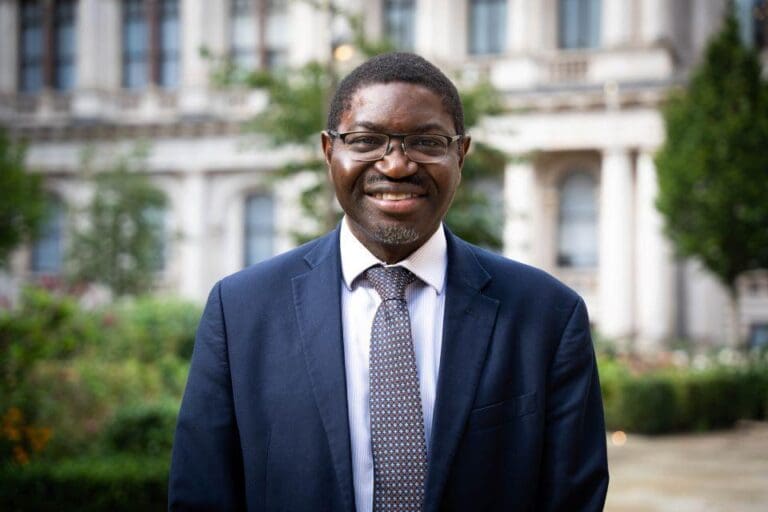
Professor Dapo Akande, a Nigerian-born international law scholar and one of the leading legal academics at the University of Oxford, has been elected as a judge of the International Court of Justice (ICJ), the principal judicial organ of the United Nations. His election on 3 November 2026 marks a major milestone in his distinguished legal career and ends the United Kingdom’s absence from the court’s bench since 2018.
Akande secured the required support in the first round of voting by the United Nations General Assembly and the UN Security Council. He received 129 votes in the General Assembly and 11 in the Security Council, comfortably exceeding the required absolute majorities in both bodies. He will take up his seat at the Peace Palace in The Hague on 6 February 2027 and serve a nine-year term running to 2036.
The appointment is significant for the United Kingdom, which campaigned strongly for his candidacy, and is also a notable moment for Nigeria, where Akande was born and first qualified as a lawyer. His career reflects the international reach of Nigerian-trained legal professionals and the role they can play in shaping debates on global justice, peace and international law.
A Major Appointment to the United Nations’ Highest Court
The International Court of Justice, commonly known as the World Court, was established under the United Nations system and began its work in 1946. Based in The Hague, Netherlands, it is made up of 15 judges who are elected by the General Assembly and Security Council for nine-year terms. Elections are held every three years for five seats, helping to maintain continuity in the court’s work.
The ICJ has two principal responsibilities. It hears legal disputes submitted by one state against another and gives advisory opinions on legal questions referred to it by authorised United Nations bodies and agencies. Its work covers a wide range of issues, including territorial disputes, maritime boundaries, diplomatic relations, the use of force, international humanitarian law and the interpretation of treaties.
Unlike a domestic court, the ICJ does not hear criminal cases against individuals. It is also different from the International Criminal Court (ICC), which prosecutes individuals accused of crimes such as genocide, war crimes and crimes against humanity. The ICJ deals primarily with the legal rights and obligations of states. This distinction is important because both institutions are frequently mentioned in international discussions about conflict and accountability, but their mandates are separate.
Judges elected to the ICJ are expected to act independently and impartially. Although Akande was nominated as the United Kingdom’s candidate, he will not sit on the bench as a representative or political advocate of the British government. Once elected, ICJ judges serve in their personal judicial capacity and are required to decide cases according to international law.
From Nigeria to the International Legal Stage
Akande’s professional journey began in Nigeria, where he was born and raised and where he qualified as a lawyer in 1993. He later developed an international academic and legal career, building a reputation as a specialist in public international law and the legal rules governing relations between states.
His academic career has included appointments at Durham University and the University of Oxford. He was a lecturer in law at Durham from 2000 to 2004 and later spent many years at Oxford’s St Peter’s College as Yamani Fellow in Public International Law. From 2018 to 2023, he served as Professor of Public International Law at Oxford’s Blavatnik School of Government.
In 2023, he became the Chichele Professor of Public International Law, one of the most distinguished academic chairs in the field. He is also a Fellow of All Souls College, Oxford, and co-director of the Oxford Institute for Ethics, Law and Armed Conflict. In addition to his academic responsibilities, he practises as a barrister at Essex Court Chambers.
Akande has also been a member of the United Nations International Law Commission since 2021. The commission is a body of independent legal experts established to promote the progressive development and codification of international law. Its work includes examining areas where international rules may need clarification, consolidation or further development.
A Career Shaped by Research and International Legal Practice
Akande’s influence extends beyond university teaching and academic writing. He has advised governments and international organisations on complex questions involving international law, armed conflict, human rights, international institutions and dispute settlement.
His professional work has involved organisations such as the United Nations, the African Union Commission, the Commonwealth Secretariat, the Council of Europe and the North Atlantic Treaty Organization. He has also contributed to international legal discussions involving the regulation of armed conflict and the application of international law to emerging areas such as cyber operations.
His experience in litigation and international dispute resolution is particularly relevant to his new position. Akande has acted as advocate, counsel, adviser or expert in proceedings before several international courts and tribunals, including the International Court of Justice itself, the International Criminal Court, the International Tribunal for the Law of the Sea, the European Court of Human Rights and the African Court on Human and Peoples’ Rights. He has also worked on matters before World Trade Organization panels and in national proceedings, including cases involving the United Kingdom Supreme Court.
This combination of academic research and practical courtroom experience gives him familiarity with both the principles of international law and the challenges involved in applying them to disputes between states. His work has covered subjects ranging from the law of international organisations and the use of force to international criminal law and the legal implications of digital and cyber operations.
He has also contributed to influential legal publications. Among his work is Oppenheim’s International Law: The United Nations, a major reference text on the legal framework of the United Nations. He was the founding editor of EJIL!, a widely read blog associated with the European Journal of International Law, and has served on the editorial or advisory boards of leading international law journals.
The Return of British Representation After Nearly a Decade
Akande’s election also carries diplomatic significance for the United Kingdom. Britain had maintained a judge on the ICJ from the court’s establishment in 1946 until the end of Sir Christopher Greenwood’s term in 2018. Greenwood failed to secure re-election in 2017, leaving the country without a permanent judge on the court for the first time in its history.
The absence was viewed as a setback for Britain’s influence and standing within one of the United Nations’ most important judicial institutions. The 2026 campaign therefore became a significant diplomatic effort, involving ministers and British officials seeking support from governments across different regions.
The United Kingdom’s candidate was elected after receiving 129 votes in the General Assembly, where 97 votes were needed for an absolute majority, and 11 votes in the Security Council, where the required threshold was eight. The election process requires candidates to secure separate majorities in both bodies. The five permanent members of the Security Council do not exercise their usual veto in ICJ judicial elections.
The successful campaign was supported by senior British officials, including Lord Chancellor and Justice Secretary Alex Norris. In a statement delivered at the United Nations on 29 October, Norris described Akande as a candidate with the qualities needed by the court at a time when international law is facing growing pressure.
“At a moment when international law is under pressure, Professor Akande brings the independence, legal rigour, judgement and breadth of perspective that the Court needs,” Norris said. “He would make a formidable contribution to its work.”
The British government also emphasised its commitment to the ICJ and encouraged countries that have not accepted the court’s compulsory jurisdiction to consider doing so in accordance with its statute. Prime Minister Andy Burnham and Foreign Secretary Ed Miliband also backed Akande’s candidacy, pointing to his legal expertise, integrity and international experience.
Akande Pledges Independence and Impartiality
In his reaction to the election, Akande expressed gratitude to the countries that supported his candidacy and described the appointment as a profound honour. He also acknowledged the responsibility that comes with serving on a court whose decisions can have far-reaching consequences for international relations.
“I pledge to serve with independence and to decide cases on the basis of a faithful and impartial application of the law,” he said.
His statement reflects a central principle of the ICJ: judges are not appointed to advance the interests of the countries that nominated them. Their responsibility is to assess arguments, interpret relevant legal instruments and reach decisions without political direction. The court’s authority depends significantly on public confidence that its members will apply the law consistently, regardless of the size, power or political influence of the states involved.
Akande also said he looked forward to contributing to the court’s work in resolving disputes through peaceful means alongside the other judges elected in the same round.
A Court Facing Intense International Scrutiny
Akande will join the ICJ at a time when its work is attracting significant attention. In recent years, the court has been involved in proceedings and advisory opinions concerning major international conflicts and questions about state responsibility.
One prominent example is the court’s work relating to Israel and the occupied Palestinian territory, including East Jerusalem and Gaza. On 19 July 2024, the ICJ issued an advisory opinion concluding that Israel’s continued presence in the Occupied Palestinian Territory was unlawful and that it was under an obligation to bring that presence to an end as rapidly as possible. The court also addressed settlement activity and the legal consequences of the situation for Israel and other states.
The opinion has been the subject of extensive international debate and has highlighted the importance of the court’s advisory function. Advisory opinions are generally consultative rather than binding in the same way as judgments in contentious cases, but they carry considerable legal authority and can influence the conduct and positions of states and international organisations.
The ICJ has also considered contentious proceedings arising from the war in Gaza, including the case brought by South Africa against Israel under the Genocide Convention. Such cases demonstrate how international law can become central to disputes involving armed conflict, civilian protection, humanitarian obligations and allegations of serious violations.
These issues will form part of the wider legal environment in which the court operates during Akande’s tenure. However, his election does not predetermine how he will approach any particular dispute. Any case assigned to the court will be considered under its applicable procedures, and judgments will be reached through the collective work of the judges.
What Akande’s Election Means for Nigeria and the Wider World
For Nigeria, Akande’s achievement is a source of international recognition for a legal professional whose early training took place in the country before his career expanded across leading academic and judicial institutions. His election may also draw attention to the value of legal education, scholarship and professional development in Nigeria and across Africa.
It is important, however, to distinguish his Nigerian background from the formal capacity in which he was elected. Akande stood as the United Kingdom’s candidate, and the United Nations election records identify him as a judge elected for the UK. His judicial duties will not be to represent Nigeria or Britain, but to serve independently as a member of the court.
His appointment also comes at a time when the international legal system faces questions about its effectiveness, the willingness of states to comply with court decisions and the ability of multilateral institutions to respond to conflicts. The ICJ cannot resolve every political disagreement, nor does it have its own enforcement force. Its influence rests on the authority of international law, the consent and participation of states, and the willingness of the international community to respect its decisions.
Akande’s combination of Nigerian legal training, international practice and academic experience places him in a strong position to contribute to the court’s deliberations. His nine-year term will provide an opportunity to bring his expertise to some of the most consequential legal questions facing the international community.
His election is therefore more than a personal career milestone. It marks the return of a British judge to the World Court, highlights the global reach of a Nigerian-born legal scholar and reinforces the continuing importance of independent judicial institutions in a world where disputes between states remain a major threat to peace and stability.