

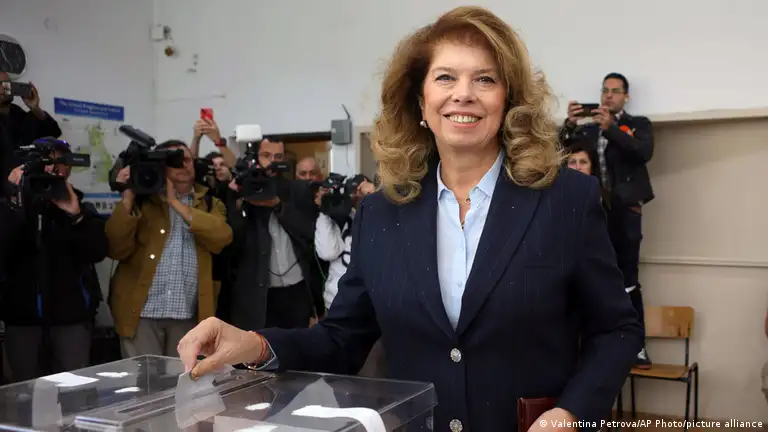
Bulgaria has entered a new chapter in its political history after Iliana Yotova emerged victorious in the country’s presidential runoff election, becoming the first woman ever elected to serve as its president. Her victory represents a significant milestone for women’s political representation in the European nation, following decades in which the country’s highest elected office had been occupied exclusively by men.
Yotova secured 57.58 per cent of the votes, according to near-final results released by Bulgaria’s Central Election Commission on Monday, November 2, 2026, after 99.95 per cent of polling station protocols had been processed.
Her presidential ticket, alongside running mate Kiril Valchev, defeated the opposition pairing of former caretaker Prime Minister Andrey Gyurov and Georgi Kandev, who received 39.47 per cent of the votes.
The outcome gives Yotova an electoral mandate after she had already been serving as Bulgaria’s acting president since January 2026, following the resignation of former President Rumen Radev.
Her election is particularly significant because it makes her not only Bulgaria’s first woman to hold the presidency on an elected basis but also a central figure in the country’s continuing political developments.
A Historic Victory for Women in Bulgarian Politics
Iliana Yotova’s victory marks an important moment in Bulgaria’s political history and the broader conversation about women’s participation in leadership and governance.
Although women have increasingly occupied influential positions in politics, business, diplomacy and public administration across Europe, the Bulgarian presidency had never previously been won by a woman through a national election.
Yotova’s achievement therefore represents a breakthrough in a country where the highest political office has traditionally been held by male politicians.
Her victory also demonstrates the growing visibility of women in senior political positions, particularly in European institutions, where female politicians have played important roles in shaping public policy, international relations and democratic governance.
For Bulgaria, the election creates an opportunity to reflect on the country’s political development and the changing role of women in its national leadership.
The significance of Yotova’s achievement extends beyond the election results themselves. Her journey from journalism to European parliamentary politics, then to the vice-presidency and eventually the presidency, illustrates a career spanning several important areas of public service.
Her election is also a reminder that political representation is not simply about occupying positions of authority but about ensuring that different groups have opportunities to participate in the institutions responsible for shaping their countries’ futures.
Election Results: Yotova Secures 57.58 Per Cent of the Votes
The presidential runoff election, held on Sunday, November 1, 2026, followed an inconclusive first round on October 25, when no presidential ticket secured the majority required to win outright.
In the first round, Yotova and Valchev finished ahead with approximately 34.76 per cent of the votes, while Gyurov and Kandev came second with approximately 31.95 per cent. Their performances qualified both tickets for the decisive second round.
The runoff produced a clearer outcome, with Yotova and Valchev securing 57.58 per cent of the votes, representing approximately 1.1 million ballots. Their opponents received about 39.47 per cent, equivalent to approximately 749,500 votes.
Meanwhile, approximately 2.95 per cent of voters selected the option indicating that they did not support any of the candidates.
The result confirmed Yotova’s victory and placed her in a historic position as the first woman elected to Bulgaria’s presidency.
However, the election was also characterised by relatively low voter participation. Reports put turnout at approximately 27 per cent, highlighting the continuing challenges of political participation and public engagement in the country.
The election results also revealed differences in voting patterns between domestic and overseas voters. According to Radio Bulgaria’s reporting on the near-final results, Yotova secured victories in 28 electoral districts, while Gyurov led in three, including two districts in Sofia and Kardzhali. Among Bulgarians voting abroad, Gyurov received a larger share of the votes counted at that stage.
The figures demonstrate that although Yotova secured the national victory, the electorate remained divided across geographical and political lines.
Who Is Iliana Yotova? A Look at Her Background and Political Journey
Iliana Yotova, born on October 24, 1964, in Sofia, Bulgaria, is a Bulgarian politician, former journalist and European parliamentarian whose career has developed across media, national politics and European institutions.
Before becoming president, she built a professional background that combined communication, public affairs and political representation.
Her educational journey began in Sofia, where she attended the Alphonse de Lamartine French Language School. She later graduated from Sofia University St. Kliment Ohridski with a degree in Bulgarian philology.
She also pursued specialised studies in France, including training at the National School of Administration (ENA) and the Centre for European Studies in Strasbourg.
Her academic background provided a foundation for a career that would eventually take her into journalism, political communication and public administration.
From Journalism to National Politics
Before entering the political arena, Yotova worked as a journalist at Bulgarian National Television, one of the country’s major public broadcasters.
Her experience in the media industry helped her develop skills in communication, public information and understanding political developments.
Between 1990 and 1997, she worked in different journalistic positions, including as a reporter, editor and head of the directorate responsible for news and current affairs programmes.
Her transition from journalism into politics began in the late 1990s, when she became involved in the Bulgarian Socialist Party’s political and communication structures.
She subsequently served as head of the party’s press office and became involved in its leadership activities.
In 2005, Yotova entered the Bulgarian National Assembly as a member of parliament, marking another significant stage in her political development.
Her experience in national politics eventually opened the door to a broader European political career.
Her Ten Years in the European Parliament
One of the most important stages of Yotova’s political career was her membership of the European Parliament between 2007 and 2017.
During her decade in the European legislature, she participated in parliamentary committees dealing with issues such as the internal market, consumer protection, fisheries, employment, social affairs, civil liberties and justice.
She also served on a special committee concerned with organised crime, corruption and money laundering between 2012 and 2013.
Her European parliamentary experience exposed her to international policymaking and the political relationships that shape the European Union.
Bulgaria joined the European Union in 2007, the same year Yotova began her parliamentary service in the institution. Her decade in the European Parliament therefore coincided with an important period in her country’s integration into European political and economic structures.
That experience became an important part of her political profile before she returned to the centre of Bulgarian national politics as a vice-presidential candidate.
From Vice-President to Acting President
Yotova’s rise to the presidency was closely connected to her political partnership with Rumen Radev.
In November 2016, she was elected vice-president of Bulgaria alongside Radev, who won the presidential election that year.
The pair officially assumed office in January 2017.
Their political partnership continued into the 2021 presidential election, when they secured another term, allowing Yotova to remain vice-president for a second consecutive five-year term.
Her time as vice-president gave her experience in the country’s highest political institution and placed her in a position to assume greater responsibility when the presidency became vacant.
The major turning point came in January 2026, when Radev announced his resignation.
Radev stepped down to pursue a parliamentary political career, leaving Yotova to assume the responsibilities of head of state.
On January 23, 2026, she officially took over the presidency following the Constitutional Court’s formal termination of Radev’s presidential powers.
Her assumption of office made her the first woman to serve as Bulgaria’s president, although she initially held the position through succession rather than a direct presidential election.
The November 2026 runoff victory has now given her an electoral mandate of her own, establishing her place in Bulgarian history as the country’s first elected female president.
What Her Victory Means for Bulgaria’s Political Future
Beyond its historical significance for women’s representation, Yotova’s election carries important political implications for Bulgaria, particularly concerning the country’s domestic political direction and international relationships.
Bulgaria is a member of both the European Union and the North Atlantic Treaty Organization (NATO). It joined NATO in 2004 and became an EU member in 2007, making its political and diplomatic relationships with European and international partners important to its national interests.
Yotova’s political position is particularly relevant because she is an ally of Rumen Radev, whose Progressive Bulgaria party endorsed her presidential candidacy.
Radev’s political influence remains significant following his party’s performance in the April 2026 parliamentary election, when Progressive Bulgaria secured 131 of the 240 seats in parliament.
Her victory therefore represents a continuation of the political influence associated with Radev’s political movement, although the presidency and parliament have different constitutional responsibilities.
On international affairs, Yotova and Radev have both called for a diplomatic resolution to Russia’s war in Ukraine. Yotova has also opposed further Bulgarian military assistance to Ukraine, arguing that the conflict requires a diplomatic rather than military solution.
Her position has attracted attention because Bulgaria’s relationship with Russia remains a subject of political debate, particularly following Moscow’s invasion of Ukraine.
While some political groups support stronger cooperation with Ukraine and closer alignment with Western security policies, others favour diplomatic engagement with Moscow and a different approach to the conflict.
During the election campaign, her opponent, Andrey Gyurov, received support from pro-Western reformist political groups and expressed support for Ukraine. He had also signed a security cooperation agreement with Kyiv while serving as caretaker prime minister.
The election consequently reflected differences in political approaches to foreign policy, regional security and Bulgaria’s relationship with international partners.
However, Yotova’s victory does not automatically mean that Bulgaria’s foreign policy will undergo dramatic changes. The country’s parliament retains most decision-making powers, and major government policies require parliamentary approval.
Understanding the Powers of the Bulgarian President
Although the Bulgarian presidency is primarily ceremonial, the position carries important constitutional responsibilities.
The president serves as the country’s head of state, represents Bulgaria in international relations and performs duties connected to national security and the constitutional system.
Among the president’s responsibilities are serving as commander-in-chief of the armed forces, signing international treaties and appointing ambassadors.
The president also has the authority to veto legislation passed by parliament, although the legislature can reconsider and override such a veto under the country’s constitutional procedures.
This means that while the president does not exercise the same executive powers as the prime minister, the office remains an important part of Bulgaria’s political structure.
Yotova’s presidency will therefore involve balancing the responsibilities of national representation, constitutional oversight and international diplomacy.
Her relationship with the government and parliament will also be important in determining how effectively the country’s political institutions work together.
According to the Associated Press, Bulgarian presidents are elected for five-year terms and cannot serve more than two terms.
Following her electoral victory, Yotova is expected to be inaugurated on January 22, 2027, for her new five-year presidential term, with Kiril Valchev serving as vice-president.
Kiril Valchev: The Man Joining Yotova in Bulgaria’s New Presidential Leadership
Another important figure in the election is Kiril Valchev, who contested alongside Yotova as her vice-presidential running mate.
Valchev is a lawyer and journalist who has served as the head of the Bulgarian News Agency since 2021.
His professional background in law and journalism brings experience in public communication and institutional affairs to the incoming presidential leadership.
By winning the election together, Yotova and Valchev will form Bulgaria’s next presidential and vice-presidential team.
Their responsibilities will include representing the country at home and abroad, carrying out constitutional duties and contributing to the functioning of Bulgaria’s democratic institutions.
Valchev’s appointment is also significant because the Bulgarian vice-president is an elected constitutional office rather than simply an informal political advisory position.
International Reactions to Yotova’s Election
Yotova’s victory has attracted attention beyond Bulgaria, particularly because of its historical significance and the country’s position within the European Union.
European Commission President Ursula von der Leyen congratulated the newly elected president and expressed interest in continuing cooperation with Bulgaria on issues including security, defence, competitiveness and energy independence.
Her message highlighted the importance of Bulgaria’s continued participation in European affairs and its cooperation with other EU member states.
Yotova, in her post-election remarks, emphasised national consensus, dialogue and the importance of institutions working in the interests of citizens.
She also spoke about maintaining a strong Bulgaria with its own foreign policy within a strong Europe.
Her comments suggest that national unity and institutional cooperation will feature prominently in the political direction she intends to pursue.
Meanwhile, Gyurov accepted the election outcome and acknowledged that the results reflected the decision of Bulgarian voters.
His concession marked the conclusion of a competitive presidential contest that had attracted considerable attention because of its implications for Bulgaria’s domestic politics and international relationships.
A Milestone for Women in Global Leadership
Yotova’s election also adds to the growing list of women who have occupied some of the highest political offices around the world.
Across different continents, women have increasingly assumed leadership responsibilities as presidents, prime ministers, parliamentary speakers and heads of major international institutions.
Figures such as Germany’s former Chancellor Angela Merkel, Liberia’s former President Ellen Johnson Sirleaf, Tanzania’s former President Samia Suluhu Hassan and Mexico’s President Claudia Sheinbaum have demonstrated the increasing presence of women in national leadership.
However, women’s representation in the highest levels of political authority remains uneven across countries.
In many societies, women continue to encounter institutional, cultural and political barriers when seeking elected office.
Yotova’s achievement is therefore particularly relevant to discussions about political representation and equal opportunities in public leadership.
For young women in Bulgaria and elsewhere, her election provides another example of a woman progressing through different professional and political institutions before reaching the highest elected office in her country.
Nevertheless, the historical importance of her election will ultimately be considered alongside her performance in office, the policies she supports and her ability to fulfil the responsibilities of the presidency.
Her victory does not automatically resolve the broader challenges facing women in politics, but it adds a significant chapter to the history of female political representation in Europe.
What Lies Ahead for Bulgaria’s First Elected Female President?
As Yotova prepares to begin her elected presidential term in January 2027, attention will increasingly shift from the historic nature of her victory to the responsibilities and challenges associated with the office.
Her administration will face questions surrounding national unity, economic development, European cooperation, regional security and Bulgaria’s foreign policy relationships.
The country will also need to navigate political disagreements over the war in Ukraine and its broader diplomatic relationship with Russia.
Another important consideration will be the relationship between the presidency, parliament and the government.
With Radev’s political movement holding a parliamentary majority and Yotova emerging from the same political alliance, the interaction between the country’s institutions will remain an important issue for observers.
Her ability to maintain dialogue across political divisions will be particularly relevant, especially given her post-election emphasis on national consensus.
Bulgaria’s economic and social priorities will also remain central to public expectations. Citizens will look to political leaders to address issues affecting their everyday lives, including employment, living standards, public services and confidence in democratic institutions.
Although the president does not control all these policy areas directly, the office provides an important platform for national representation and constitutional oversight.
For Yotova, the next five years will offer an opportunity to establish her own presidential legacy while navigating the political relationships and international challenges surrounding Bulgaria.
Conclusion
Iliana Yotova’s victory in Bulgaria’s November 1, 2026, presidential runoff represents a defining moment in the country’s political history.
By securing 57.58 per cent of the votes, she defeated Andrey Gyurov and became the first woman elected to Bulgaria’s highest political office.
Her journey from journalism to national politics, the European Parliament, the vice-presidency and eventually the presidency reflects decades of involvement in public affairs.
Although she had already assumed the presidency in January 2026 following Rumen Radev’s resignation, her election victory has given her a direct mandate from voters.
Her achievement is significant not only for Bulgaria but also for the wider international conversation about women’s participation in politics and leadership.
As she prepares for her inauguration in January 2027, the focus will be on how she approaches the country’s political divisions, international relationships and constitutional responsibilities.
For Bulgaria, the election marks the beginning of a historic presidential chapter. For women aspiring to leadership positions around the world, Yotova’s achievement adds another example of a woman reaching the highest elected office in her country.
Ultimately, her legacy will be shaped not only by being the first elected female president but also by the decisions, policies and leadership she delivers during her time in office.