

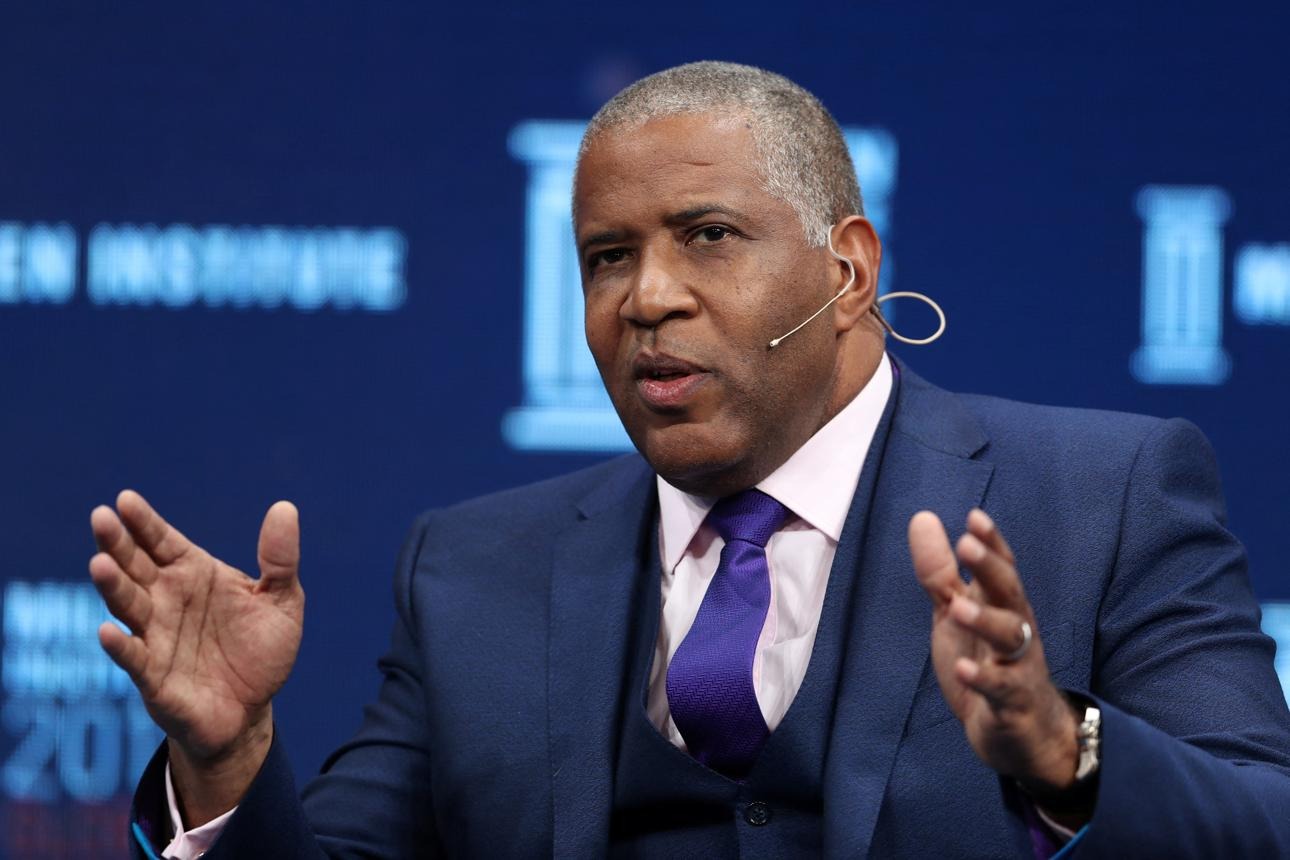
Robert Frederick Smith is one of America’s most influential Black business leaders, renowned for building a multibillion-dollar investment empire in the technology industry while using his wealth to support education, economic empowerment, and opportunities for underserved communities.
As the founder of Vista Equity Partners, a leading private investment firm specializing in enterprise software, Smith has established himself as a major figure in the global technology investment landscape. His business achievements have placed him among the wealthiest African Americans in the United States, demonstrating the growing influence of Black entrepreneurs and investors in industries traditionally dominated by established financial institutions.
However, Smith’s influence extends beyond corporate boardrooms and investment portfolios. He has attracted international attention for his philanthropic activities, particularly his extraordinary commitment to helping students overcome financial barriers to higher education.
One of his most remarkable contributions came in May 2019, when he announced that he would pay off the student loan debt of the graduating class of Morehouse College, a historically Black men’s college in Atlanta, Georgia. The announcement transformed the graduation ceremony into a historic moment and highlighted the enormous difference that private philanthropy can make in addressing educational inequality.
Smith’s journey is significant not simply because of the wealth he has accumulated, but because of how he has used his professional success to influence conversations about financial inclusion, educational access, racial inequality, and the responsibilities of wealthy individuals toward society.
His story represents an important example of Black excellence in the American business world and illustrates how investment, entrepreneurship, and philanthropy can combine to create opportunities for future generations.
Early Life and Educational Background
Robert F. Smith was born on December 1, 1962, in Denver, Colorado, United States. He grew up in a family that placed considerable importance on education, discipline, and professional development.
His parents were educators, and their commitment to learning helped shape his outlook on life. Growing up in an environment where education was highly valued influenced his determination to pursue academic excellence and develop the skills necessary to succeed in competitive professional environments.
Smith attended East High School in Denver, where he demonstrated an early interest in science and technology. His curiosity about engineering and how things worked eventually led him toward a career in the technical and business fields.
After completing high school, he enrolled at Cornell University, one of America’s leading institutions of higher learning. He studied chemical engineering and graduated in 1985.
His engineering education provided him with a strong foundation in analytical thinking, problem-solving, and technical innovation. These abilities would later become valuable in his investment career, particularly when evaluating technology companies and identifying businesses with the potential for long-term growth.
Following his undergraduate education, Smith pursued further studies at Columbia Business School, where he earned a Master of Business Administration degree in 1994.
His combination of engineering and business qualifications gave him a distinctive professional advantage. Rather than approaching investments exclusively from a financial perspective, he developed the ability to understand the technology behind businesses while also examining their commercial potential.
This combination would eventually become one of the defining characteristics of his investment strategy.
Building a Career in Technology and Finance

Before establishing his own investment firm, Smith gained considerable experience working with some of the world’s most prominent financial and technology companies.
One of the most important stages of his professional career was his employment at Goldman Sachs, the global investment banking institution.
At Goldman Sachs, he worked in technology investment banking, where he advised companies on mergers, acquisitions, and other financial transactions. His responsibilities exposed him to the business structures of major technology companies and gave him valuable insight into how investors could identify, finance, and expand promising enterprises.
During his time at the institution, Smith worked with major technology businesses and developed an understanding of the growing importance of software in the global economy.
He recognized that software was becoming an essential component of modern business operations. Companies across different industries were increasingly depending on specialized technology to manage their operations, improve productivity, protect information, and serve customers.
Rather than treating technology as a temporary business trend, Smith understood that enterprise software would become a permanent foundation of the modern economy.
This realization helped shape his decision to establish an investment firm focused specifically on software businesses.
His experience at Goldman Sachs also taught him the importance of disciplined financial management, effective corporate leadership, and strategic planning. These lessons would become central to the investment philosophy he later introduced through Vista Equity Partners.
The Founding of Vista Equity Partners: Building a Technology Investment Empire

In 2000, Smith took a major step that would change the direction of his career and establish his place among America’s most successful Black entrepreneurs. He founded Vista Equity Partners, an investment firm dedicated to investing in enterprise software companies.
At the time, the technology industry was experiencing significant changes. Businesses were increasingly adopting digital systems to improve their operations, manage information, communicate with customers, and increase efficiency.
Smith believed that enterprise software would become one of the most important sectors of the global economy. He saw opportunities in companies producing the technology that organizations needed to operate effectively.
His investment philosophy was built around identifying promising software businesses, acquiring stakes in them, improving their management structures, and helping them achieve sustainable growth.
Unlike investment firms that spread their resources across numerous unrelated industries, Vista developed a specialized focus on enterprise software. This allowed the company to build considerable expertise in understanding the unique challenges and opportunities within the technology sector.
Enterprise software refers to digital applications and systems designed to help businesses manage important operations. These include financial management, human resources, cybersecurity, customer relationship management, data analysis, and other essential business functions.
As organizations increasingly depended on digital infrastructure, demand for these services expanded. Vista positioned itself to benefit from this transformation.
Under Smith’s leadership, the firm developed an investment approach that combined financial discipline with operational improvements. Rather than simply providing money to businesses, Vista worked with company executives to improve leadership, strengthen management systems, expand operations, and increase long-term business value.
The firm’s growth has been remarkable. According to Vista’s published figures, as of June 30, 2026, it managed approximately $103 billion in assets and maintained a portfolio of more than 85 enterprise software, data, and technology-enabled companies. The businesses in its portfolio employed more than 95,000 people worldwide.
Vista also reported that its investment activities had involved more than 690 completed transactions, representing over $350 billion in aggregate transaction value. These figures demonstrate the scale of the investment platform Smith established.
His success in building Vista has made him an influential figure in private equity, particularly in the specialized business of investing in enterprise technology.
More importantly, he demonstrated that Black entrepreneurs could establish and lead major investment institutions capable of competing at the highest levels of global finance.
Breaking Barriers as a Black Business Leader
The significance of Smith’s achievements becomes even clearer when considered against the historical challenges faced by Black entrepreneurs in the United States.
For generations, African Americans have encountered structural barriers to accessing investment capital, establishing major financial institutions, and participating equally in industries that control substantial economic resources.
Private equity, in particular, has historically been an industry in which leadership positions and investment opportunities have been concentrated among a relatively small group of wealthy and well-connected individuals.
Smith’s emergence as the founder and chief executive of a major private investment firm represents an important achievement in this environment.
He did not simply build a successful technology company. He established an investment institution that provides capital to other businesses, influences corporate leadership, and participates in transactions involving billions of dollars.
This position gives him an influence that extends beyond his personal business interests.
Through Vista, Smith has helped shape the development of companies responsible for providing technology services to businesses, government institutions, and other organizations.
His achievements have also challenged conventional perceptions about who can occupy the highest positions in American finance.
For young Black professionals interested in engineering, investment banking, entrepreneurship, and technology, his career provides an example of how technical education, financial knowledge, strategic thinking, and long-term commitment can open doors to significant opportunities.
His success also highlights the importance of representation in industries where Black professionals have historically been underrepresented.
The Historic Morehouse College Student Debt Announcement

Although Smith had already established himself as a successful investor, one of the most memorable moments of his public life came in May 2019, when he delivered the commencement address at Morehouse College in Atlanta.
Morehouse College is one of America’s most respected historically Black colleges and universities (HBCUs). It has educated generations of influential African American leaders, including civil rights activists, politicians, business executives, and academics.
During the graduation ceremony, Smith made an announcement that stunned the graduating students, their families, and the wider public.
He pledged to eliminate the student loan debt of the entire graduating class of 2019.
The announcement immediately transformed the atmosphere of the ceremony. Students who had spent years worrying about how they would repay their educational loans suddenly received the possibility of beginning their professional lives without that financial burden.
Smith’s commitment was subsequently expanded to include educational loans held by the graduates’ parents and guardians on their behalf.
The total cost of the commitment was widely reported at approximately $34 million, making it one of the most significant individual gifts to a graduating class in American higher education.
The announcement attracted international attention because student debt is a major challenge in the United States.
Many American students depend on loans to finance their university education. After graduation, they often enter the workforce carrying substantial financial obligations.
These debts can affect their ability to purchase homes, establish businesses, save for retirement, support family members, and pursue further education.
For graduates from economically disadvantaged backgrounds, the burden can be particularly difficult.
Smith’s intervention demonstrated what could happen when substantial private wealth was directed toward addressing an immediate educational challenge.
Instead of simply donating money toward the construction of buildings or funding an institution’s general operations, he directly addressed a financial burden affecting hundreds of young graduates.
The gesture also carried a powerful symbolic message: talented young people should not have their future opportunities restricted by the cost of obtaining an education.
Morehouse College subsequently became an international example of how private philanthropy could make a direct difference in the lives of students.
The announcement also strengthened Smith’s reputation as a philanthropist whose giving was closely connected to his personal experiences and commitment to expanding opportunities for Black Americans.
Establishing the Student Freedom Initiative
Smith’s commitment to Morehouse graduates was not intended to remain an isolated act of generosity.
He recognized that student debt was a much larger problem affecting thousands of students, particularly those attending historically Black colleges and other minority-serving institutions.
To address this broader challenge, the Student Freedom Initiative (SFI) was established.
The initiative seeks to reduce the financial pressures associated with higher education and provide students with greater freedom to make professional and personal decisions after graduation.
Its initial focus included students pursuing science, technology, engineering, and mathematics (STEM) degrees at HBCUs and other minority-serving institutions.
The initiative received an initial $50 million contribution from Fund II Foundation, the charitable organization of which Smith is the founding director and president. Smith subsequently matched that contribution in October 2020.
This financial commitment helped create a broader structure for supporting students beyond the graduating class at Morehouse.
The initiative focuses on making higher education more affordable through financial support, flexible financing arrangements, student services, internships, and career development opportunities.
Its underlying philosophy is that students should be able to pursue careers based on their abilities, ambitions, and interests rather than being forced to make every decision around the need to repay overwhelming educational debts.
For example, a graduate carrying substantial student loans may feel compelled to accept the highest-paying job immediately, even if another opportunity offers better long-term professional development.
By reducing financial pressure, initiatives such as SFI aim to give graduates greater flexibility in determining their futures.
This is particularly important for students from low-income families who may not have access to the financial support available to their wealthier counterparts.
Smith’s approach therefore goes beyond paying off loans. It seeks to improve the economic conditions under which students enter the workforce.
Supporting Education and the Next Generation of Black Professionals
Education remains one of the central pillars of Smith’s philanthropic activities.
His contributions reflect a belief that talent exists in every community, but access to the resources required to develop that talent is not equally distributed.
He has supported institutions that helped shape his own professional journey, including Cornell University and Columbia Business School.
His relationship with Cornell University has been particularly significant.
In 2016, Smith and Fund II Foundation made a combined $50 million contribution to Cornell. In 2022, he also contributed $15 million to the university’s College of Engineering to establish scholarship funds.
At Columbia Business School, he has supported initiatives intended to expand educational opportunities for students. In 2022, he donated $10 million to establish the Robert F. Smith ’94 Scholarship Fund, which supports students with financial needs.
These contributions demonstrate his willingness to invest in institutions that develop future engineers, entrepreneurs, business leaders, and innovators.
His educational philanthropy is also important because it creates opportunities for students who may otherwise struggle to access elite academic institutions.
By supporting scholarships and financial assistance, Smith is helping reduce some of the economic obstacles that prevent talented students from receiving advanced education.
His work also sends a message to successful Black professionals that giving back to educational institutions can have an impact that extends far beyond one generation.
Fund II Foundation: Expanding Philanthropy Beyond Education
Another important part of Smith’s philanthropic activities is his leadership of Fund II Foundation, where he serves as founding director and president.
The foundation supports initiatives designed to improve the lives of underserved communities and expand access to opportunities.
Its areas of interest include cultural preservation, social justice, environmental conservation, music and arts education, healthcare, and career development.
One particularly important aspect of its work involves preserving the history and cultural contributions of African Americans.
For centuries, Black Americans have played significant roles in shaping American society, politics, business, music, science, and culture. However, many aspects of their history have received inadequate recognition or preservation.
Through Fund II Foundation, Smith has supported projects that help document, preserve, and promote the African American experience.
The foundation also supports initiatives that provide educational and professional opportunities to young people who may lack access to important resources.
One example is internXL, a platform designed to connect talented students with internship opportunities at leading companies.
Internships are particularly important for young professionals because they provide practical experience, professional connections, mentorship, and exposure to workplace environments.
For students from disadvantaged backgrounds, access to these opportunities can make a significant difference in their future careers.
Smith understands that academic qualifications alone do not always guarantee professional success. Young people also need access to networks, mentors, professional experience, and opportunities to demonstrate their abilities.
By supporting initiatives that connect students with employers, he is helping address some of the structural challenges that prevent talented individuals from entering competitive industries.
Fund II Foundation’s activities demonstrate that Smith’s philanthropy is not limited to writing large cheques. It also involves building programmes and supporting organizations capable of creating lasting social benefits.
Supporting Healthcare and Improving Access to Medical Services
Smith has also directed significant philanthropic resources toward healthcare, particularly initiatives addressing health inequalities affecting African American communities.
One of his notable contributions involved supporting prostate cancer research and early detection.
In 2018, he made a $2.5 million donation to establish the Robert Frederick Smith Precision Oncology Center of Excellence at the Jesse Brown VA Medical Center in Chicago.
He also supported the development of the Smith Polygenic Risk Test for Prostate Cancer through a partnership with the Prostate Cancer Foundation.
The test is designed to use genetic information to help assess an individual’s risk of developing prostate cancer, potentially supporting earlier identification and more informed medical decisions.
This area of philanthropy is important because health inequalities continue to affect different communities in the United States.
Black Americans experience disparities in access to healthcare, preventive screening, and treatment for certain medical conditions.
Smith’s support for medical research and screening initiatives reflects his understanding that economic empowerment must also include access to quality healthcare.
He has also supported efforts to improve breast cancer awareness and healthcare access among African American women through initiatives associated with the Susan G. Komen organization.
These contributions demonstrate his interest in addressing social challenges through research, institutional partnerships, and targeted financial support.
Making History Through the Giving Pledge
In 2017, Smith achieved another significant milestone when he became the first Black American to sign the Giving Pledge.
The Giving Pledge is a philanthropic initiative established by billionaires Warren Buffett and Bill Gates, encouraging wealthy individuals and families to commit more than half of their wealth to charitable causes during their lifetimes or through their estates.
By joining the initiative, Smith publicly demonstrated his commitment to directing a substantial portion of his wealth toward projects that could improve society.
His decision was particularly significant because it highlighted the importance of Black participation in major global philanthropic movements.
Smith has frequently connected his achievements to the sacrifices made by previous generations of African Americans.
He acknowledges that his opportunities were made possible partly through the struggles, achievements, and contributions of people who came before him.
This perspective has influenced his philanthropic philosophy.
Rather than viewing wealth simply as a personal accomplishment, he sees it as a resource that can help remove obstacles for others.
His participation in the Giving Pledge therefore represents more than a financial commitment. It reflects his belief that successful individuals have a responsibility to help create opportunities for future generations.
Leadership and Recognition on the Global Stage
Smith’s achievements in business and philanthropy have earned him recognition from several prominent institutions.
In 2016, he became chairman of the board of trustees of Carnegie Hall in New York, making history as the first Black person to hold the position.
This appointment was significant because Carnegie Hall is one of the world’s most respected cultural institutions.
His involvement reflects his interest in expanding access to arts education and creating opportunities for young people to develop their musical abilities.
In 2019, Smith received the Carnegie Medal of Philanthropy in recognition of his contributions to society and his commitment to improving educational opportunities.
In 2020, he was included in TIME magazine’s list of the 100 most influential people in the world.
He has also received recognition from organizations including the Congressional Black Caucus Foundation, the Jackie Robinson Foundation, and the Robert Toigo Foundation.
These awards reflect the breadth of his influence across business, education, civil rights, and philanthropy.
His recognition is not limited to his financial achievements. Many of the institutions that have honoured him have emphasized his commitment to expanding opportunities for communities that have historically experienced economic and social disadvantages.
His Impact on Black Economic Empowerment
One of the most important aspects of Robert F. Smith’s story is the example he provides for Black economic empowerment.
His career demonstrates that Black professionals can move beyond traditional employment structures and become owners, investors, institution builders, and influential decision-makers in major industries.
Through Vista Equity Partners, Smith has established a powerful investment platform that participates in the development and expansion of technology businesses.
His achievements are particularly relevant at a time when technology is increasingly determining the direction of global economic growth.
Industries such as artificial intelligence, cybersecurity, financial technology, cloud computing, and enterprise software are creating new opportunities for wealth creation.
However, access to investment capital, advanced education, and professional networks remains unevenly distributed.
Smith’s success illustrates the importance of increasing Black participation in these industries, not only as employees but also as business owners, investors, innovators, and corporate leaders.
His philanthropy complements this business achievement by helping young people access education, internships, professional networks, and other resources required to participate in the modern economy.
This creates a connection between wealth creation and social development.
For example, supporting a young Black engineering student through university may eventually help produce a software developer, technology entrepreneur, researcher, or business executive.
Similarly, providing internships and mentorship can help young graduates enter industries that might otherwise be difficult to access.
Smith’s activities therefore contribute to a broader conversation about how wealth can be used to create economic opportunities that extend beyond individual success.
Conclusion
Robert F. Smith’s journey from Denver, Colorado, to becoming one of America’s most influential Black investors is a remarkable story of education, ambition, strategic thinking, entrepreneurship, and philanthropy.
Through Vista Equity Partners, he built a major investment institution that has helped shape the enterprise software industry and established him as a significant figure in global private equity.
Yet, his impact cannot be measured solely by the size of his business empire or his personal wealth.
His historic commitment to eliminating the student loan debt of Morehouse College’s graduating class in 2019 demonstrated how private wealth could be used to address an important social challenge.
Through Fund II Foundation, Student Freedom Initiative, healthcare programmes, and educational contributions, he has continued supporting initiatives designed to improve opportunities for underserved communities.
His achievements also carry a broader message about Black representation in global business.
For generations, African Americans have fought to overcome barriers to education, employment, entrepreneurship, and financial independence. Smith’s success demonstrates what can be achieved when talent, education, access to opportunity, and determination come together.
He has shown that Black excellence is not limited to entertainment, sports, politics, or activism. It is also flourishing in technology investment, corporate leadership, financial management, and global philanthropy.
Perhaps the most important part of his legacy is the opportunity he is helping create for others.
By investing in businesses, supporting students, funding research, and preserving African American history, Robert F. Smith is contributing to a future in which more people can participate in economic growth and innovation.
His story is therefore not simply about a Black billionaire who built a successful investment firm. It is about a businessman who has used his influence to demonstrate that financial success and social responsibility can work together.
For aspiring entrepreneurs, business leaders, and young Africans seeking inspiration, Robert F. Smith offers an important example of how individual achievement can become a foundation for broader economic and social transformation.