

Nelson Mandela’s journey from a young anti-apartheid activist to South Africa’s first Black president remains one of the most remarkable stories of courage, sacrifice, leadership and reconciliation in modern history. After spending 27 years behind bars for his opposition to racial oppression, Mandela emerged from prison determined to build a democratic South Africa where people of all races could live together with equal rights and opportunities.
His extraordinary leadership helped bring an end to apartheid, a system of institutionalised racial segregation and discrimination that had oppressed South Africa’s Black majority for decades. Rather than seeking revenge against those responsible for his suffering, Mandela championed national unity, forgiveness and reconciliation, becoming an international symbol of freedom and human dignity.
Even decades after his presidency, his influence continues to inspire movements for democracy, racial equality, justice and human rights across the world.
Early Life and Background: The Making of a Future Leader

Nelson Rolihlahla Mandela was born on July 18, 1918, in the village of Mvezo, in the Eastern Cape region of South Africa. He belonged to the Thembu royal family, a branch of the Xhosa-speaking people. His father, Gadla Henry Mphakanyiswa, was a local chief and adviser to the Thembu royal family.
Mandela’s birth name was Rolihlahla, a Xhosa expression commonly interpreted as meaning someone who pulls a branch off a tree or, figuratively, a troublemaker. His English name, Nelson, was given to him by a teacher on his first day at school, following a colonial-era practice of assigning African children English names.
Although Mandela grew up in a traditional African environment, his education exposed him to the political and social realities of South Africa under white minority rule. As a young boy, he listened to stories about African leaders who had resisted colonial domination and fought to defend their communities.
These stories helped shape his understanding of justice, freedom and leadership.

Mandela attended several educational institutions, including the University of Fort Hare, one of the few higher education institutions available to Black South Africans at the time. However, his studies were interrupted after he became involved in student protests and political disagreements with university authorities.
He later moved to Johannesburg, where he encountered the harsh realities of racial discrimination more directly. Black South Africans faced restrictions on where they could live, work, study and travel. Their political rights were severely limited, while white South Africans enjoyed privileges protected by law.
Mandela eventually studied law and became involved in political activism. His legal education would later become an important instrument in his fight against racial injustice.
The Beginning of His Fight Against Apartheid

Mandela’s political journey became more organised in 1944 when he joined other young activists in establishing the African National Congress Youth League (ANCYL), an organisation within the African National Congress (ANC).
The ANC had been established in 1912 to defend the rights of Black South Africans, but younger activists believed that more direct and organised resistance was necessary to challenge the country’s increasingly oppressive racial policies.
Alongside prominent activists such as Walter Sisulu and Oliver Tambo, Mandela helped promote a more determined approach to political mobilisation.
In 1948, South Africa’s National Party came to power and formally introduced apartheid as government policy. Although racial discrimination and segregation had existed long before that election, the new government expanded and enforced these practices through an extensive legal framework.

Apartheid divided people according to racial classification, determining where they could live, which schools they could attend, what jobs they could perform and whom they could marry.
Black South Africans were subjected to forced removals, restrictions on movement and unequal access to economic opportunities. They were also denied meaningful participation in national government.
Mandela and other ANC leaders recognised that apartheid was not simply a collection of discriminatory attitudes but a political system supported by legislation, police power and state institutions.
In response, the ANC organised campaigns of civil disobedience, strikes, protests and public demonstrations.
One of the major campaigns was the Defiance Campaign of 1952, during which volunteers deliberately violated discriminatory laws as a form of nonviolent protest. Mandela played an important organisational role and became increasingly recognised as one of the country’s leading anti-apartheid figures.

His activism attracted government attention, resulting in repeated arrests, restrictions and legal proceedings.
Nevertheless, he remained committed to the struggle, believing that all South Africans deserved equal rights regardless of race.
The Rivonia Trial: A Turning Point in Mandela’s Life

As the apartheid government intensified its crackdown on opposition groups, Mandela and other ANC activists faced increasing pressure. The government used arrests, bans and security legislation to weaken the resistance movement.
In 1960, the Sharpeville massacre marked one of the darkest moments in South Africa’s struggle against apartheid. Police opened fire on demonstrators protesting against the country’s pass laws, killing 69 people and injuring many others.
The massacre shocked the international community and intensified opposition to apartheid. In its aftermath, the South African government banned the ANC and the Pan Africanist Congress (PAC), forcing many activists to operate underground.
Mandela and other anti-apartheid leaders concluded that peaceful demonstrations alone might not be sufficient to force the government to abandon apartheid. In 1961, Mandela became a leading figure in the establishment of Umkhonto we Sizwe (MK), the armed wing associated with the ANC.
The organisation initially focused on sabotage against government installations and infrastructure, seeking to avoid civilian casualties. Its objective was to increase pressure on the apartheid government and demonstrate that continued political oppression would not go unchallenged.

Mandela was arrested in August 1962 after returning from an international trip during which he had sought support for the liberation struggle and received military training.
He was initially convicted of inciting workers to strike and leaving the country illegally. He received a five-year prison sentence.
However, the situation became more serious when police raided Liliesleaf Farm in Rivonia in July 1963, discovering documents linking several anti-apartheid activists to underground resistance activities.
Mandela, who was already imprisoned, was subsequently charged alongside other leaders in the Rivonia Trial.
The trial became a defining moment in South African history.
In April 1964, Mandela delivered a powerful statement from the dock in which he explained his opposition to racial domination and his vision of a democratic society.
He declared that he had fought against white domination and Black domination, expressing his commitment to a society in which everyone could live together with equal opportunities.
He concluded his statement with words that would become among the most recognised political declarations of the 20th century:
“I am prepared to die.”
The statement demonstrated his willingness to sacrifice his freedom and even his life for the cause of equality and democracy.

On June 12, 1964, Mandela and seven other defendants were sentenced to life imprisonment rather than execution. This decision prevented the immediate execution of some of the country’s most prominent anti-apartheid leaders, but it also marked the beginning of Mandela’s long imprisonment.
27 Years Behind Bars: The Prison Years That Changed History

Nelson Mandela spent 27 years in prison, from 1962 until his release in February 1990. Much of this period was spent at Robben Island, a notorious prison located off the coast of Cape Town.
Robben Island had become a symbol of the apartheid government’s determination to silence political opponents. Prisoners were subjected to harsh conditions, racial discrimination and restrictions on communication with the outside world.
Mandela was assigned prison number 466/64, meaning he was the 466th prisoner admitted to Robben Island in 1964.
Life behind bars was extremely difficult. Prisoners were required to perform hard labour, including working in a limestone quarry under difficult conditions. They also faced limited food, restricted family visits and censorship of letters.
Mandela’s imprisonment did not, however, destroy his determination.
He continued studying, reading and discussing political issues with fellow prisoners. He also encouraged younger activists to educate themselves and understand the political and economic structures responsible for racial inequality.
His imprisonment gradually transformed him into a powerful symbol of resistance. Across South Africa, activists continued the struggle, while international campaigns demanded his release and the dismantling of apartheid.
Universities, political organisations, churches and human rights groups around the world joined calls for his freedom.
The campaign became particularly prominent during the 1980s, when international pressure against South Africa increased through economic sanctions, cultural boycotts and diplomatic isolation.

Mandela’s name became widely associated with the global anti-apartheid movement. The slogan “Free Nelson Mandela” appeared at demonstrations, concerts and political gatherings in different parts of the world.
Interestingly, while Mandela remained behind bars, the apartheid government repeatedly attempted to negotiate his release under conditions that would have required him to renounce certain aspects of the armed struggle.
Mandela rejected offers that would have compromised his political principles, particularly when they did not address the broader oppression of Black South Africans.
He maintained that freedom could not be meaningful if millions of people remained deprived of their basic rights.
His 27 years in prison therefore became more than a personal story of endurance. They represented the suffering of an entire population struggling against institutionalised racial discrimination.
Mandela’s Release in 1990: The Beginning of a New South Africa

On February 11, 1990, Nelson Mandela walked out of Victor Verster Prison near Cape Town after spending 27 years behind bars.
His release was one of the most significant political events of the 20th century.
Thousands of supporters gathered to celebrate his freedom, while television and radio broadcasts carried images of the historic moment across the world.
Mandela’s release followed the decision by President F.W. de Klerk’s government to lift the ban on the ANC and other political organisations.

The South African government had begun recognising that apartheid could no longer be maintained in its existing form. Domestic resistance, economic pressure, international condemnation and political instability had made the system increasingly difficult to sustain.
However, Mandela’s release did not immediately end apartheid. South Africa remained deeply divided, and negotiations between the government and liberation movements faced numerous challenges.
Political violence, distrust and disagreements over the country’s future threatened the possibility of a peaceful transition.
Mandela nevertheless emerged as a central figure in negotiations aimed at establishing a democratic political system.
He worked with de Klerk and other political leaders to negotiate the end of apartheid and create a framework for elections based on universal adult suffrage.
His leadership during this period demonstrated a remarkable commitment to dialogue, even when negotiations became difficult.
Rather than allowing decades of racial oppression to produce an endless cycle of revenge, Mandela argued that South Africa needed a political settlement that recognised the rights of all its citizens.

In 1993, Mandela and F.W. de Klerk jointly received the Nobel Peace Prize in recognition of their efforts to bring apartheid to an end and establish the foundations of a democratic South Africa.
The award recognised a historic political transformation that had the potential to influence societies struggling with racial divisions and authoritarian government across the world.
Becoming South Africa’s First Black President in 1994

One of the greatest achievements of Mandela’s political career came in April 1994, when South Africa held its first democratic national election in which citizens of all races could vote.
For generations, the country’s Black majority had been denied equal political participation through apartheid legislation. The 1994 election therefore represented a historic victory for democracy.
Millions of South Africans participated in the election, many voting for the first time in their lives.
The African National Congress won the election with approximately 62.7 per cent of the national vote, giving it a decisive mandate to form a government.
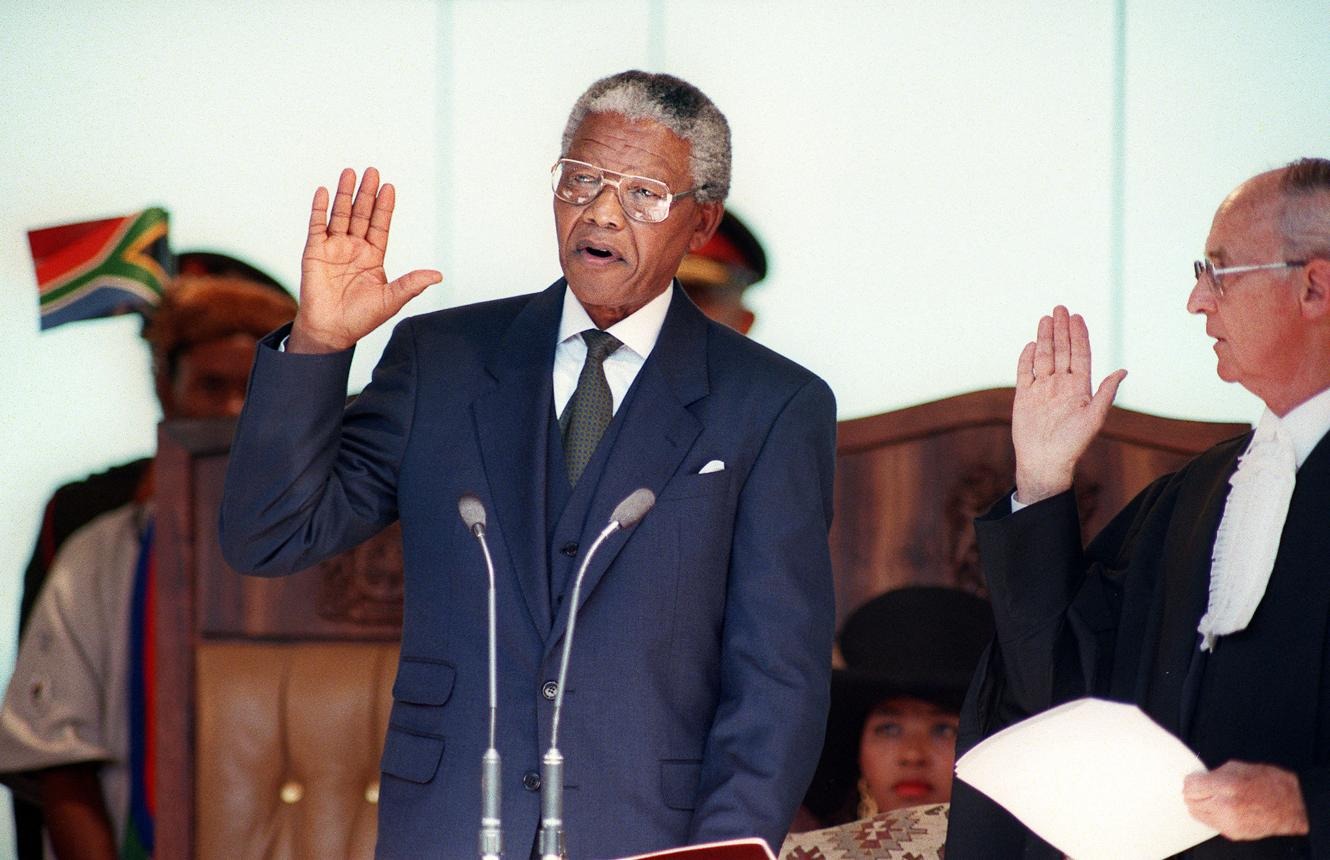
On May 10, 1994, Nelson Mandela was inaugurated as South Africa’s first Black president.
The inauguration ceremony took place at the Union Buildings in Pretoria and attracted international leaders, diplomats and representatives from different parts of the world.
It marked the end of centuries of institutionalised white political domination and the beginning of a new democratic era.
Mandela’s inauguration was particularly significant because it demonstrated that a country deeply divided by racial oppression could move towards democratic governance through negotiations and elections.

In his inaugural address, Mandela emphasised the importance of building a society based on equality, dignity and freedom.
His presidency represented more than a change in political leadership. It was a symbolic victory for millions of Black South Africans who had endured discrimination, forced removals, political exclusion and economic hardship.
For many people across Africa and the wider world, Mandela’s election demonstrated that determined resistance, international solidarity and political negotiation could help dismantle even deeply entrenched systems of oppression.
His Presidential Leadership and the Fight for National Reconciliation

As president, Mandela faced the enormous challenge of governing a country emerging from decades of racial division.
South Africa had inherited deep economic inequalities, widespread poverty, inadequate housing, unequal education systems and tensions between communities.
Mandela understood that ending apartheid politically was only the beginning. The country also needed institutions and policies that could support social and economic transformation.
One of his most important priorities was national reconciliation.
Rather than encouraging Black South Africans to retaliate against those who had benefited from apartheid, he promoted a vision of a shared future.
This approach did not mean ignoring the crimes committed under apartheid. Instead, Mandela believed that South Africa needed to confront its past while creating opportunities for peaceful coexistence.
A major part of this process was the establishment of the Truth and Reconciliation Commission (TRC), chaired by Archbishop Desmond Tutu.
The commission was created to investigate gross human rights violations committed during apartheid and provide a platform for victims and perpetrators to tell their stories.
It also offered conditional amnesty to individuals who made full disclosure of politically motivated crimes, in accordance with the commission’s legal framework.
The process was controversial, and many victims and families felt that justice was incomplete. Nevertheless, it became an important international example of transitional justice and efforts to address historical abuses.
Mandela also used sport as a means of bringing South Africans together.

One of the most memorable moments of his presidency occurred during the 1995 Rugby World Cup, hosted by South Africa.
For decades, rugby had been strongly associated with white South African identity, while many Black South Africans viewed the national team, the Springboks, as a symbol of apartheid-era exclusion.
Mandela recognised the opportunity to transform the tournament into a national unifying event.
He publicly supported the team and wore a Springboks jersey during the final against New Zealand.
When South Africa won the tournament, Mandela presented the trophy to captain Francois Pienaar in front of a jubilant crowd.
The image of a Black president celebrating with a traditionally white-associated sporting team became one of the most powerful symbols of reconciliation in modern South African history.
It demonstrated his belief that national identity should not be defined by race but by shared citizenship and common aspirations.
Mandela’s Contributions to Democracy, Education and Human Rights

Beyond reconciliation, Mandela’s presidency helped establish important democratic institutions and expand access to basic services.
The new government introduced policies aimed at addressing inequalities inherited from apartheid.
These included initiatives to improve access to housing, education, healthcare, electricity and clean water, particularly in historically disadvantaged communities.
The government also worked towards establishing a constitutional democracy founded on equality, human dignity, freedom and the protection of individual rights.
South Africa adopted a new interim constitution in 1993, followed by the final Constitution in 1996, after Mandela’s presidency had begun.
The 1996 Constitution became an important foundation for the country’s democratic institutions and included extensive protections for civil liberties and equality.
Mandela also recognised that education was essential to overcoming historical disadvantages.
Under apartheid, Black South Africans had been subjected to an inferior and deliberately unequal education system. His government sought to improve educational opportunities and expand access to schools and public services.
Although many of South Africa’s economic and social problems remained unresolved during his presidency, his administration helped create a political and constitutional environment in which these challenges could be addressed through democratic processes.
Mandela’s commitment to human rights also extended beyond South Africa.
He spoke against racism, discrimination, political oppression and injustice wherever they occurred.
His influence helped strengthen international recognition of the importance of democratic government and equal citizenship.
Stepping Down After One Presidential Term
One of the most remarkable aspects of Mandela’s leadership was his decision not to remain in power indefinitely.
After serving as president from 1994 to 1999, he voluntarily stepped down and allowed his successor, Thabo Mbeki, to take over the country’s leadership.
In many countries, political leaders struggle to relinquish power, even when their constitutional terms have ended. Mandela’s decision demonstrated his commitment to democratic principles and institutional stability.
He understood that democracy required more than holding elections. It also required respecting constitutional limits, strengthening institutions and allowing new generations of leaders to contribute to national development.
After leaving office, Mandela continued supporting humanitarian causes through several organisations.
He established the Nelson Mandela Children’s Fund in 1995 to improve the lives of vulnerable children and young people.
He also established the Nelson Mandela Foundation, which promotes his legacy through education, dialogue, historical preservation and social justice initiatives.
In 2003, he became involved in the 46664 campaign, which helped raise international awareness about HIV/AIDS, a disease that was devastating communities across Africa.
Mandela also became increasingly outspoken about the need for African governments to address poverty, corruption, inequality and inadequate healthcare.
His retirement from the presidency did not mean an end to his public service. Instead, it allowed him to concentrate on issues that extended beyond party politics and government administration.
Nelson Mandela Foundation+2
International Recognition and Global Influence

Nelson Mandela’s influence extended far beyond the borders of South Africa.
He became one of the most respected political figures of the 20th century, receiving international recognition for his contribution to democracy, racial equality and human rights.
In 1993, he jointly received the Nobel Peace Prize with F.W. de Klerk for their efforts to end apartheid peacefully and establish the foundations of a democratic South Africa.
The award recognised the importance of political negotiations in resolving one of the most deeply rooted systems of racial oppression in modern history.
Mandela also received numerous international honours, honorary degrees and awards from governments, universities and civil society organisations.
His birthday, July 18, became globally recognised as Nelson Mandela International Day after the United Nations General Assembly declared it an international observance in 2009.
The day encourages people around the world to dedicate time to community service, humanitarian activities and efforts to improve the lives of others.
The initiative reflects Mandela’s belief that every individual has a responsibility to contribute positively to society.
His life also inspired political leaders, civil rights activists and young people in different parts of the world.
For many, Mandela demonstrated that leadership should be measured not simply by political authority but by the ability to serve others, defend human dignity and create opportunities for future generations.
Nelson Mandela’s Death and the World’s Reaction

After decades of public service, Nelson Mandela’s health gradually deteriorated.
He experienced recurring respiratory problems and was hospitalised several times during the final years of his life.
On December 5, 2013, Mandela died peacefully at his home in Johannesburg, South Africa, at the age of 95.

His death triggered an extraordinary international outpouring of grief.
South Africans from different racial, religious and political backgrounds mourned a man whose life had helped transform their country.
World leaders, former presidents, international organisations and ordinary citizens paid tribute to his courage, sacrifice and commitment to human dignity.
The then South African president, Jacob Zuma, announced his death, describing him as the nation’s greatest son.
His funeral and memorial ceremonies attracted international dignitaries and political representatives from across the world.
Among those who paid tribute were former United States presidents, African leaders and representatives of international institutions.
His death marked the end of an extraordinary life, but it did not diminish the significance of his achievements.
Mandela left behind a legacy that continues to influence discussions about racial justice, democratic leadership, forgiveness and the responsibilities of political power.
The Challenges and Unfinished Work of Mandela’s Legacy
Although Mandela is widely celebrated for his achievements, it is important to recognise that South Africa’s transition to democracy did not immediately eliminate the inequalities created by apartheid.
The country continued to struggle with poverty, unemployment, unequal access to education, housing shortages and significant differences in wealth between racial groups.
Many Black South Africans continued to experience economic disadvantages even after gaining political freedom.
These challenges have generated debates about the extent to which the democratic transition achieved economic justice alongside political equality.
Mandela’s presidency also faced criticism from different quarters over the pace of economic transformation and the compromises made during negotiations with the former apartheid government.
Some critics argue that the transition preserved too many existing economic power structures, leaving substantial inequalities unresolved.
Others emphasise that Mandela inherited a deeply divided country and faced the difficult task of preventing widespread violence while establishing democratic institutions.
These debates are important because they demonstrate that Mandela’s legacy should not be understood as a claim that every problem in South Africa was solved during his presidency.
Rather, his greatest contribution was helping to create the political conditions in which citizens could pursue equality, justice and national development through democratic institutions.
His leadership provided a foundation upon which subsequent generations could continue the struggle for a more inclusive society.
Conclusion
Nelson Mandela’s life remains one of the most inspiring examples of courage, determination and transformative leadership in modern history.
From his early days as a young political activist to his 27 years in prison, his emergence as a global symbol of resistance and his election as South Africa’s first Black president, Mandela demonstrated an extraordinary commitment to freedom and equality.
His contribution to the struggle against apartheid changed South Africa permanently and influenced the global fight against racial discrimination.
Perhaps his most remarkable achievement was his ability to promote reconciliation after experiencing decades of imprisonment and personal suffering.
Instead of using political power to encourage revenge, he advocated dialogue, forgiveness and the construction of a shared national identity.
His decision to leave the presidency after one term further demonstrated that democratic leadership should be based on service rather than the desire to retain power.
Although South Africa continues to confront economic and social challenges, Mandela’s contribution to the establishment of democratic government remains historically significant.
His story also carries an important message for African countries and developing nations where political divisions, corruption, discrimination and inequality continue to undermine progress.
Mandela demonstrated that meaningful leadership requires courage, patience, sacrifice and a willingness to put the interests of society above personal ambition.
Today, he is remembered not simply as a former president or political prisoner but as a freedom fighter whose determination helped change the direction of an entire nation.
His life reminds the world that even the most deeply entrenched systems of injustice can be challenged through collective action, perseverance and principled leadership.
Nelson Mandela’s greatest legacy was not merely becoming South Africa’s first Black president. It was helping to transform a country built on racial division into a democracy founded on the promise of equality, dignity and freedom for all.