

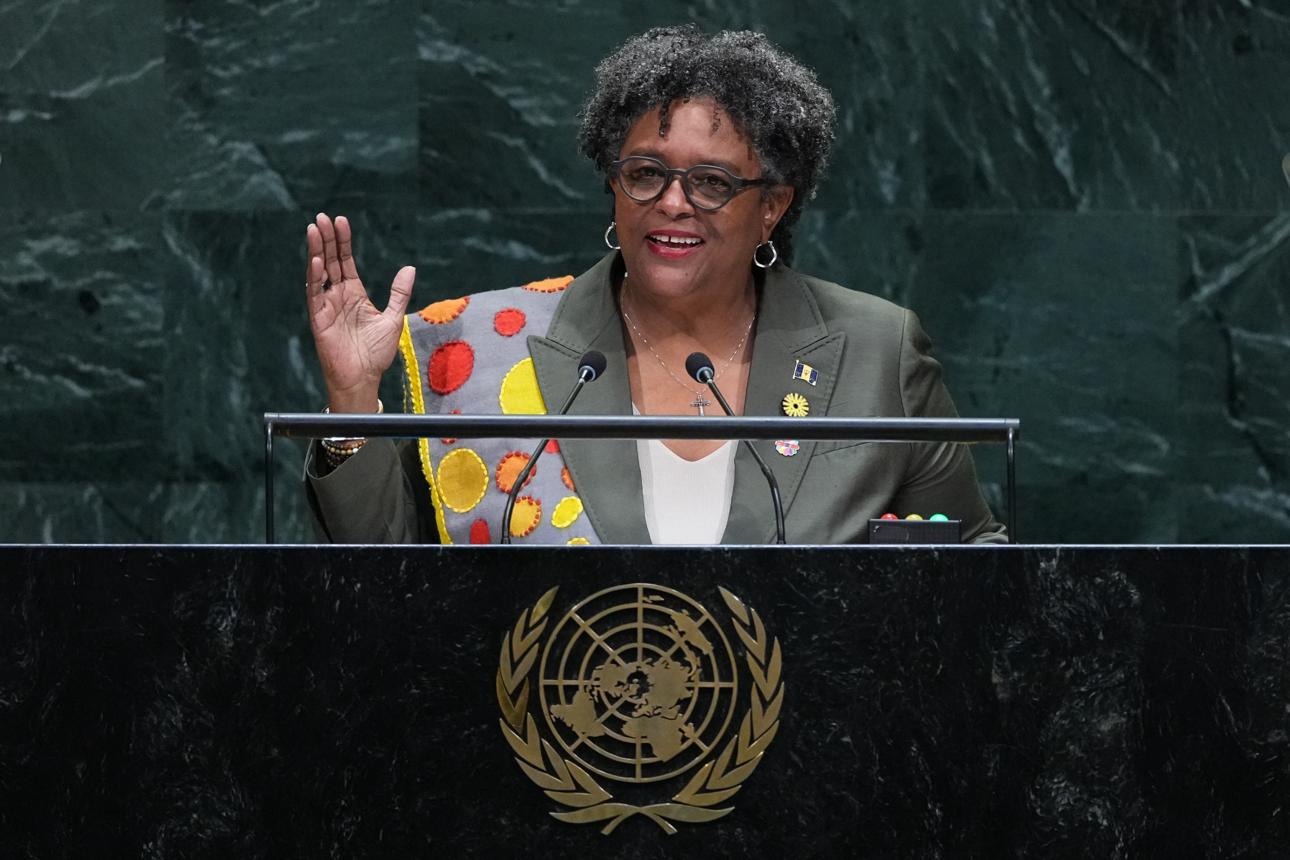
Mia Amor Mottley has emerged as one of the most influential political leaders in the Caribbean and an increasingly powerful voice in international affairs. As the first woman to become Prime Minister of Barbados, she has made history in her country while establishing herself as a leading advocate for developing nations facing the devastating consequences of climate change.
Her influence extends far beyond the shores of Barbados. Through international speeches, diplomatic engagements and economic reform proposals, Mottley has challenged wealthy nations and powerful financial institutions to reconsider how the world responds to climate change, particularly when it comes to countries with limited financial resources.
At the centre of her international advocacy is a simple but important argument: countries that contribute relatively little to global greenhouse gas emissions should not be left to shoulder the greatest financial and human consequences of climate change.
Her campaign has brought renewed attention to the struggles of small island developing states, which face rising sea levels, destructive hurricanes, coastal erosion, droughts and other environmental threats. She has also called for changes to international lending arrangements that often leave vulnerable countries borrowing heavily to recover from natural disasters.
Through the Bridgetown Initiative, Mottley has helped reshape discussions about climate finance, international debt and the responsibilities of wealthy countries towards vulnerable economies.
Her leadership demonstrates how a politician from a relatively small Caribbean nation can influence international conversations and challenge established global economic structures.

1. Early Life, Education and Political Background
Mia Amor Mottley was born on October 1, 1965, in Barbados, an island nation in the Caribbean. She grew up in a country with a rich political history, a strong cultural identity and an economy heavily influenced by tourism, international trade and services.
Her early experiences helped shape her understanding of the challenges confronting small countries, particularly those with limited natural resources and considerable exposure to international economic developments.
Mottley pursued her education in Barbados before attending the prestigious London School of Economics and Political Science in the United Kingdom, where she studied law.
Her legal education provided a foundation for her later career in public administration, political leadership and international diplomacy. She subsequently became an attorney-at-law and established herself as a prominent legal professional.
However, her ambitions extended beyond the legal profession. She developed an interest in public service and entered politics at a relatively young age.
In 1991, she served as one of Barbados’ Opposition Senators. Three years later, in September 1994, she was elected to the country’s House of Assembly as a representative of St. Michael North East under the Barbados Labour Party.
Her election marked the beginning of a political career that would eventually place her at the centre of national and international affairs.
Mottley quickly distinguished herself through her intellectual ability, political determination and willingness to take on important responsibilities.
Between 1994 and 2001, she served as Minister of Education, Youth Affairs and Culture. Her responsibilities included contributing to policies affecting education, young people and cultural development.
In 2001, she became Attorney General and Deputy Prime Minister of Barbados, making history as the first woman to occupy that combined senior leadership position.
These experiences provided her with valuable knowledge of government administration, constitutional affairs and national development.
She also became one of the youngest people in Barbados to attain the distinction of Queen’s Counsel, reflecting her achievements in the legal profession.
According to the United Nations Conference on Trade and Development, Mottley’s political career has included several senior government responsibilities and decades of involvement in Barbadian public life.
2. Making History as Barbados’ First Female Prime Minister
One of the most significant milestones in Mottley’s career came in May 2018, when she led the Barbados Labour Party to a historic victory in the country’s general election.
The party won all 30 seats in the House of Assembly, delivering an overwhelming electoral victory and ending the political dominance of the opposing Democratic Labour Party.
Mottley consequently became the eighth Prime Minister of Barbados and the first woman to hold the office since the country gained independence from Britain in 1966.
Her victory represented more than a change in government. It was a historic moment for women’s political representation in Barbados and the wider Caribbean.
For many women and young people, her achievement demonstrated that the highest levels of political leadership were accessible regardless of gender.
She also inherited a country facing considerable economic difficulties, including public debt, financial pressures and concerns about sustainable economic growth.
Her administration therefore had to balance economic recovery, social development and the need to improve the country’s resilience against external economic and environmental shocks.
In 2021, Barbados completed its transition from a constitutional monarchy to a parliamentary republic, replacing the British monarch as its head of state with a Barbadian president.
Mottley played an important leadership role during this historic transition, which represented another significant development in the country’s journey towards strengthening its national sovereignty.
In January 2022, she was sworn in for a second term after leading her party to another decisive general election victory.
Her continued leadership provided an opportunity to advance her government’s development agenda and strengthen Barbados’ position in international diplomacy.
3. Becoming an International Voice for Climate Justice

Although Mottley’s political responsibilities initially centred on Barbados, her international influence grew considerably as she began speaking more forcefully about the relationship between climate change, economic inequality and global development.
She recognised that climate change was not simply an environmental problem. For vulnerable countries, it was also an economic, social and humanitarian crisis.
Small island nations such as Barbados face unique environmental challenges. Their geographical location exposes them to hurricanes, rising sea levels, coastal erosion and changing weather patterns.
These threats can destroy homes, damage infrastructure, disrupt tourism, affect agricultural production and threaten the livelihoods of entire communities.
For countries with large economies, recovering from natural disasters may be difficult but financially manageable. For smaller developing nations, however, a single devastating hurricane can cause economic damage equivalent to a significant proportion of their annual national output.
This creates a difficult situation in which governments must spend enormous amounts of money rebuilding infrastructure instead of investing in education, healthcare, housing and other essential services.
Mottley has consistently argued that this situation is fundamentally unfair.
Her position is that developing countries should not be expected to carry the financial burden of a climate crisis they contributed relatively little to creating.
She has therefore called on industrialised countries, which accumulated much of their wealth through carbon-intensive industrialisation, to take greater responsibility for supporting vulnerable nations.
Her advocacy focuses on climate justice, a principle that recognises that the consequences of environmental destruction are not distributed equally.
The countries and communities least responsible for global emissions are frequently among those most exposed to climate-related disasters.
This argument has become a central feature of international climate negotiations, particularly discussions involving small island developing states and countries across Africa, Asia, the Pacific and Latin America.
Her powerful intervention at the United Nations
One of the moments that helped establish Mottley as a prominent international climate advocate was her address to the United Nations General Assembly in September 2021.
During her speech, she criticised the failure of powerful countries to respond adequately to the climate emergency.
She challenged world leaders to move beyond promises and take meaningful action to protect vulnerable populations.
Her passionate intervention attracted international attention because she spoke directly about the human consequences of political inaction.
She highlighted the danger of allowing short-term economic interests to undermine the future of millions of people.
Her speeches also emphasised that the climate crisis was connected to other global challenges, including poverty, inequality, public health and economic insecurity.
In 2021, the United Nations Environment Programme recognised her with its Champions of the Earth award in the Policy Leadership category.
The recognition acknowledged her commitment to environmental protection and her efforts to promote stronger international action against climate change.
Her appearance at the 2021 United Nations climate conference in Glasgow and subsequent interventions at international climate summits further strengthened her reputation as a leader willing to challenge powerful governments over climate commitments.
4. The Bridgetown Initiative: Her Most Significant Contribution to Global Financial Reform
Perhaps the most important contribution to Mottley’s international legacy is the Bridgetown Initiative, a proposal aimed at reforming the international financial system to make it more responsive to the needs of developing countries.
Named after Bridgetown, the capital of Barbados, the initiative emerged in 2022 as a response to the growing difficulties faced by developing nations in financing climate adaptation and sustainable development.
Mottley recognised that many vulnerable countries were trapped in a cycle of borrowing, disaster recovery and increasing debt.
When a hurricane, flood or other climate-related disaster strikes, affected governments must mobilise enormous financial resources to rebuild damaged infrastructure and restore economic activity.
However, these countries often lack sufficient savings and affordable financing.
Consequently, they are forced to borrow money, sometimes at significantly higher interest rates than wealthier countries.
This creates a cycle in which countries become increasingly indebted while trying to protect their populations against environmental threats.
The Bridgetown Initiative seeks to address this problem by changing the way international financial institutions provide financial assistance to developing countries.
Rather than relying entirely on traditional loans and existing lending arrangements, Mottley has advocated for a more flexible system that provides affordable financing, emergency liquidity and greater investment in climate resilience.
The initiative also calls for international institutions to recognise that climate vulnerability should be an important consideration when determining the financial support available to countries.
Its proposals include several important areas:
A. Increasing access to emergency financing
Developing countries need access to financial resources when natural disasters and other economic shocks occur.
The Bridgetown Initiative advocates mechanisms that allow vulnerable nations to obtain emergency funding without immediately falling into deeper debt.
This would enable governments to respond to disasters more effectively and restore essential services without compromising their long-term development plans.
B. Reforming multilateral development banks
Institutions such as the World Bank and regional development banks play important roles in financing infrastructure and development projects.
However, Mottley has argued that these institutions must become more responsive to the realities facing climate-vulnerable countries.
She has called for expanded lending capacity, better financial instruments and greater willingness to support projects that strengthen environmental resilience.
C. Addressing developing-country debt
Another central element is the need to make international borrowing arrangements more sustainable.
Countries should not be pushed into financial crises simply because they have to rebuild after hurricanes, floods and other disasters.
The initiative supports debt-related mechanisms that can provide breathing space to countries experiencing severe external shocks.
D. Mobilising private-sector investment
Governments alone cannot provide all the money required to address climate change.
Mottley has therefore advocated stronger partnerships involving governments, international institutions and private investors.
The objective is to direct more private capital towards renewable energy, climate adaptation, sustainable infrastructure and other development priorities.
The Bridgetown Initiative has evolved since its introduction, with successive versions expanding and refining its proposals.
In September 2024, Mottley officially launched the third version, known as Bridgetown Initiative 3.0, during the 79th United Nations General Assembly in New York.
The updated proposal focused on three broad priorities: reforming the rules and governance of the international financial system, protecting vulnerable economies against debt and liquidity crises, and increasing financing for resilience and sustainable development.
The Barbados Government described the initiative as an effort to reshape the international development and climate finance architecture.
Its significance lies in the fact that it takes the climate debate beyond environmental promises and addresses the financial structures that determine whether developing countries can actually implement climate policies.
5. Challenging Wealthy Nations to Take Greater Responsibility
Mottley’s international advocacy has also focused on the responsibilities of wealthy countries towards developing nations.
For decades, international climate negotiations have involved disagreements over who should pay for the transition towards cleaner energy and the costs associated with climate-related disasters.
Developing countries argue that industrialised nations have historically contributed a much larger share of greenhouse gas emissions and therefore have a greater responsibility to support global climate action.
Mottley has consistently supported this position.
She believes that climate financing should not be treated simply as charitable assistance from wealthy nations to poorer countries.
Instead, she has presented it as an important component of international responsibility and fairness.
Her argument is particularly relevant to small island states, where the consequences of climate change can threaten national survival.
For example, rising sea levels can gradually destroy coastal communities, damage tourism infrastructure and contaminate freshwater resources.
Stronger hurricanes can devastate buildings, roads, electricity networks and other essential facilities.
In countries that depend heavily on tourism, environmental disasters can also cause substantial losses in foreign exchange earnings and employment.
These challenges demonstrate why climate adaptation requires consistent investment rather than temporary financial assistance after disasters occur.
Mottley has used international platforms to remind world leaders that failing to provide adequate climate financing could undermine decades of development achievements.
Her approach has helped bring greater attention to the financial inequalities between countries that contribute heavily to climate change and those that experience some of its most severe consequences.
6. Promoting Climate Resilience and Environmental Sustainability in Barbados
While Mottley has become internationally recognised for her speeches and financial reform proposals, her government has also pursued environmental initiatives within Barbados.
One important programme is the Roofs to Reefs Programme, designed to strengthen the country’s resilience against climate-related threats.
The programme adopts an integrated approach to environmental protection, connecting the safety of homes and communities with the protection of coastal and marine ecosystems.
Its priorities include reinforcing houses, improving infrastructure, protecting natural environments and strengthening the country’s ability to withstand severe weather events.
The initiative recognises that climate resilience must begin with protecting ordinary people.
For example, strengthening residential buildings can reduce the damage caused by hurricanes, while protecting coral reefs and coastal ecosystems can help reduce the impact of waves and coastal erosion.
This approach is particularly important for Barbados because its economy, infrastructure and population are closely connected to its coastal environment.
Mottley’s administration has also promoted renewable energy and greater environmental sustainability.
Barbados has pursued an ambitious vision of transitioning towards a more sustainable energy system, including increased solar power generation and the wider adoption of electric vehicles.
Reducing dependence on imported fossil fuels could provide several benefits.
It could lower the country’s exposure to international energy price fluctuations, reduce carbon emissions and create opportunities for investment in renewable energy technologies.
Mottley’s environmental agenda also includes tree-planting efforts and the protection of natural ecosystems.
These policies demonstrate that her climate advocacy is not limited to demanding action from other countries. She has also sought to position Barbados as an example of how small developing nations can pursue environmental sustainability despite financial and geographical limitations.
The United Nations Environment Programme has highlighted both the Roofs to Reefs Programme and Barbados’ renewable energy ambitions in its assessment of Mottley’s environmental leadership.
7. Elevating the Concerns of Small Island Developing States
One of Mottley’s most important achievements has been giving small island developing states a stronger voice in international political and economic discussions.
Small island developing states, commonly known as SIDS, face environmental and economic challenges that are often overlooked in discussions dominated by larger countries.
Many of these nations depend heavily on tourism, fishing, agriculture and international trade. Their economies are particularly vulnerable to disruptions caused by extreme weather conditions and global economic instability.
For instance, a powerful hurricane can destroy hotels, damage airports, disrupt electricity supplies and force communities to relocate.
The consequences extend beyond the immediate destruction. Governments may experience declining tax revenues, rising public expenditure, unemployment and increased borrowing requirements.
Mottley has argued that international institutions must recognise these vulnerabilities when determining how financial assistance is distributed.
She has also emphasised that measuring a country’s financial strength solely through traditional economic indicators, such as gross domestic product, can produce unfair outcomes.
A country may have a relatively high income per person but still face enormous financial difficulties when recovering from natural disasters.
Her position is that international lending arrangements should take climate vulnerability, economic exposure and the cost of rebuilding into account.
Through her advocacy, Barbados has become an important representative of countries seeking more equitable international financial arrangements.
Her work has also encouraged greater cooperation among Caribbean countries and other developing nations confronting similar environmental and economic challenges.
8. Recognition and International Influence
Mottley’s contributions to environmental leadership and international diplomacy have attracted recognition from several prominent organisations.
In 2021, she received the United Nations Environment Programme’s Champions of the Earth award in the Policy Leadership category.
In 2022, she was included in TIME magazine’s list of the 100 most influential people in the world.
In 2023, she was also recognised on TIME’s list of influential leaders driving climate action.
These recognitions reflected her growing influence in international discussions about climate change, sustainable development and global economic reform.
Her leadership has also attracted attention from international organisations, financial institutions, development experts and environmental advocates.
In September 2024, the launch of Bridgetown Initiative 3.0 demonstrated her continued determination to push for changes to the global financial system.
In 2025, she received further international recognition, including the Zayed Award for Human Fraternity and the TIME Earth Award, according to the Government of Barbados.
She has also held important international responsibilities, including serving as Co-Chair of the United Nations Sustainable Development Goals Advocates group and participating in leadership roles connected to international development and climate finance.
These positions have provided additional platforms through which she can promote the interests of developing countries.
Her international influence demonstrates that leadership is not necessarily determined by the size of a country’s population, economy or military strength. A leader with a clear vision, effective diplomacy and the ability to build international partnerships can influence discussions far beyond national borders.
9. The Challenges and Limitations of Her Climate Advocacy
Despite her achievements, Mottley’s campaign for climate justice faces significant challenges.
One of the biggest obstacles is the difficulty of translating international promises into actual financial commitments.
Although wealthy countries and international institutions have repeatedly announced plans to increase climate financing, developing nations continue to face difficulties accessing affordable and sufficient resources.
There are also disagreements over whether climate financing should primarily take the form of grants, concessional loans or private-sector investments.
For countries already struggling with substantial public debt, additional borrowing can create further economic problems.
This is one of the reasons Mottley has continued to advocate for changes to international lending arrangements.
Another challenge is the slow pace of reform within major financial institutions.
Organisations such as the International Monetary Fund and the World Bank operate through complex governance structures involving numerous member countries with different economic interests and political priorities.
Consequently, implementing major reforms requires international cooperation and negotiations that can take considerable time.
There is also the challenge of ensuring that climate investments produce measurable benefits for vulnerable communities.
Access to financing alone does not guarantee successful environmental protection. Governments must also develop effective policies, strengthen institutions, ensure transparency and direct resources towards projects that genuinely improve people’s lives.
Furthermore, Barbados itself must continue balancing climate ambitions with domestic economic realities.
As a small developing country, it faces financial limitations, infrastructure requirements and the need to maintain employment and economic growth.
Nevertheless, these difficulties have not stopped Mottley from advocating for international reforms.
Instead, they have strengthened her argument that vulnerable countries need a more supportive global financial system.
10. Mia Mottley’s Lasting Impact on Africa and the Developing World
Although Mottley’s political leadership is rooted in the Caribbean, her message has important implications for Africa and other developing regions.
African countries face several climate-related challenges, including droughts, desertification, flooding, food insecurity and changing rainfall patterns.
Many African economies also face high borrowing costs and limited access to affordable international financing.
These conditions make it difficult for governments to invest sufficiently in renewable energy, agricultural resilience, water infrastructure and climate adaptation.
Mottley’s argument that climate vulnerability should influence international financial arrangements is therefore relevant to African countries.
Her advocacy also challenges the idea that developing nations must choose between economic development and environmental protection.
Instead, she promotes a system in which climate action and sustainable economic growth can support each other.
For example, affordable financing could help African countries expand renewable energy production, modernise agricultural systems, improve transportation infrastructure and strengthen their ability to withstand extreme weather conditions.
Her campaign also reinforces the importance of cooperation among developing countries.
Rather than approaching international negotiations individually, vulnerable nations can build stronger coalitions and demand reforms that reflect their shared interests.
For African leaders, policymakers and environmental advocates, Mottley’s international approach offers an important lesson about the value of strategic diplomacy.
She has demonstrated that countries with relatively limited economic power can still influence international debates by developing clear proposals, building alliances and consistently defending their interests.
Her leadership also provides an example of how women can occupy influential positions in international politics and contribute to discussions about some of the world’s most pressing challenges.
11. Her Legacy: A Small Island Leader with a Global Vision
Mia Mottley’s growing international reputation represents an important chapter in the political history of Barbados and the wider Caribbean.
From her early career as a lawyer and parliamentarian to becoming the country’s first female Prime Minister, she has built a political legacy defined by determination, public service and international advocacy.
However, her influence extends beyond the historic significance of her election.
She has helped transform the concerns of small island developing states into major subjects of international discussions about climate justice, economic inequality and financial reform.
Through the Bridgetown Initiative, she has challenged traditional approaches to development financing and called for a global financial system that responds more effectively to the needs of vulnerable countries.
Her advocacy has also highlighted the importance of investing in climate resilience, protecting coastal communities and ensuring that developing countries have access to the resources required to secure their futures.
Her message is particularly important in a world where climate change increasingly threatens economic stability, food security, public health and human settlements.
While many of the reforms she advocates require sustained international cooperation, her efforts have helped establish an important framework for discussing how climate financing should work.
She has also demonstrated that meaningful international leadership does not depend exclusively on representing a wealthy or powerful nation.
A leader from a small Caribbean country can command global attention when speaking about issues that affect humanity as a whole.
As Barbados continues pursuing its environmental and economic development goals, Mottley’s contribution will remain closely associated with the country’s efforts to promote climate justice and international financial reform.
Her legacy will ultimately be measured not only by the speeches she has delivered or the proposals she has introduced, but also by how much progress the international community makes towards creating a fairer financial system for vulnerable nations.
Mia Mottley has become a powerful symbol of how political leadership, international diplomacy and determined advocacy can give developing countries a stronger voice in shaping the world’s future.
Conclusion
Mia Mottley’s impact on Barbados and the international community goes beyond her historic achievement as the country’s first female Prime Minister.
She has emerged as a leading advocate for climate justice, using her political position to draw attention to the unequal consequences of global warming and the financial difficulties confronting vulnerable nations.
Her Bridgetown Initiative has introduced important proposals for reforming international financial institutions, improving access to affordable financing and protecting developing countries from the economic consequences of climate-related disasters.
Through her leadership, Barbados has also strengthened its environmental ambitions while becoming an influential participant in international discussions about sustainable development.
For Africa, the Caribbean and other developing regions, her message is particularly significant: countries should not be denied opportunities for development simply because they lack the financial resources to confront challenges they did relatively little to create.
Mottley’s story demonstrates that a country’s international influence is not determined by its geographical size or economic strength alone. Vision, courage, strategic diplomacy and a commitment to fairness can also make a leader globally influential.
Her enduring contribution is the determination to ensure that the voices of vulnerable nations are heard and that climate justice becomes more than an international promise.