

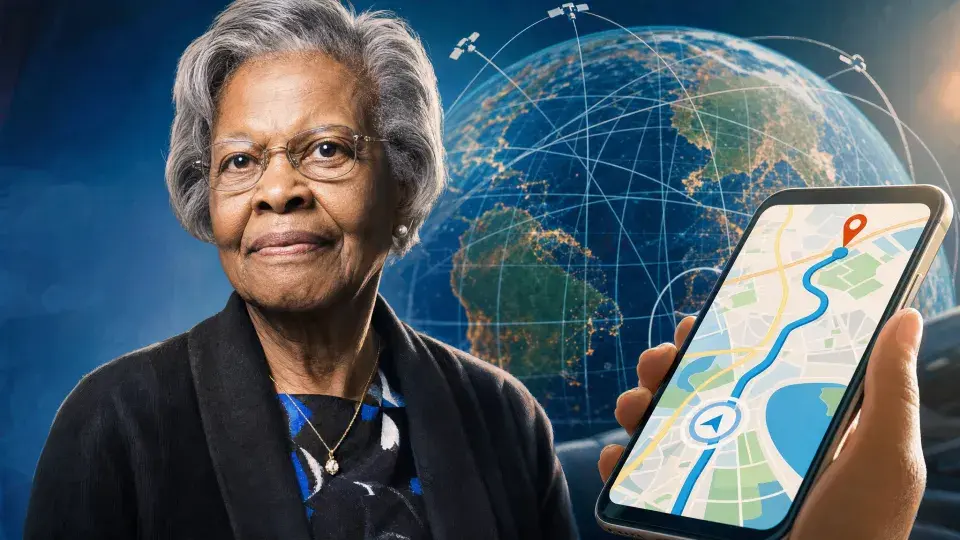
How a determined African-American woman from rural Virginia helped shape modern navigation through mathematics, satellite technology and groundbreaking research into the Earth’s shape.
Imagine travelling to an unfamiliar city, ordering a delivery, tracking a shipment, finding a nearby hospital or navigating through unfamiliar streets without getting lost. Today, millions of people perform these activities every day using the Global Positioning System (GPS), a technology that has transformed transportation, communication, commerce and everyday life.
Behind this remarkable technology are the contributions of numerous scientists, mathematicians and engineers whose work made accurate satellite navigation possible. Among these pioneers was Gladys Mae West, an African-American mathematician whose groundbreaking research into the Earth’s shape and satellite positioning helped establish the mathematical foundations of modern GPS technology.
Although she did not invent GPS single-handedly, her contribution was instrumental in developing the highly accurate geodetic models that allow satellites and navigation devices to determine locations around the world.
West’s story is particularly remarkable because she achieved scientific excellence during a period when racial segregation and gender discrimination severely restricted opportunities for Black Americans, especially Black women. Through intelligence, determination, education and an extraordinary commitment to mathematics, she rose above these barriers to become one of the important figures in the history of modern navigation technology.
Her work continues to influence billions of people, even those who have never heard her name.
Early Life: Growing Up on a Farm in Segregated Virginia
Gladys Mae Brown, later known as Gladys West, was born on October 27, 1930, in Sutherland, Virginia, United States. She grew up in a rural farming community during the Great Depression, a difficult period in American history characterised by widespread unemployment, poverty and economic hardship.
Her parents worked hard to support their family, with farming and other labour-intensive activities forming an important part of their livelihood. As a young girl, West helped with responsibilities around the family farm, including feeding chickens and chopping wood.
However, she had ambitions that extended beyond the agricultural environment in which she was raised.
At a time when educational opportunities for Black children were severely restricted by racial segregation, West developed a strong interest in learning. She understood that education could provide an opportunity to escape the limitations imposed by poverty and racial discrimination.
Her early educational experience reflected the inequalities of the Jim Crow era. She attended a segregated one-room schoolhouse, where Black children were taught under difficult conditions. The school had limited resources, inadequate facilities and insufficient educational materials.
West and her siblings reportedly walked approximately three miles to attend school. Despite these challenges, she developed a passion for mathematics and science.
Her academic performance improved as she progressed through school, and she eventually emerged as one of the brightest students in her class.
West recognised that academic excellence could create opportunities that were otherwise unavailable to young Black women in American society. She therefore made education her priority.
Her determination paid off when she graduated as the valedictorian of her high school class. This achievement earned her a college scholarship and opened the door to a university education.
Educational Journey and the Beginning of a Mathematical Career
Following her outstanding performance in high school, West enrolled at Virginia State College, now known as Virginia State University, a historically Black institution located in Petersburg, Virginia.
Attending the institution exposed her to new intellectual opportunities and allowed her to develop her interest in mathematics.
She pursued a degree in mathematics and graduated with a Bachelor of Science in 1952.
At the time, Black women were significantly underrepresented in scientific and technical professions. Nevertheless, West remained committed to her academic ambitions.
After completing her undergraduate studies, she began teaching mathematics and science at a rural high school in Virginia.
Her teaching career provided valuable experience, but she was determined to advance her knowledge of mathematics. She subsequently returned to Virginia State College to pursue postgraduate studies.
In 1955, she obtained a master’s degree in mathematics.
Her academic qualifications, combined with her exceptional mathematical abilities, positioned her for an opportunity that would eventually change the direction of her career and contribute to one of the world’s most important technological developments.
That opportunity came in 1956, when she was recruited by the United States Navy to work as a mathematician at the Naval Proving Ground in Dahlgren, Virginia.
Her appointment marked the beginning of a remarkable 42-year professional career.

Breaking Racial and Gender Barriers at the United States Navy
Joining the Naval Proving Ground was a significant achievement for West.
The institution was a predominantly white working environment, and opportunities for Black women in scientific research were extremely limited.
She was among only four Black employees at the facility and was the second Black woman hired there, according to historical accounts of her career.
Most of her colleagues were white men, meaning she had to navigate both racial and gender barriers while establishing herself as a professional mathematician.
The circumstances were particularly challenging because she was entering a highly technical environment where mathematical precision, computer programming and scientific research were essential.
Nevertheless, West demonstrated an exceptional ability to understand complex mathematical problems and develop solutions.
Her early responsibilities included working on mathematical calculations related to naval weapons systems. She helped develop computer programmes and algorithms used to calculate the trajectories and ranges of weapons.
The work required extensive mathematical precision because even small errors in calculations could produce significant differences in the predicted movement of objects.
West also became involved in scientific research examining the movement of celestial bodies.
In 1962, she joined a five-member team working on an astronomical project that investigated the relationship between the movements of Pluto and Neptune.
The project involved approximately five billion arithmetic calculations and required about 100 hours of computing time.
The team’s work demonstrated the regularity of Pluto’s motion relative to Neptune and earned recognition from the United States Navy in 1964.
This achievement demonstrated West’s ability to work with complex mathematical models and large-scale computational problems.
More importantly, it helped establish her reputation as a highly skilled mathematician and computer programmer.
The Groundbreaking Research That Helped Make GPS Possible
West’s most significant scientific contribution emerged from her research into the shape of the Earth.
Although the Earth is commonly represented as a sphere in textbooks and geographical illustrations, its actual shape is considerably more complicated.
The planet is not a perfect sphere. Its rotation causes it to bulge slightly around the equator, making it wider at the equator than between the North and South Poles.
Furthermore, variations in the Earth’s internal mass distribution, mountains, ocean trenches and other geographical features create differences in gravitational forces across the planet.
These variations affect the precise mathematical description of the Earth’s surface.
For technologies that depend on extremely accurate positioning, understanding these irregularities is essential.
West dedicated much of her scientific career to studying these complexities and developing mathematical models that could describe the Earth’s shape more accurately.
One of the most important concepts associated with her research was the geoid.
The geoid is a mathematical model representing the Earth’s gravity-based shape. It approximates global mean sea level and extends beneath the continents as an imaginary reference surface.
Unlike the smooth mathematical shape of an ellipsoid, the geoid reflects variations in the Earth’s gravitational field.
Understanding the geoid is important because it helps scientists, engineers and surveyors measure elevations and establish accurate geographical reference systems.
West used satellite observations, mathematical algorithms and advanced computer technology to calculate these variations.
Her work involved analysing enormous amounts of satellite data and accounting for the effects of gravity, tides and other forces that influence the Earth’s shape.
She also contributed to improving the mathematical reference ellipsoid used to represent the Earth and calculations of satellite orbital trajectories.
These three interconnected areas of research were particularly important to the development of accurate satellite navigation.
How Her Research Contributed to Modern GPS Technology
The Global Positioning System, commonly known as GPS, is a satellite-based navigation system that allows users to determine their geographical positions almost anywhere on Earth.
The technology operates through a network of satellites orbiting the planet, ground-based control stations and GPS receivers found in smartphones, vehicles and other electronic devices.
GPS satellites continuously transmit radio signals containing information about their positions and the precise time at which the signals were transmitted.
A GPS receiver measures how long these signals take to travel from the satellites to the device.
By calculating the distance between itself and at least four satellites, the receiver can use mathematical principles known as trilateration to determine its position in three dimensions.
However, achieving accurate positioning requires more than simply receiving signals from satellites.
The system must also have highly accurate information about the satellites’ positions, their movements and the mathematical reference framework used to describe locations on Earth.
This is where West’s research became particularly important.
Her mathematical models improved scientists’ understanding of the Earth’s shape and gravitational characteristics. Her work on satellite orbits and geodetic reference models contributed to the accuracy required for satellite-based positioning.
For example, GPS uses a mathematical ellipsoid as a reference for geographical coordinates, while geoid models help relate satellite-derived heights to elevations referenced to mean sea level.
Without accurate models of the Earth’s shape and satellite movements, navigation systems would struggle to provide the level of precision people have come to expect.
West’s contribution was therefore not the invention of the entire GPS system but the development and refinement of important mathematical foundations that helped make modern satellite navigation more accurate and reliable.
It is a contribution that has had consequences far beyond the original military and scientific applications for which much of the research was conducted.
Leading Important Satellite Research Projects
West’s responsibilities expanded as her expertise in mathematical modelling and satellite geodesy developed.
During the 1970s, she became involved in important satellite research projects designed to improve scientists’ understanding of the Earth’s surface and oceans.
One of her notable assignments involved the Geodynamics Experimental Ocean Satellite programme, which explored how satellite radar altimeters could be used to collect information about the oceans.
In 1978, she became project manager for SEASAT, an important satellite mission designed to remotely observe the Earth’s oceans.
The satellite used advanced radar technology to gather information about ocean conditions, including surface characteristics and variations in sea levels.
The information collected helped scientists improve their understanding of the Earth’s gravitational field and refine mathematical models of the planet.
West also worked with the GEOSAT programme, which provided additional satellite measurements for geodetic research.
Her work involved developing and refining data-processing methods that helped researchers calculate geoid heights and improve the accuracy of geographical models.
In June 1986, she published a technical guide titled Data Processing System Specifications for the GEOSAT Satellite Radar Altimeter.
The publication explained methods for processing satellite radar-altimeter data and determining the accuracy of geoid-height calculations.
These contributions helped establish important scientific procedures for future research into satellite positioning and the Earth’s physical characteristics.
Her work demonstrated how mathematics, computer programming and satellite technology could be combined to solve complicated scientific problems.
The Technology That Changed Everyday Life
Today, the influence of GPS technology can be seen in almost every aspect of modern society.
Millions of people use GPS-enabled smartphones to navigate unfamiliar streets, locate businesses, find hospitals and identify the fastest routes to their destinations.
Transportation companies depend on satellite navigation to track vehicles, coordinate deliveries and manage logistics.
Commercial airlines and maritime operators use satellite-based navigation systems to support safe and efficient journeys.
Farmers employ precision agriculture technologies to identify specific areas of farmland, guide agricultural machinery and improve the management of crops.
Emergency services also benefit from GPS technology because accurate location information can help rescue teams identify where assistance is needed.
In addition, construction companies, land surveyors, researchers and mapping professionals rely on satellite positioning to obtain accurate geographical measurements.
The global economy has also benefited significantly from the technology.
International shipping, road transportation, supply-chain management and several other industries depend on accurate positioning and timing information.
Although GPS development involved the contributions of numerous scientists and engineers, West’s research into the Earth’s mathematical representation helped provide an important foundation for the accuracy that modern navigation systems require.
Her work illustrates how scientific research conducted decades ago can continue to influence technological development and everyday human activities long after the original research has been completed.
Recognition Came After Years of Overlooked Contributions
Despite the importance of her scientific achievements, Gladys West did not immediately receive widespread public recognition for her contribution to GPS development.
For many years, her work remained largely unknown outside scientific and military research circles.
This lack of recognition reflected, in part, the limited visibility often afforded to Black women working in technical professions during the twentieth century.
West had spent decades performing complex mathematical research, developing computer programmes and contributing to important satellite projects.
However, her contributions were not widely celebrated in the same way as those of many better-known figures in the technology industry.
She also experienced professional discrimination, including being passed over for certain advancement opportunities that went to white male colleagues.
Her story eventually gained greater public attention during the 2010s, when more people began recognising the contributions of women and Black scientists to major technological developments.
In 2018, she was inducted into the United States Air Force Space and Missile Pioneers Hall of Fame.
The recognition celebrated her contributions to the mathematical models and satellite research that helped establish the foundations of GPS technology.
She also received the Female Alumna of the Year award at the Historically Black Colleges and Universities Awards in 2018.
In 2021, Virginia State University awarded her an honorary doctorate in recognition of her remarkable achievements.
In 2023, she received the National Museum of the Surface Navy’s first Freedom of the Seas Exploration and Innovation Award.
These honours represented an important acknowledgement of a career that had remained largely behind the scenes for decades.
Education, Perseverance and Her Doctoral Achievement
One particularly inspiring aspect of West’s life was her commitment to education, even after completing decades of professional scientific work.
While working at the Naval facility, she continued pursuing additional academic qualifications.
In 1973, she earned a master’s degree in public administration through the University of Oklahoma.
After retiring from the Navy in 1998, she continued her academic journey.
In 2000, following recovery from two strokes, she completed her doctoral studies in public administration and public affairs at Virginia Tech.
This achievement was especially significant because it demonstrated that her commitment to learning had not diminished after retirement.
Her educational journey also provided an example for young people, particularly girls and members of underrepresented communities, who aspire to careers in mathematics, science, engineering and technology.
West encouraged young people to pursue education, develop confidence in their abilities and remain committed to their ambitions despite obstacles.
Her life demonstrated that academic achievement does not have to be limited by a person’s background, gender or economic circumstances.
The Passing of a Remarkable Scientist and Her Lasting Legacy
Gladys Mae West died on January 17, 2026, at the age of 95.
Her death marked the end of an extraordinary life dedicated to mathematics, scientific research, education and technological advancement.
Following the announcement of her passing, Virginia State University paid tribute to its distinguished alumna, describing her as a pioneering mathematician whose work helped lay the foundation for GPS technology.
Her legacy, however, extends far beyond the awards and professional recognition she received during her lifetime.
She helped demonstrate the importance of mathematical research in developing technologies that connect people, businesses and communities across the world.
Her achievements also challenged traditional perceptions about who could become a leading scientist or mathematician.
At a time when Black women faced considerable barriers in American scientific institutions, West established herself as an accomplished professional whose work contributed to a technology used internationally.
Her journey from a rural farming community in segregated Virginia to the development of mathematical models that underpin modern satellite navigation remains an inspiring example of determination and intellectual excellence.
For young Black girls who dream of becoming mathematicians, engineers, computer scientists or researchers, her story offers an important message: talent and determination can create opportunities even in environments where success appears difficult to achieve.
Conclusion
Gladys West’s contribution to modern technology is a powerful reminder that some of the most important scientific achievements are not always associated with the most famous names.
While millions of people use GPS every day, relatively few know about the mathematician whose research helped make accurate satellite positioning possible.
Her work on the Earth’s shape, gravitational variations, satellite orbits and geodetic models became an important part of the scientific foundation behind modern navigation systems.
From helping people find their destinations to supporting global transportation, logistics, mapping and scientific research, the impact of satellite positioning continues to expand.
West did not create GPS alone, but her mathematical contributions helped make the technology more accurate and useful to the world.
Her story is not simply about mathematics or technological advancement. It is also about overcoming discrimination, pursuing education, breaking barriers and making a lasting contribution to humanity.
Today, every time someone opens a navigation application, tracks a delivery or uses satellite positioning to locate a destination, they are benefiting from a technological ecosystem shaped by the work of scientists like Gladys West.
She may have spent much of her career working behind the scenes, but her legacy is visible across the world.
Gladys West will be remembered as one of the pioneering Black women whose brilliance helped change how humanity understands, measures and navigates the Earth.