

Her story is about much more than mathematics. It is about brilliance in the face of racial discrimination, courage in a male-dominated profession, and the power of education to change the world.

Today, Johnson is remembered as one of the most influential women in the history of American space exploration. Her life helped bring greater recognition to Black women in science and demonstrated that talent can flourish even when society places barriers in its way.


1. Who was Katherine Johnson?
Katherine Coleman Goble Johnson was born on August 26, 1918, in White Sulphur Springs, West Virginia, United States. She became a mathematician whose work supported the calculations required for early American crewed spaceflight.
She worked at the National Advisory Committee for Aeronautics (NACA), which later became NASA in 1958. At a time when racial segregation and gender discrimination restricted many opportunities for Black Americans and women, Johnson established herself through exceptional mathematical ability and determination.

Full name: Katherine Coleman Goble Johnson
Date of birth: August 26, 1918
Place of birth: White Sulphur Springs, West Virginia, USA
Profession: Mathematician, aerospace researcher and NASA research mathematician
Known for: Calculating and verifying trajectories for early American human spaceflight
Major historical contribution: Supporting the missions of Alan Shepard and John Glenn, among others
Awards: Presidential Medal of Freedom, Congressional Gold Medal and NASA’s Silver Snoopy Award
Date of death: February 24, 2020, aged 101
Johnson’s achievements helped make her a symbol of intellectual excellence, perseverance, and progress for women and Black communities worldwide.
2. Her childhood and early interest in mathematics
Katherine Johnson showed an unusual talent for numbers from an early age. She enjoyed counting and calculating, and her curiosity about mathematics became apparent while she was still a young child.
Her parents, Joshua and Joylette Coleman, valued education and encouraged their children to learn. However, opportunities for Black students in their community were limited by segregation. The local public education system did not provide the same opportunities for Black children as it did for white children.
Because Johnson’s hometown did not offer a full secondary-school education for Black students, her family made sacrifices to ensure their children’s schooling could continue. Her father worked away from home at times to support the family’s education.
Johnson’s early experiences taught her two important lessons: education could open doors, and determination was essential when opportunities were restricted.
An exceptional student
Johnson advanced rapidly through school because of her strong mathematical ability. She completed her high-school education at just 14 years old.
Her ability to recognize numerical patterns, solve difficult problems and approach mathematics with confidence laid the foundation for her later career in aerospace research.
Her story also highlights the importance of families, teachers and communities that support gifted children, particularly those who face social and economic barriers.
3. Her university education and early career

Johnson attended West Virginia State College, now known as West Virginia State University, a historically Black institution.
She graduated in 1937, at only 18 years old, with degrees in mathematics and French.
At university, she encountered teachers who recognized her abilities and encouraged her to develop them further. One of the most influential was mathematician W. W. Schieffelin Claytor, who helped prepare her for advanced mathematics.
Johnson initially worked as a teacher. In 1939, she was selected to pursue graduate study at West Virginia University after the university began integrating its graduate programs. She was among the first three Black students selected to integrate its graduate school, and she was the first Black woman to attend its graduate mathematics program.
Although she did not complete the graduate degree at that time, the experience marked an important step in her educational journey.
She eventually returned to teaching and raising her family before an opportunity arose that would transform her professional life.
4. How Katherine Johnson joined NASA

In 1953, Johnson joined the National Advisory Committee for Aeronautics (NACA) at the Langley Research Center in Hampton, Virginia. NACA was NASA‘s predecessor and conducted research that helped advance aeronautics and flight technology.
She joined a group of African American women mathematicians working in a segregated unit known as the West Area Computing section. Before modern electronic computers became widely available, these women were called human computers because they performed mathematical calculations by hand using pencils, paper, and mechanical calculating machines.
Their work was essential to engineering research, aircraft testing and, eventually, spaceflight.
Johnson initially worked under the supervision of Dorothy Vaughan, another pioneering Black mathematician. Within approximately two weeks, Vaughan assigned her to work on a project in the Flight Research Division. Johnson’s abilities quickly distinguished her, and her temporary assignment became permanent.
The barriers she faced
Johnson began her career during an era when segregation and gender discrimination were widespread in the United States.
She faced several significant challenges:
Racial segregation: Black employees were separated from white employees in certain workplace facilities and organizational structures.
Gender discrimination: Women were often excluded from technical briefings, meetings and opportunities to receive credit for research.
Limited recognition: The contributions of women performing mathematical and analytical work were frequently overlooked.
Professional isolation: Black women had to navigate both racial prejudice and assumptions about women’s abilities in science.
Johnson did not allow these restrictions to define her capabilities. She asked questions, sought to understand the reasoning behind assignments and pushed to participate in technical discussions.
NASA records describe how she asked to attend meetings and briefings that women had not traditionally attended. Her persistence helped her become a trusted member of the research team.
Her experience illustrates an important lesson: breaking barriers sometimes requires not only exceptional skill, but also the courage to claim opportunities that others have denied you.
5. Katherine Johnson’s most important scientific achievements

Johnson’s central contribution was the application of advanced mathematics to the movement of aircraft and spacecraft. Her calculations helped engineers understand where a spacecraft would travel, when it should launch, where it should return, and how its movement could be controlled.

Here are her major contributions.
A. Calculating Alan Shepard’s historic spaceflight in 1961
On May 5, 1961, astronaut Alan Shepard became the first American to travel into space aboard Freedom 7, during NASA’s Project Mercury.
Johnson calculated the flight trajectory for the mission. A trajectory is the path an aircraft or spacecraft follows through space over time.
Her work helped determine the flight path and supported the planning needed for the capsule’s recovery after its flight.
This mission was an important milestone in American space exploration. Johnson’s contribution demonstrated that her mathematical skills could help solve some of the most demanding problems in the emerging human spaceflight programme.
B. Verifying John Glenn’s orbital calculations in 1962
This was one of the defining moments of Johnson’s career.
On February 20, 1962, astronaut John Glenn flew aboard Friendship 7 and became the first American to orbit Earth.
The mission was more complex than Shepard’s suborbital flight. Glenn’s spacecraft had to achieve the correct orbit, follow a carefully calculated path around Earth and return safely.
NASA engineers had begun relying on electronic computers to calculate the flight. However, concerns about the reliability of the new technology remained.
Glenn requested that Johnson independently check the computer’s calculations before he flew. He trusted her mathematical judgement and wanted her verification before entrusting his life to the mission’s numbers.
Johnson repeated the calculations by hand using a mechanical calculator. Her results agreed with those of the electronic computer.
Glenn subsequently completed his historic orbital flight successfully.
This achievement made Johnson’s work an important example of the relationship between human expertise and emerging computing technology.
It also demonstrated that electronic computers, however powerful, still depended on sound mathematical methods, careful verification and people who understood the science behind the numbers.
C. Contributing to the Apollo 11 Moon landing in 1969

On July 20, 1969, NASA’s Apollo 11 mission achieved the first crewed Moon landing. Neil Armstrong and Buzz Aldrin descended to the lunar surface while Michael Collins remained in orbit around the Moon.
Johnson contributed to the mathematical work supporting the Apollo programme. She was particularly proud of the calculations that helped synchronize the Lunar Module with the Command and Service Module orbiting the Moon.
This involved complex orbital mechanics: the mathematics describing the movement of spacecraft under gravitational forces.
For a successful lunar mission, the spacecraft needed to follow precise trajectories and coordinate their movements. Errors in calculations could threaten the mission and the lives of the astronauts.
Johnson’s work was part of the wider scientific and engineering effort that helped make Apollo possible. It is important to recognize that the Moon landing was a collective achievement involving thousands of engineers, mathematicians, technicians, astronauts and other specialists.
D. Supporting the Apollo 13 mission
In April 1970, Apollo 13 suffered a serious technical failure while travelling to the Moon. The crew could not complete the planned lunar landing and had to return to Earth.
Johnson had previously worked on backup navigation calculations and charts for Apollo missions. NASA’s historical accounts identify this work as part of the broader body of research supporting contingency planning and safe navigation.
Her work on navigational methods and backup calculations illustrates why mission planning must account for emergencies as well as ideal conditions.
However, Apollo 13’s safe return was not the result of Johnson’s work alone. It required the combined efforts of the astronauts, flight controllers, engineers and many other NASA personnel.
E. Contributing to satellite and space research
Johnson also worked on mathematical research relating to satellites, spacecraft navigation and orbital motion.
In 1960, she co-authored a research report with engineer Ted Skopinski titled Determination of Azimuth Angle at Burnout for Placing a Satellite Over a Selected Earth Position.
The report addressed how to calculate the direction a rocket should be travelling at engine burnout to place a satellite in an orbit that would take it over a selected point on Earth.
It was a significant professional milestone: Johnson became the first woman in her division to receive credit as an author of a research report.
She also contributed to research on the Echo I communications satellite, an experimental inflatable reflector designed to help demonstrate long-distance communications using radio signals.
F. Contributing to later NASA programmes
Johnson’s work extended beyond the first human spaceflights and Apollo missions.
Over her 33-year career, she contributed to work involving:
The Mercury human spaceflight programme.
The Apollo lunar exploration programme.
Spacecraft guidance, navigation and orbital calculations.
The Space Shuttle programme.
Earth-observation satellite research.
Studies related to flight dynamics and control.
She retired from NASA in 1986. Her career demonstrates how mathematical expertise can remain valuable as technology evolves, from hand calculations and mechanical calculators to increasingly sophisticated electronic computing systems.
6. Why Katherine Johnson’s mathematics mattered to the world
To understand Johnson’s impact, it helps to understand what her work actually accomplished.
Spaceflight is not simply a matter of building a rocket and launching it into the sky. Engineers must calculate how gravity, speed, direction, propulsion and time affect the spacecraft’s movement.
Johnson’s work helped address several fundamental challenges.

1. Launch planning
Mathematical models help determine the timing, direction and conditions required for a spacecraft to enter its intended flight path.

2. Orbital mechanics
Calculations help predict a spacecraft’s position and movement around Earth or another celestial body.

3. Navigation and recovery
Predicting where a spacecraft will travel and return helps mission planners coordinate tracking, recovery operations and astronaut safety.

4. Mission coordination
Lunar missions require spacecraft to follow compatible trajectories and coordinate their positions and movements at precise times.
These principles remain fundamental to spaceflight today. Modern spacecraft use sophisticated digital systems, but those systems still rely on mathematics, physical models, algorithms and careful verification.
Johnson’s legacy is therefore not limited to a handful of historic missions. It is also part of the larger history of the mathematical and engineering methods that made human space exploration possible.
7. Katherine Johnson and the women of Hidden Figures

Katherine Johnson became widely known to the public through the book and film Hidden Figures by Margot Lee Shetterly.
The book, published in 2016, tells the stories of Black women mathematicians who worked at NASA’s predecessor, NACA, during a period of racial segregation. The film adaptation, released in 2016, brought their achievements to a much wider international audience.
Johnson was one of three central figures in the film, alongside two other remarkable women.
Her calculations supported early human spaceflight and lunar exploration. She became known for her ability to solve difficult mathematical problems and explain the reasoning behind her work.

Vaughan led the West Area Computing section and became an expert in programming, including the FORTRAN language, as NASA adopted electronic computers.
Mary Jackson — The aerospace engineer
Jackson became NASA’s first Black female engineer and helped advance opportunities for women in engineering and technical careers.
The three women made different contributions, but their stories share a common theme: exceptional ability can exist in people whom institutions have historically overlooked.
The film took creative liberties with some events and workplace details, so it should not be treated as a perfect documentary. Nevertheless, it helped introduce the women’s historical achievements to millions of viewers.
8. Katherine Johnson’s impact on Black people and the African diaspora
Johnson’s significance reaches beyond the history of NASA. Her life is particularly meaningful to Black communities across Africa, the Caribbean, Europe, the Americas and other parts of the world.
Here are some of the most important aspects of her legacy.
A. She challenged racial stereotypes
During Johnson’s lifetime, Black people faced institutional racism in education, employment and public life. Black women in technical fields faced additional barriers.
Johnson’s success challenged the false idea that race or gender determines intellectual ability.
Her achievements were not based on public attention or celebrity. They were grounded in mathematical knowledge, discipline, precision and the trust of colleagues who relied on her expertise.
Her career helped demonstrate that Black excellence belongs in the history of science and technological innovation.
B. She became a role model for Black girls
For generations, girls have sometimes grown up with limited exposure to women who look like them succeeding in mathematics, engineering and other technical fields.
Johnson’s story provides a powerful counterexample.
She showed that a Black girl from a small town could become an internationally recognized figure in a field that had historically excluded people like her.
For young Black girls in Nigeria, Ghana, Kenya, South Africa, Jamaica, the United Kingdom, the United States and elsewhere, her life offers an important message: your background does not have to determine the limits of your ambition.
C. She helped expand the meaning of Black history
Black history includes political leadership, literature, music, sports, activism and cultural achievements. Johnson’s story emphasizes another essential dimension: scientific discovery.
Her career reminds the world that Black people have helped develop the mathematics, engineering and technical systems underlying modern technology.
D. She demonstrated the importance of access to education
Johnson’s family made considerable sacrifices to ensure that she could continue her education.
Her story highlights the importance of investing in schools, teachers, scholarships, science laboratories, mathematics education and opportunities for gifted students.
Her success also reveals the cost of exclusion. Society can lose valuable talent when people are denied opportunities because of their race, gender or economic background.
These lessons are relevant to countries around the world, including Nigeria, where developing scientific talent and expanding access to quality STEM education can contribute to innovation and economic growth.
9. Her impact on women in science and technology
Katherine Johnson helped expand the possibilities for women in mathematics, engineering, aerospace research and other technical professions.
Her impact can be understood in several ways.
Representation: She became a visible example of a woman succeeding in a highly technical environment.
Professional recognition: Her research authorship helped challenge assumptions about who deserved recognition for scientific work.
Workplace inclusion: Her determination to attend technical meetings challenged practices that excluded women.
STEM inspiration: Her story has encouraged educators, students and organizations to discuss women’s contributions to science.
Historical visibility: Her recognition has helped bring attention to other women whose work was overlooked.
Her influence should not be understood as the work of one person transforming an entire industry single-handedly. Rather, Johnson was part of a broader history of women and Black professionals whose work gradually helped change scientific institutions.
Her achievements demonstrate why workplaces benefit when talented people have the opportunity to contribute regardless of their backgrounds.
10. Awards and honours received by Katherine Johnson
Johnson received significant recognition during her later years, including awards from the United States government and NASA.

2015 — Presidential Medal of Freedom
President Barack Obama awarded Johnson the Presidential Medal of Freedom, one of the highest civilian honours in the United States, in recognition of her contributions and pioneering career.

2016 — NASA Silver Snoopy Award
This recognition reflected her contributions to human spaceflight. The Silver Snoopy Award is associated with exceptional contributions to mission safety and success.

2019 — Congressional Gold Medal
The United States Congress recognized Johnson, along with other women of Hidden Figures, for their achievements and contributions to the American space programme.
She also received honorary degrees and other professional honours, including recognition associated with NASA’s lunar exploration work.
These awards were important because they acknowledged achievements that had not always received adequate public attention during her working life.
11. NASA’s lasting tribute to Katherine Johnson

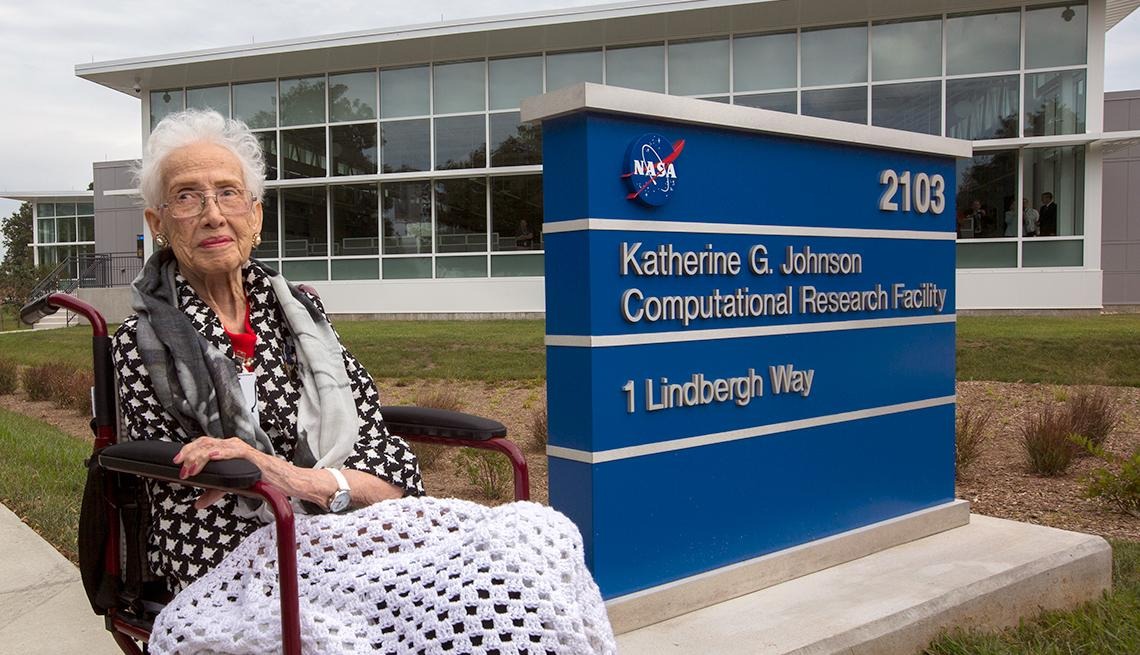
In 2016, NASA named its Computational Research Facility at Langley Research Center the Katherine G. Johnson Computational Research Facility.
The facility supports advanced computational research and engineering. Naming it after Johnson connected her legacy to the continuing scientific work of the institution where she spent much of her career.
The tribute was especially meaningful because she had worked at Langley during a period when Black women were often assigned to segregated computing units and excluded from professional opportunities available to others.
Her name now stands alongside the research and innovation taking place at a leading NASA centre.
For future generations of scientists, the building serves as a reminder that the history of technological progress includes the work of people whose contributions were not always widely recognized at the time.
12. Her personal life and family
Katherine Johnson’s life was not defined by her professional achievements alone.
She married James Francis Goble in 1939, and they had three daughters: Constance, Joylette and Katherine. Johnson initially left graduate school to raise her family and later returned to professional work when her children were older.
Her first husband died in 1956. In 1959, she married James A. Johnson, a United States Army officer, and they remained married for decades.
Balancing family responsibilities with a demanding scientific career was one of the many dimensions of her life. Her story also reminds us that people who make significant contributions to society often have personal responsibilities and experiences that are not fully visible in public accounts.
Johnson retired from NASA in 1986 after 33 years of service.
She died on February 24, 2020, at the age of 101, in Newport News, Virginia. NASA and leaders across the United States paid tribute to her life and achievements.
13. What made Katherine Johnson exceptional?
Several qualities distinguished Johnson throughout her career.
Intellectual curiosity
She wanted to understand not only what answer was required, but why the answer was correct.
Precision
Spaceflight calculations demanded accuracy because small errors could have serious consequences.
Integrity
Her role in checking flight calculations illustrates the importance of independently verifying technical results.
Persistence
She continued to develop her skills and pursue professional opportunities despite discriminatory restrictions.
Commitment to learning
Her education and professional experience demonstrate how sustained learning can create opportunities to contribute to complex scientific work.
Johnson’s accomplishments were not simply the result of being naturally gifted. They also reflected preparation, practice, professional courage, collaboration and a willingness to tackle difficult questions.
14. Katherine Johnson’s legacy in the modern world
Katherine Johnson’s influence continues through education, scientific research, popular culture and public recognition.
Her story is relevant in a world increasingly shaped by artificial intelligence, data science, software engineering, robotics, satellite technology and space exploration.
Although the tools available to today’s scientists differ dramatically from those Johnson used, many of the underlying principles remain the same: mathematical reasoning, careful verification, collaboration and an understanding of how systems behave.
Her life also provides an important historical perspective on diversity in technology. Innovation depends on finding and developing talent, and discrimination can prevent institutions from benefiting fully from the abilities of the people who work for them.
For young people considering careers in science, Johnson is an example of someone who combined intellectual ability with curiosity and perseverance. For organizations, her story is a reminder that recognizing talent should not depend on race, gender or social background.
Her impact can be seen not only in the history of spaceflight, but also in the conversations her life continues to inspire about fairness, education and opportunity.
15. Timeline of Katherine Johnson’s life and achievements
1918
Birth
Born in White Sulphur Springs, West Virginia, on August 26.
1937
University graduation
Graduates from West Virginia State College at age 18 with degrees in mathematics and French.
1939
Graduate school milestone
Selected among the first Black students to integrate graduate education at West Virginia University.
1953
Joins NACA
Begins working at Langley Research Center as a research mathematician.
1961
First American in space
Contributes trajectory calculations for Alan Shepard’s Freedom 7 flight.
1962
John Glenn’s orbital mission
Independently verifies the calculations for Friendship 7 at Glenn’s request.
1969
Apollo 11
Contributes to the mathematical work supporting the Apollo lunar programme.
1986
Retirement
Concludes a 33-year career at NASA and its predecessor, NACA.
2015
Presidential Medal of Freedom
Receives one of America’s highest civilian honours.
2016
Global public recognition
The Hidden Figures film introduces her story to a new generation, and NASA dedicates a computational research facility in her honour.
2019
Congressional Gold Medal
Receives one of the United States’ most prestigious civilian honours.
2020
Death at age 101
Dies on February 24, leaving a lasting scientific and cultural legacy.
Conclusion: The woman whose mathematics helped change history
Katherine Johnson’s life demonstrates that some of the most consequential contributions to human progress come from people whose names were not always known to the public.
She helped calculate the paths that carried astronauts into space, supported the mathematical work behind historic lunar missions, and showed that the pursuit of scientific excellence can challenge deeply entrenched prejudice.
But her legacy extends beyond rockets, spacecraft and equations.
She represents the possibilities that emerge when education is encouraged, talent is recognized and people are allowed to contribute without being limited by discrimination. Her achievements remain a source of inspiration for aspiring scientists, Black communities, women in STEM and anyone who has ever been told that their circumstances place a ceiling on their potential.
Katherine Johnson did more than calculate trajectories for spacecraft. She helped expand humanity’s understanding of what was possible—and widened the horizon of possibility for generations who followed her.
Her story deserves to be remembered not merely because she helped America reach space, but because she helped the world recognize the brilliance that can flourish when ability is given the opportunity to shine.