

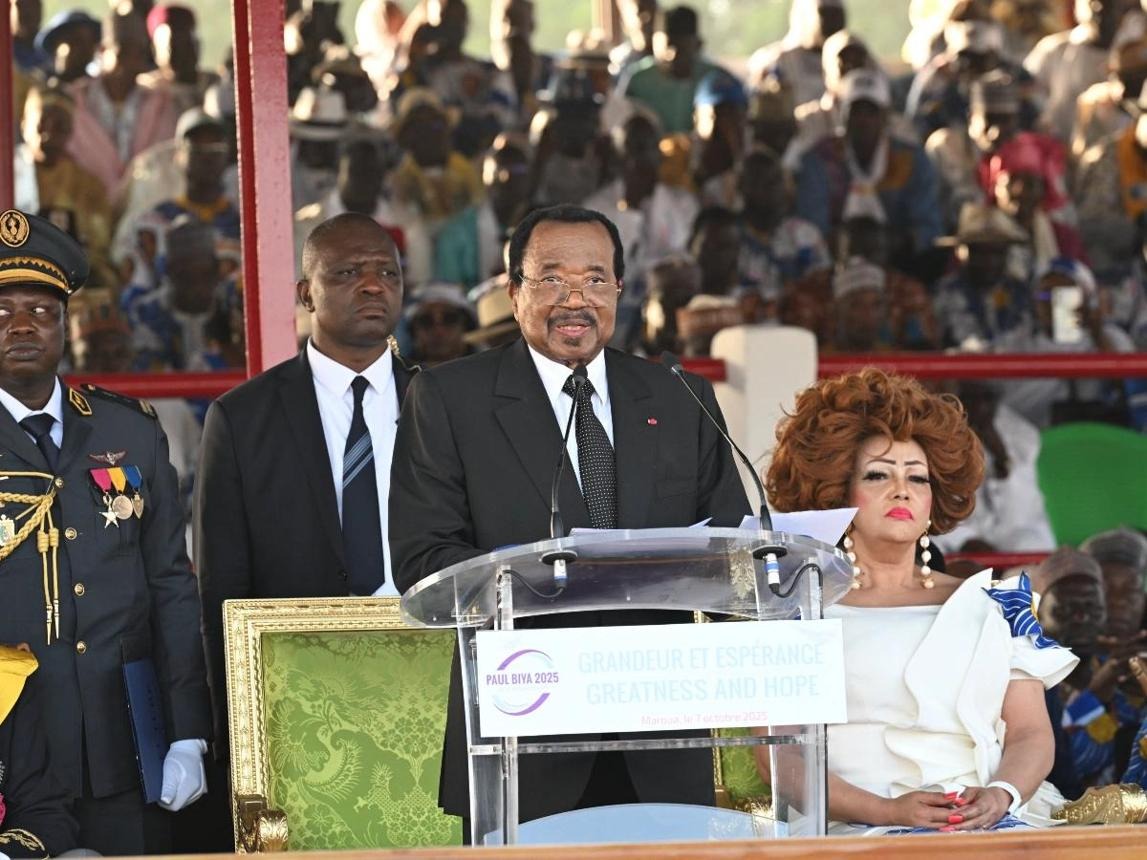
Biya became president in 1982 and, in October 2025, secured another seven-year term in a disputed presidential election. At 93 years old in 2026, he is the world’s oldest serving head of state, and his continued rule has intensified debates about whether political leadership in Cameroon has become too closely tied to one individual.
His supporters have remained loyal to his ruling party, while critics have questioned the country’s political openness, the credibility of its elections, the government’s response to conflict and the concentration of power around the presidency.
HowAfrica examines ten major controversies associated with Biya’s presidency, separating documented events from opposition allegations and wider political interpretations.
Who is Paul Biya, and how long has he ruled Cameroon?

Full name: Paul Barthélemy Biya’a bi Mvondo
Date of birth: 13 February 1933
Became president: 6 November 1982
Political party: Cameroon People’s Democratic Movement (CPDM), also known by its French acronym, RDPC
Presidential term: Seven years
Latest re-election: October 2025
Age in October 2026: 93
Biya initially rose through the government of his predecessor, Ahmadou Ahidjo, eventually becoming prime minister in 1975. When Ahidjo resigned in 1982, Biya succeeded him as president.
What was initially a presidential succession developed into a political era lasting more than 40 years. During this period, Cameroon moved from a single-party system to multiparty elections, but Biya and his ruling party continued to dominate the country’s national political institutions.
The central controversy is not simply that Biya has served for so long. It is how the rules governing presidential elections, the balance of political power, the treatment of opponents and the management of national crises have evolved during his administration.
1. The abolition of presidential term limits: How Biya opened the door to indefinite rule

One of the most consequential controversies of Biya’s presidency was the 2008 constitutional amendment that removed presidential term limits.
Before the amendment, Cameroon’s constitution limited presidents to two terms. Removing that restriction enabled Biya to continue contesting presidential elections without a constitutional term-limit barrier.
The reform was promoted and passed under a political system dominated by Biya’s ruling party. Opposition figures and civil society groups criticised it as an attempt to preserve his hold on power rather than facilitate leadership renewal.
Why this became a major controversy
Presidential term limits are intended to establish a predictable endpoint for executive leadership and encourage peaceful transfers of power. When those limits are removed, an incumbent can continue running as long as the applicable eligibility rules allow it.
Critics argue that this creates several problems:
Unequal political competition: An incumbent who controls the advantages of office can remain in power while opponents struggle to build comparable national networks.
Weak leadership renewal: New generations of politicians may have fewer opportunities to lead the country.
Institutional dependence: Political institutions can become increasingly associated with the interests of the governing party.
Uncertainty over succession: The longer a president stays in office, the more consequential questions about who will succeed him can become.
The amendment did not itself make every subsequent election invalid. Rather, it removed a constitutional restriction that would otherwise have prevented Biya from seeking additional terms.
That distinction matters when examining the broader debate about democratic competition in Cameroon.
2. The controversial 2025 presidential election and allegations of electoral fraud
Biya sought an eighth consecutive term, despite widespread calls for political change. The election was held on 12 October 2025, and the Constitutional Council announced the final results on 27 October.
The official results were:

Paul Biya
53.66%
Official result · Incumbent

Issa Tchiroma Bakary
35.19%
Official result · Main challenger
Source: Cameroon’s Constitutional Council, as reported by Human Rights Watch and International IDEA.
Why did the opposition reject the results?
Tchiroma disputed the official outcome and claimed that he had won. Opposition figures raised allegations of irregularities, including concerns about vote tabulation and turnout in areas affected by the Anglophone conflict.
The Constitutional Council rejected petitions challenging the election and declared its decision final under Cameroon’s electoral framework. The government rejected the opposition’s fraud allegations. International IDEA reported that observers from the African Union and the Economic Community of Central African States considered the election to have been conducted largely in accordance with international standards, while other observers and civic groups raised concerns.
This means that the official outcome and the credibility of the electoral process became separate but connected questions. Biya was legally declared the winner by the country’s highest electoral adjudicative body, but the decision did not end public disagreement about the fairness of the contest.

The human cost of the post-election unrest
The election controversy escalated into protests and clashes between demonstrators and security forces.
Human Rights Watch reported that international media citing United Nations sources put the death toll at 48. Opposition sources cited by the organisation reported 55 deaths. The organisation also documented mass arrests, injuries and allegations of excessive force by security personnel. Some protesters were reported to have committed acts of violence, including attacks on police and damage to property.

The differing casualty figures illustrate the difficulty of establishing a definitive toll during periods of political unrest.
For critics of Biya’s government, the election raised a fundamental question: how can citizens have confidence in an election when major opposition figures dispute the outcome and demonstrations are met with lethal force?
3. The exclusion of Maurice Kamto from the 2025 presidential race

Another major controversy emerged before the election, when prominent opposition politician Maurice Kamto was excluded from the presidential race.
Kamto had challenged Biya in the 2018 election and was widely recognised as a significant opposition figure. In 2025, he sought to run under the African Movement for New Independence and Democracy, known as MANIDEM.
Cameroon’s electoral commission rejected his candidacy in July 2025, citing a dispute involving competing nominations from the same party. Kamto’s lawyers argued that the decision lacked a valid legal basis and was politically motivated. The Constitutional Council upheld the exclusion in August.
Why did the decision generate criticism?
Human Rights Watch argued that excluding a prominent challenger damaged confidence in the electoral process before voting even began.
The dispute was significant for three reasons:
Reduced voter choice: Kamto’s supporters could not vote for their preferred candidate.
Questions about electoral rules: Critics questioned how the nomination requirements were applied and whether the process was impartial.
Public confidence: The exclusion reinforced existing concerns about the fairness of competition between the ruling party and opposition groups.
The commission’s stated reason was a candidate-nomination dispute, not a formal finding that Kamto was guilty of electoral wrongdoing. The key controversy concerns the decision’s fairness, its legal basis and its effect on the range of choices available to voters.
This case also highlights a broader issue: an election’s credibility depends not only on counting votes accurately but also on whether candidates can compete under fair and consistently applied rules.
4. Allegations of political repression and restrictions on opposition parties

Biya’s government has repeatedly faced criticism over its treatment of political opponents, demonstrators, activists and civil society organisations.
These concerns did not begin with the 2025 election. Following the disputed 2018 presidential election, opposition protests were met with a government crackdown. Human Rights Watch documented arrests of opposition figures and supporters, including Kamto and more than 200 supporters who were detained in January 2019. Kamto was released in October 2019, and the charges against him were dropped.
Ahead of the 2025 election, further disputes emerged over public demonstrations and political meetings. Human Rights Watch reported the exclusion of Kamto, the disruption of opposition activities and arrests of supporters protesting the decision.
What are the principal allegations?
Critics have raised concerns about:
Restrictions on peaceful demonstrations and political gatherings.
Arrests and prosecution of people involved in opposition activities.
The use of tear gas, water cannons and, in some cases, live ammunition to disperse protests.
Limits on the ability of activists and opposition parties to organise freely.
The government’s approach has often been defended in terms of public order and security. However, restrictions on political activity raise serious questions when they affect peaceful opposition as well as violent conduct.
Under international human rights standards, governments may take lawful measures to protect public safety, but they must also respect freedom of expression, association and peaceful assembly.
The controversy is therefore not simply about whether the government has the authority to maintain order. It is about whether that authority has been exercised proportionately and without unfairly suppressing political dissent.
5. The Anglophone crisis: A conflict that has challenged Biya’s government

The Anglophone crisis is among the most serious security and governance challenges of Biya’s presidency.
Cameroon has two major English-speaking regions, the Northwest and Southwest, whose populations have long expressed concerns about political representation, language, education, the legal system and their place within a predominantly French-speaking state.
The current crisis intensified in 2016, when protests by lawyers and teachers over the treatment of English-language legal and educational institutions developed into a broader political movement. The government’s response and the subsequent emergence of armed separatist groups helped transform the dispute into a prolonged armed conflict.

How did the crisis develop?
Initially, many demonstrators were demanding greater protection for Cameroon’s Anglophone legal and educational systems. Some activists later called for a federal system, while separatist groups demanded independence for a proposed state commonly referred to as Ambazonia.
The government resisted secession, and the conflict escalated as armed separatists attacked state institutions and security personnel. Government security forces have also been accused by human rights organisations of abuses against civilians.

What are the main controversies surrounding Biya’s response?
Allegations of excessive force: Human rights organisations have documented allegations of killings, arbitrary detention, torture and other abuses by government security personnel.
Separatist violence: Armed separatist groups have also been accused of killing civilians, kidnapping people, attacking schools and imposing shutdowns that disrupt daily life.
Displacement and humanitarian suffering: The conflict has forced many people from their homes, disrupted education and healthcare, and damaged economic activity.
The failure to achieve a lasting settlement: Critics question whether the government’s security-first approach has adequately addressed the political grievances that contributed to the crisis.
The conflict is not solely the result of decisions made by Biya, nor are all abuses attributable to government forces. Armed separatist groups bear responsibility for their own actions. Nevertheless, because Biya has led the country throughout the crisis, his administration’s handling of it remains central to the debate over his legacy.
The conflict also undermines the argument that prolonged presidential continuity automatically guarantees national stability.
6. Corruption allegations, public resources and economic inequality

Corruption and the management of public resources have been recurring concerns in discussions about Biya’s administration.
Cameroon has valuable natural resources, including oil, gas and minerals. Yet the existence of these resources has not eliminated widespread economic insecurity, inadequate public services or limited employment opportunities for many citizens.
In April 2026, Pope Leo XIV urged Biya and Cameroon’s officials to combat corruption, improve transparency and distribute national wealth more fairly during a visit to the country. His remarks reflected longstanding concerns about governance and inequality.
What are the main criticisms?
Transparency: Critics demand greater disclosure about public spending, natural-resource revenues and government contracts.
Accountability: Questions persist about whether powerful political figures and their associates are subject to effective scrutiny.
Economic inequality: Many citizens see a gap between the country’s resource wealth and their everyday experiences of unemployment, poor infrastructure and limited public services.
Patronage: Analysts have argued that political networks and the distribution of benefits to influential groups have helped sustain the ruling party’s dominance.
These concerns should not be confused with proof that Biya personally committed a specific criminal offence. Allegations about systemic corruption, documented cases involving individual officials and accusations against the president himself are different categories of claims.
The broader controversy concerns whether institutions under his administration have provided sufficient transparency, independent oversight and meaningful consequences for corruption.
7. The absentee presidency: Questions about governing from abroad

Another longstanding controversy concerns Biya’s extended periods outside Cameroon, particularly private stays in Switzerland.
Critics have described him as an absentee president, arguing that his periods abroad raise questions about the visibility and responsiveness of national leadership. Reports on his travel have also fuelled public debate about the costs of presidential trips and the responsibilities of the head of state.
The issue became especially prominent in 2026.
According to a September 2026 analysis by the Carnegie Endowment for International Peace, Biya spent 73 days in Geneva before returning to Cameroon on 20 August 2026. His absence intensified questions about who was directing government business and how a transfer of power would occur if he could no longer serve.
Why does presidential absence matter?
A president does not necessarily have to be physically present in the country at every moment to govern. Modern governments operate through ministers, civil servants, diplomatic channels and established administrative structures.
The controversy arises when prolonged absence coincides with uncertainty about decision-making, limited public communication or an unclear succession arrangement.
Critics have questioned whether the public can adequately assess government performance when the president’s activities and whereabouts are not consistently communicated.
Supporters may argue that the president can delegate responsibilities to his cabinet and that travel alone does not establish an inability to govern.
The key question is institutional: Are there clear, transparent and accountable arrangements for executive decision-making when the president is absent?
That question became more pressing as Biya approached the later years of his eighth presidential term.
8. The succession controversy: Who will lead Cameroon after Biya?

After more than four decades under one president, the question of succession has become a major national concern.
Biya’s political longevity has raised questions about whether the governing party and the country’s institutions can manage a transition without instability or a struggle among competing political factions.
The controversy intensified in 2026 following constitutional changes that reintroduced the office of vice president. Under the new arrangement, the president appoints the vice president, who would succeed the president for the remainder of the term if the presidency became vacant under the circumstances specified by law.
Why is the vice presidency controversial?
Critics have questioned whether an appointed successor provides sufficient democratic legitimacy, particularly if the public does not directly vote for that person as president.
The arrangement also raises questions about the balance of power between the presidency, parliament, the Senate and the institutions responsible for constitutional succession.
As of the Carnegie Endowment’s September 2026 analysis, Biya had not appointed a vice president. That left uncertainty about how the new arrangement would operate in practice.
Is Biya preparing his son to succeed him?
Speculation has circulated about Franck Biya, the president’s son, and the possibility of a family succession.
However, such speculation must be distinguished from verified events. Africa Check reported in May 2026 that social media claims alleging Franck Biya had already been appointed vice president were false. It found no evidence of a genuine appointment, and reported that Franck Biya held no public office at the time of its investigation.
The continuing debate is about the risk of political succession being determined by family connections or elite negotiations rather than an open, competitive process.
There is no verified basis for treating a future family succession as an established fact. The central concern is whether Cameroon has transparent and credible arrangements for leadership transition.
9. Human rights, press freedom and the restriction of civic space

Cameroon’s human rights record under Biya has drawn sustained criticism from international organisations.
The concerns extend beyond election periods to the treatment of journalists, activists, opposition figures and people accused of challenging the government.
Freedom House’s 2026 country assessment classified Cameroon as “Not Free,” awarding it 15 out of 100 points for overall freedom. Its assessment cited restrictions on opposition parties, press freedom, civil society activity and due-process protections. This is the organisation’s evaluation, rather than a legal finding by a court.
The principal areas of concern
Press freedom: Journalists and media organisations have faced restrictions and pressure, particularly when reporting on politically sensitive matters or security operations.
Freedom of assembly: Authorities have restricted or dispersed certain demonstrations, including protests involving opposition supporters.
Detention and due process: Human Rights Watch has reported cases in which detainees faced limited access to lawyers, allegations of mistreatment or uncertainty about the legal basis for detention.
Civil society: Organisations working on governance, elections and human rights have raised concerns about their ability to operate without intimidation or administrative obstruction.
What is the government’s position?
Governments have legitimate responsibilities to prevent violence, protect public safety and maintain national security. Cameroon has also faced real security threats from separatist armed groups and Boko Haram.
However, security concerns do not automatically justify restrictions on peaceful criticism or unlawful detention. The important distinction is between legitimate law enforcement and the disproportionate suppression of civil liberties.
The controversy surrounding Biya is therefore linked to a broader question of accountability: what independent mechanisms exist to investigate alleged abuses and ensure that public officials comply with the law?
10. Economic stagnation, unemployment and frustration among young Cameroonians

One of the most persistent criticisms of Biya’s presidency concerns the gap between the expectations of Cameroon’s population and the economic opportunities available to many citizens.
Cameroon has a large young population, significant natural resources and an important position in Central Africa. Nevertheless, many young people face insecure employment, informal working conditions, limited economic opportunities and frustration with the pace of political change.
An Associated Press report published ahead of the 2025 presidential election described widespread youth dissatisfaction over unemployment, perceived corruption and limited opportunities. It also noted that many young Cameroonians worked in the informal economy, where employment does not necessarily provide stable earnings or social protection.

Why has this become a political controversy?
After more than 40 years in power, Biya’s administration is inevitably associated with the country’s long-term economic performance.
Critics argue that the government has not sufficiently translated Cameroon’s resources into broad-based prosperity, reliable public services and opportunities for younger generations.
The issues most frequently raised include:
Youth unemployment and underemployment: Many young people struggle to secure stable, adequately paid jobs.
Informal employment: Workers may earn a living without reliable contracts, pensions or other protections.
Infrastructure and public services: Uneven access to reliable electricity, healthcare, education and transport remains a concern.
The cost of living: Household financial pressures contribute to dissatisfaction with the government’s performance.
Limited political renewal: Some young citizens question whether the existing political system provides meaningful opportunities for new leadership.

However, economic performance cannot be attributed to one person or one administration alone. Global commodity prices, demographic growth, regional insecurity, investment conditions and other structural factors also affect development.
The central question is whether the government’s policies and institutions have delivered results commensurate with the country’s resources and the needs of its population.
For a generation that has known no other president, the demand for economic opportunity is increasingly connected to the debate about political succession.
11. The concentration of power and the future of democratic institutions

Beyond individual controversies, a broader concern runs through Biya’s presidency: the concentration of political authority in a system dominated by the president and his ruling party.
The Cameroon People’s Democratic Movement has maintained national political dominance throughout much of Biya’s presidency. Critics argue that the ruling party’s influence over government institutions, combined with restrictions on opposition activity, makes it difficult to create an effective system of checks and balances.
What does the concentration of power mean in practice?
A weakened opposition environment. Opposition parties can contest elections, but critics say restrictions, unequal access to political resources and disputes over candidate eligibility can limit their effectiveness.
Questions about institutional independence. The appointment processes and decisions of bodies responsible for elections and constitutional disputes have attracted scrutiny.
Limited accountability. When the governing party dominates political institutions, critics question whether those institutions can independently investigate failures or constrain executive authority.
Uncertainty about the future. A system built around a long-serving president can struggle to demonstrate that it has a clear, trusted process for transferring power.
These issues are not unique to Cameroon, but Biya’s unusually long tenure makes them especially significant.
A durable political system requires more than regular elections. It also depends on public confidence in the rules, the independence of oversight institutions and the ability of citizens to organise and challenge those in office without fear.
Why does Paul Biya continue to contest elections?
Biya’s motivations cannot be established conclusively without reliable evidence of his personal reasoning. However, political analysts have identified several structural factors that help explain his continued hold on power.
1. The removal of term limits
The 2008 constitutional amendment eliminated the restriction that would otherwise have prevented him from seeking further presidential terms.
2. The strength of the ruling-party network
The ruling party’s longstanding influence over national political institutions and its established networks of support have helped sustain Biya’s political position.
3. Institutional continuity and elite interests
Analysts have argued that established political alliances, patronage networks and concerns about instability help explain the persistence of the existing political order.
4. The absence of a settled succession process
The lack of a clearly established successor has intensified uncertainty over how the governing system would function after Biya leaves office.
These factors help explain the political environment in which Biya continues to govern. They do not establish that every election was fraudulent or that every supporter of the president backs him for the same reason.
How do Biya’s supporters defend his long presidency?
A balanced examination must also consider the arguments made by Biya’s supporters and the official position of his administration.
Supporters have presented continuity as a source of stability in a region affected by armed conflict, political transitions and security threats. Cameroon has faced Boko Haram attacks in the north, a prolonged separatist conflict in its English-speaking regions and wider regional instability.
Some supporters also point to the government’s ability to maintain national institutions and continue holding elections despite these challenges. In the 2025 election, the African Union and the Economic Community of Central African States assessed the poll more positively than several domestic critics and opposition groups did.
These arguments form part of the public debate. They do not resolve the separate questions surrounding political competition, human rights, economic performance or the independence of oversight institutions.
Similarly, acknowledging the government’s security challenges does not mean that allegations of excessive force or restrictions on peaceful political activity should be ignored.
The relevant issues can be assessed independently: the government’s record on security, the credibility of elections, economic outcomes, civil liberties and the effectiveness of constitutional safeguards.
What does Biya’s eighth term mean for Cameroon?
Biya’s re-election in October 2025 extended his presidency into a fifth decade. His current seven-year term is due to run to 2032, subject to the country’s constitutional and political circumstances.
Several major questions will shape the country’s future.
Electoral credibility: Will future elections command broader confidence among opposition parties, voters and independent observers?
National reconciliation: Can the government and other stakeholders make progress towards resolving the Anglophone conflict?
Economic opportunity: Can the country expand stable employment and improve public services for younger generations?
Institutional accountability: Will oversight bodies be able to exercise their responsibilities independently?
Succession and continuity: Will Cameroon establish a transparent and widely accepted process for leadership transition?
These questions extend beyond Biya’s individual presidency. They concern the strength of Cameroon’s institutions and their capacity to function effectively regardless of who occupies the presidential office.
Conclusion
Paul Biya’s presidency is one of the longest in modern African political history. His continued rule has coincided with constitutional changes that removed presidential term limits, repeated disputes over elections, allegations of political repression, the Anglophone conflict, concerns about corruption and economic opportunity, and growing uncertainty about succession.
The October 2025 election brought many of these issues together. Although the Constitutional Council declared Biya the winner, opposition allegations, protests, arrests and reported deaths demonstrated that the official result did not settle the wider dispute over electoral confidence.
At the same time, an accurate account must distinguish documented events from allegations, recognise the government’s stated security concerns and avoid treating every criticism as a proven offence.
Ultimately, the controversy surrounding Biya is about more than his age or the number of elections he has contested. It concerns the relationship between presidential power and democratic accountability, the ability of citizens to choose their leaders freely, and whether national institutions can provide a credible path to political renewal.
For Cameroon, the challenge is to ensure that political continuity, where desired by citizens, does not come at the expense of transparent governance, fundamental rights and a peaceful, clearly defined transfer of power.