

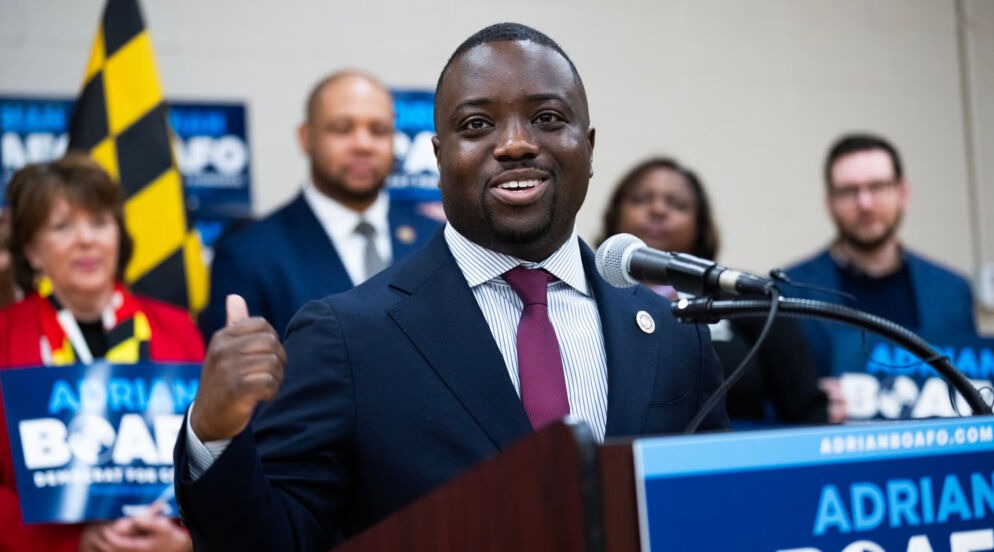
A new generation of African-descended political leadership is emerging in the United States as 32-year-old Ghanaian-American Democrat Adrian Boafo secures a landmark victory in Maryland’s 5th Congressional District, succeeding veteran lawmaker Steny Hoyer.
The political landscape of the United States has witnessed another significant moment for the African diaspora following the election of Ghanaian-American politician Adrian Boafo to the U.S. House of Representatives. The 32-year-old Democrat emerged victorious in the November 3, 2026, midterm elections, winning Maryland’s 5th Congressional District in an impressive electoral performance that marks a major milestone in his political career and a moment of pride for people of Ghanaian heritage across the world.
Boafo defeated Republican candidate Chris Chaffee to secure the congressional seat previously held by longtime Democratic lawmaker Steny Hoyer, who is retiring after representing the district for more than four decades. His victory represents a generational transition in Maryland politics, bringing a relatively young politician with experience in local government, state legislation and national political campaigns to the U.S. Congress.
According to the Maryland State Board of Elections’ unofficial results published on November 4, Boafo received 187,219 votes, representing 68.48 per cent, while Chaffee secured 84,348 votes, or 30.85 per cent. The Associated Press called the race on election night, November 3.
The result is particularly significant because Boafo is among a growing number of Americans of African descent making their mark in the country’s political institutions. His achievement also adds another Ghanaian-American voice to the U.S. Congress, where representation from the Ghanaian diaspora continues to grow.
From Bowie to Capitol Hill: The Making of a Young Political Leader
Adrian Boafo’s journey to the United States Congress is a story of ambition, community involvement, public service and the opportunities available to children of immigrants who pursue leadership in their adopted country.
Born in Arlington, Virginia, on May 10, 1994, Boafo was raised in Prince George’s County, Maryland, by parents who emigrated from Ghana to the United States in search of education, better opportunities and a brighter future. His parents eventually settled in Prince George’s County, where they built their lives and raised their family.
Growing up in an immigrant household gave Boafo an appreciation of the sacrifices families make when they leave their countries of origin to establish themselves in a new environment. His background also placed him within two cultural experiences: the Ghanaian heritage passed down by his parents and the American society in which he was educated and developed his political ambitions.
His educational journey played an important role in shaping his interest in public service. He attended DeMatha Catholic High School in Hyattsville, Maryland, before proceeding to the University of Baltimore, where he graduated in 2016 with a bachelor’s degree in Government and Public Policy.
During his university years, Boafo became increasingly interested in political representation and the importance of ensuring that communities have a voice in decisions affecting their lives. He served as the first Black president of the university’s Student Government Association, demonstrating an early commitment to leadership and student advocacy.
He later obtained a Master of Business Administration from the Kogod School of Business at American University in 2019. His academic background, combining government, public policy and business administration, provided a foundation for his subsequent work in politics and government affairs.
According to his official biography, Boafo’s interest in public service was strengthened by student advocacy activities in Annapolis, Maryland’s state capital. These activities exposed him to the legislative process and encouraged him to pursue a career focused on influencing policies that address the everyday challenges confronting ordinary people.
Building political experience before seeking higher office
Before becoming an elected official, Boafo gained valuable experience working within the American political system.
He began his career on Capitol Hill as a national press assistant to U.S. Representative Ruben Kihuen of Nevada’s 4th Congressional District between 2017 and 2018. This position exposed him to the workings of the U.S. Congress, political communication, legislative activities and the relationship between elected representatives and their constituents.
He subsequently joined the campaign team of Steny Hoyer, one of the most influential Democratic politicians in the House of Representatives. Between 2018 and 2019, he worked as a field director before becoming campaign manager for Hoyer’s congressional campaign from 2019 to 2021.
This experience would become particularly important in retrospect. Having worked behind the scenes to support Hoyer’s political career, Boafo eventually emerged as the candidate who would succeed him in Maryland’s 5th Congressional District.
His political development continued at the local level. In 2019, he was elected to the Bowie City Council, representing District 3. He served until 2022 and also held the position of Mayor Pro Tem, a leadership role that provided him with direct experience in local government administration.
Local government offered Boafo an opportunity to understand the practical concerns of residents, including infrastructure, community development, public services and the importance of responsible leadership. It also helped him develop relationships with constituents and establish a political identity beyond his previous work as a campaign strategist.
In November 2022, he won election to the Maryland House of Delegates, representing District 23 in Prince George’s County. He officially began serving on January 11, 2023.
During his time in the state legislature, Boafo served on the Economic Matters Committee and became Assistant Majority Leader in 2024. In 2026, he also chaired the Workers’ Compensation Subcommittee.
His legislative experience gave him an opportunity to participate in discussions and decisions involving business regulation, workers’ rights, economic development and other issues affecting Maryland residents.
By the time he decided to pursue a seat in Congress, Boafo had accumulated experience in student leadership, political campaigns, municipal government and state legislation. His election therefore represents the next stage of a political journey that developed over several years rather than an overnight breakthrough.
A Historic Victory After a Competitive Democratic Primary
Boafo’s path to the November general election was not without challenges. Maryland’s 5th Congressional District became an important political battleground following Steny Hoyer’s announcement in January 2026 that he would not seek another term.
Hoyer’s retirement created an opportunity for a new generation of political leaders to compete for a seat that had remained under his representation since June 3, 1981. Over 45 years, Hoyer had risen through the Democratic Party’s leadership structure, serving as House Majority Leader and Democratic Whip.
His departure consequently opened a significant chapter in the political history of the district.
For Boafo, the contest carried a special meaning because of his previous relationship with the outgoing congressman. Having worked as Hoyer’s campaign manager, he understood the political structure of the district and the responsibilities associated with representing its residents.
However, he still had to convince voters that he was the right person to lead the district into a new political era.
He faced a crowded Democratic primary field featuring 24 candidates in June 2026. Emerging as the party’s nominee was a significant achievement, as it demonstrated his ability to secure support in a competitive contest involving several aspirants seeking to replace a political heavyweight.
His nomination positioned him to face Republican Chris Chaffee in the November 3 general election.
The outcome was decisive. The Maryland State Board of Elections initially reported 187,219 votes for Boafo, representing 68.48 per cent of the total, against Chaffee’s 84,348 votes, or 30.85 per cent. These figures were published as unofficial results, with all 227 election-day precincts reported at that stage. Subsequent updates increased Boafo’s total, but his commanding lead remained clear.
The Associated Press called the race on election night, confirming Boafo’s victory and bringing an end to the contest for one of Maryland’s most closely watched open congressional seats.
What Boafo Promised: A Campaign Focused on Everyday Americans
Beyond the historical importance of his Ghanaian heritage and his relatively young age, Boafo’s campaign was built around practical issues affecting families, workers and communities across Maryland’s 5th District.
The district stretches across communities in southern Maryland and the Washington, D.C., metropolitan area. Its residents include federal employees, professionals, business owners, working-class families, students and retirees.
For many of these residents, economic pressures, employment security, access to education and the cost of raising children are important political concerns.
Boafo sought to address these issues through a campaign message centred on affordability, economic fairness, workers’ rights and accountable government.
1. Reducing the cost of living
One of his central campaign priorities was making everyday life more affordable for American families.
Rising housing expenses, food prices, transportation costs, healthcare bills and other household expenditures have placed increasing pressure on working people. Boafo argued that wages must keep pace with the cost of living and that families should not have to struggle to meet basic needs despite being employed.
He supported increasing the federal minimum wage from $7.25 to $15 per hour and tying future increases to inflation. The proposal is intended to prevent the purchasing power of low-income workers from declining as prices rise.
He also advocated tax relief for working and middle-class families and measures to ensure that large corporations and wealthy individuals contribute fairly to public revenue.
2. Expanding access to childcare and education
Boafo also placed considerable emphasis on education and affordable childcare.
For many working parents, childcare costs represent a substantial portion of household income. Affordable and accessible childcare can enable parents to remain employed, pursue further education and provide more stable financial support for their families.
His campaign’s emphasis on these issues reflects a broader argument that access to quality education and early-childhood support should not depend entirely on a family’s financial circumstances.
Education is also an important pathway to economic mobility, particularly for children from immigrant and working-class backgrounds.
3. Protecting federal workers
Federal employment is particularly relevant to communities around Washington, D.C., where government agencies and federal institutions provide jobs for thousands of residents.
Boafo made protecting federal workers a significant part of his campaign message. His position gained additional importance amid concerns about federal job cuts, employment uncertainty and changes to government operations under the Trump administration.
For families whose livelihoods depend on federal employment, these issues extend beyond political disagreements. They involve mortgages, education expenses, healthcare coverage, retirement plans and the ability to provide for dependants.
His election therefore offers residents an opportunity to have a representative who has made federal employment security a prominent part of his political agenda.
4. Promoting transparency and accountability in government
Another notable campaign proposal was a ban on congressional stock trading.
The issue has attracted attention across the American political spectrum because of concerns about conflicts of interest when lawmakers buy and sell individual stocks while having access to information that could influence financial markets.
Boafo’s support for restrictions reflects his argument that elected officials should avoid activities that could undermine public confidence in government.
The proposal also fits into a broader conversation about political ethics, transparency and the need for public officials to place their responsibilities to constituents above personal financial interests.
5. Defending environmental protections
Environmental protection was another component of his campaign agenda.
Maryland’s natural environment, including the Chesapeake Bay and surrounding waterways, plays an important role in the state’s economy, tourism, recreation and quality of life.
Environmental policies affect communities through issues such as water quality, pollution, flooding, climate resilience and the protection of natural resources.
Boafo’s support for stronger environmental protections indicates that he intends to make environmental responsibility part of his broader legislative priorities.
Taken together, these campaign positions present an agenda focused on economic opportunity, workers’ welfare, public accountability and environmental responsibility.
A Full-Circle Moment: From Campaign Manager to Congressman
One of the most remarkable aspects of Boafo’s victory is the connection between his political beginnings and his new position in Washington.
For years, he worked alongside Steny Hoyer, helping to manage the campaign operations of a politician who had represented Maryland’s 5th District for 45 years. Now, following Hoyer’s retirement, Boafo is preparing to occupy the very congressional seat he once helped his former employer retain.
This transition represents more than a change in political office. It illustrates how experience, mentorship, grassroots engagement and political ambition can combine to create opportunities for emerging leaders.
Hoyer’s departure also marks the end of an important era in Maryland politics. During his congressional career, he became one of the most influential Democrats in Washington, serving twice as House Majority Leader and playing significant roles in major legislative achievements, including the Affordable Care Act and the Americans with Disabilities Act.
Boafo will therefore inherit a seat with a considerable political history and expectations from constituents who have been represented by an experienced national political figure for decades.
His challenge will be to build on the district’s existing political relationships while establishing his own identity, priorities and legislative achievements.
Ghanaian Heritage and the Growing Influence of the African Diaspora
Boafo’s election carries significance beyond the boundaries of Maryland. For Ghanaians at home and abroad, his achievement represents another example of the growing visibility of people with African roots in influential political institutions around the world.
The African diaspora has contributed significantly to the development of the United States in areas including business, education, healthcare, entertainment, science, technology and public administration. Political representation is another important dimension of that contribution.
For many African immigrants, relocating to the United States involves starting life in an unfamiliar environment, navigating different social structures and working to establish economic security for their families.
Their children often grow up balancing the cultural values inherited from their parents with the opportunities and responsibilities of citizenship in their country of birth.
Boafo’s story reflects this experience. Born in the United States to Ghanaian immigrant parents, he has built a political career within the American democratic system while maintaining a connection to his family’s Ghanaian background.
His success also sends an encouraging message to young people of African descent who aspire to enter public service. It demonstrates that leadership opportunities can emerge from community involvement, education, political participation and a willingness to take on responsibility.
His victory is particularly meaningful because representation in Congress provides an opportunity for people from different cultural and immigrant backgrounds to contribute to national conversations about public policy.
It is important, however, to recognise that Boafo’s responsibilities will extend to all residents of his congressional district, regardless of their ethnicity, nationality or political affiliation. His Ghanaian heritage is an important part of his personal story, but his constitutional responsibility will be to represent the entire district.
Joining Ghanaian-American Congressman Gabe Amo
Boafo’s election also adds to the growing presence of Ghanaian-descended politicians in the United States Congress.
One notable figure is Gabe Amo of Rhode Island.
Amo, whose parents are immigrants from Ghana and Liberia, was re-elected to represent Rhode Island’s 1st Congressional District in the November 3, 2026, elections. The Democratic congressman defeated his challengers to secure another term in the House of Representatives.
The political journeys of Boafo and Amo highlight the increasing participation of African-descended Americans in the country’s democratic institutions.
Although their backgrounds and political experiences differ, both represent a generation of leaders whose family histories connect the United States with the African continent.
Their presence in Congress also creates opportunities for broader conversations about African-American relations, immigration, international development, economic cooperation and the experiences of immigrant communities.
For Ghana, the achievements of citizens and people of Ghanaian descent in international political institutions can also strengthen the country’s visibility and contribute to cultural and diplomatic connections with other nations.
However, the significance of their representation should not be measured only by their ancestry. Their legislative contributions, policy decisions and ability to deliver meaningful results for their constituents will ultimately determine their political legacies.
What Lies Ahead for Adrian Boafo?
Following his election victory, attention will turn to Boafo’s transition from Maryland’s state legislature to the national legislature in Washington, D.C.
The U.S. House of Representatives is one of the most influential legislative institutions in the world. Its members participate in drafting and passing federal laws, approving government spending, conducting investigations and overseeing the activities of the executive branch.
As a new congressman, Boafo will have to navigate a complex political environment involving competing party interests, legislative negotiations and the expectations of constituents.
His immediate priorities are likely to include the economic issues that featured prominently in his campaign.
The proposed increase in the federal minimum wage, for example, will require legislative support beyond his own congressional district. Similarly, efforts to protect federal workers, expand childcare support and strengthen environmental regulations will involve negotiations with lawmakers from different states and political backgrounds.
His proposal to restrict congressional stock trading will also test his ability to build support for reforms that concern public trust and political accountability.
Another important responsibility will be maintaining regular engagement with residents across Maryland’s 5th District. Winning an election is only the beginning of public service. Constituents will expect accessible representation, effective communication and tangible progress on the issues that influenced their votes.
His previous experience in local government and the Maryland House of Delegates could prove valuable in this regard, as he has already worked within institutions where policy decisions directly affect people’s everyday lives.
At 32, Boafo will also bring a younger perspective to a Congress where questions about generational representation, political leadership and the future of American public policy remain important.
Whether he can translate his campaign promises into legislative achievements will be one of the major measures of his success.
A New Chapter for African-Descended Leadership in America
Adrian Boafo’s election to the United States House of Representatives is an important milestone in his personal journey, a significant development for Maryland’s 5th Congressional District and an encouraging moment for the Ghanaian diaspora.
From his upbringing in a Ghanaian immigrant household to his early leadership experiences at university, service on the Bowie City Council, election to the Maryland House of Delegates and eventual victory in a congressional race, his political journey demonstrates the importance of sustained commitment to public service.
His victory also brings an interesting political story full circle: the young campaign manager who once worked to advance Steny Hoyer’s political career is now preparing to take over the veteran congressman’s seat.
For Ghanaians, particularly young people who look towards the diaspora for inspiration, Boafo’s achievement offers a powerful reminder that people of African heritage can occupy influential positions in countries around the world.
Nevertheless, the real test of his leadership begins after the celebrations. The people of Maryland’s 5th District will look to him for solutions to economic challenges, employment concerns, education needs and other issues affecting their communities.
His election has created an opportunity. His performance in Congress will determine the legacy he eventually leaves behind.
One thing is certain: Adrian Boafo’s journey from the son of Ghanaian immigrants to an elected member of the United States Congress is a story of ambition, representation and the evolving face of American political leadership.